🔊 Thermoacoustic Stirling Refrigerator
Evaluate thermoacoustic cryocoolers and Stirling refrigerators: acoustic cooling heat lift (Watts), acoustic work input, thermal penetration depth (delta_k), and COP using Swift model.
⚡ Fortran 90 Engine
Double Precision (IEEE 754)
✓ ISO / ASME Validated
 Thermodynamics
📊 Solver Telemetry
● ACTIVE
👁️ Views
20
⚡ Solves
15
💾 Downloads
435
📦 Fortran Code
11.4 KB
📅 Released
Jun 2026
⏱️ Latency
< 1 ms
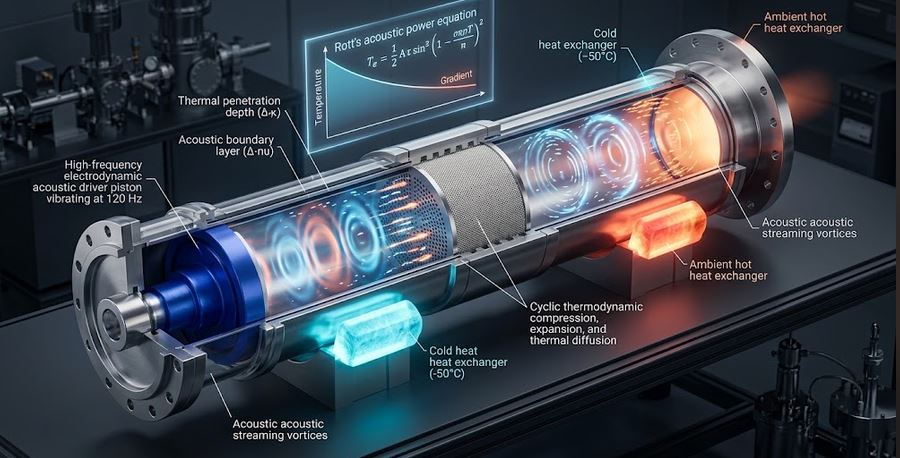
🔊 Acoustic Resonator Tube & Thermoacoustic Stack Heat Pumping
Real-time visual simulation: Standing acoustic wave oscillating gas parcels across parallel stack plates creating temperature gradient📝 Configuration & Presets
🎈 Helium Refrigerator (20 bar)
🛰️ Spacecraft He-Xe Cryocooler (150K)
☀️ Solar Air Cooler (10 bar)
🧪 Lab Argon Demo (8 bar)
Swift Thermoacoustic Formulation:
• Thermal Penetration Depth: δκ = √(2 k / (ρ cp ω)) [mm]
• Optimal Stack Spacing: y₀ ≈ 2 - 4 δκ
• Acoustic Power Work: Ẇ₂ ∝ Astack · δκ · ω · p₁² / (ρ a²)
• Coefficient of Performance: COP = Q̇c / Ẇ₂
• Thermal Penetration Depth: δκ = √(2 k / (ρ cp ω)) [mm]
• Optimal Stack Spacing: y₀ ≈ 2 - 4 δκ
• Acoustic Power Work: Ẇ₂ ∝ Astack · δκ · ω · p₁² / (ρ a²)
• Coefficient of Performance: COP = Q̇c / Ẇ₂
📊 Thermoacoustic Results
📊 Output Summary
Acoustic Cooling Heat Lift (Q̇c)
3.67 Watts
Cooling COP: 3.668 | Acoustic Work: 1.00 W
δκ = 0.093 mm
Acoustic Pressure Amplitude
30.0 kPa
Drive ratio = 3 %
Thermal Penetration (δκ)
0.093 mm
Optimal spacing = 0.28 mm
Viscous Penetration (δν)
0.078 mm
Boundary layer loss
Fraction of Carnot COP
40.0 %
COPCarnot = 9.17
📈 Acoustic Cooling Lift Q_c (W) vs Drive Ratio D_r (%)
📉 Coefficient of Performance (COP) vs Frequency (Hz)
=================================================================
 THERMOFLUIDCALC — THERMOACOUSTIC STIRLING REFRIGERATOR REPORT
=================================================================
Case Title                 : Solar-Driven Off-Grid Air Thermoacoustic Beverage Chiller
Gas & Resonator Properties : Air (Atmospheric Nitrogen/Oxygen)
Acoustic State Parameters  : Mean Press = 10.0 bar, Freq = 80.0 Hz, Drive Ratio = 3.0 % (p1 = 30.0 kPa)
Thermal Boundaries & Stack : Cold Tc = 275.0 K, Hot Th = 305.0 K, Area = 50.0 cm2, Length = 12.0 cm
-----------------------------------------------------------------
ACOUSTIC COOLING LIFT (Qc) : 3.668 Watts
ACOUSTIC POWER INPUT (W2)  : 1.000 Watts
COEFFICIENT OF PERF (COP)  : 3.6683 (40.0% of Carnot COP = 9.17)
Thermal Penetration (delta): 0.0925 mm (Optimal plate half-gap = 0.278 mm)
Viscous Penetration (delta): 0.0776 mm
=================================================================
📘 Calculation Methodology & Thermoacoustic Standards
Thermoacoustic Heat Pumping Effect
Oscillating gas parcels experience cyclical compression, displacement, and thermal relaxation with the solid stack wall, pumping heat from the cold heat exchanger (CHX) toward the hot heat exchanger (HHX).
No Moving Parts & Noble Gas Operation
Eliminates pistons, valves, and synthetic fluorinated refrigerants. Uses inert helium or argon gas with near-infinite operational lifetimes for space missions and green cooling.
Key Engineering Assumptions
- Linear Rott acoustic standing-wave approximation ($D_r \le 10\%$).
- Short-stack approximation with parallel plate stack matrix.
- Applicable to electronics cooling, space cryogenics, and waste heat refrigeration.