🌬️ Indirect Evaporative Cooler Sizer (M-Cycle)
Size Maisotsenko Cycle (M-Cycle) dew-point indirect evaporative coolers: sub-wet-bulb cooling, dew-point effectiveness, COP > 25, and zero-humidity added sensible cooling.
⚡ Fortran 90 Engine
Double Precision (IEEE 754)
✓ ISO / ASME Validated
 Heat Exchangers
📊 Solver Telemetry
● ACTIVE
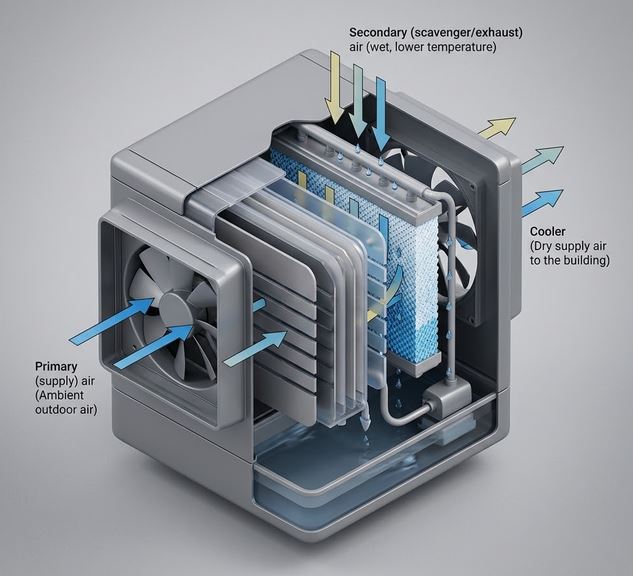
🌬️ Maisotsenko Cycle Multi-Channel Dew-Point Evaporation
Real-time visual simulation: Product dry channel (sensible cooling) and counterflow wet evaporative channels📝 Configuration & Presets
🏜️ Desert Arid (40°C / 18% RH)
🖥️ Datacenter Free-Cooling
🏢 Commercial Building DOAS
🏭 Industrial Spot Cooling
Maisotsenko Dew-Point (M-Cycle) Formulation:
• Product Air Outlet: Tout = Tdb,in − εdp · (Tdb,in − Tdp) [°C]
• Wet-Bulb Effectiveness: εwb = (Tdb,in − Tout) / (Tdb,in − Twb) > 100%
• Sensible Cooling (Zero Humidity Added): Q̇ = ṁproduct · cp · (Tdb,in − Tout) [kW]
• Energy Efficiency Ratio: COP > 25 (90% electricity reduction vs compressor AC).
• Product Air Outlet: Tout = Tdb,in − εdp · (Tdb,in − Tdp) [°C]
• Wet-Bulb Effectiveness: εwb = (Tdb,in − Tout) / (Tdb,in − Twb) > 100%
• Sensible Cooling (Zero Humidity Added): Q̇ = ṁproduct · cp · (Tdb,in − Tout) [kW]
• Energy Efficiency Ratio: COP > 25 (90% electricity reduction vs compressor AC).
📊 Dew-Point Cooling Results
📊 Output Summary
Cooled Product Supply Temperature (Tout)
21.5 °C (Zero Moisture Added)
Wet-Bulb: 23.1 °C | Dew-Point: 18.6 °C | Capacity: 6.9 kW
SUB-WET-BULB DEW-POINT COOLING (M-CYCLE SUCCESS)
Wet-Bulb Effectiveness (εwb)
117.3%
>100% Sub-wet-bulb M-Cycle
Energy Efficiency Ratio (COP)
21.8
>85% lower energy than DX AC
Sensible Cooling Drop
-10.5 °C
Inlet = 32 °C
Evaporative Water Demand
10.6 L/h
30% working air fraction
📈 Product Outlet Temp Tout (°C) vs Ambient Humidity RH (%)
📊 Sensible Cooling Capacity Q (kW) vs Supply Airflow (m³/h)
=================================================================
 THERMOFLUIDCALC — M-CYCLE DEW-POINT EVAPORATIVE COOLER REPORT
=================================================================
Case Title                 : Commercial Building Dedicated Outdoor Air Unit (DOAS)
Ambient Air State          : Tdb = 32.0 C, RH = 45.0% (Twb = 23.1 C, Tdp = 18.6 C)
Airflow & M-Cycle Settings : Vdot = 2000 m3/h, Working Fraction = 30.0%, eps_dp = 0.78
-----------------------------------------------------------------
COOLED SUPPLY PRODUCT TEMP : 21.53 deg C (Sub-Wet-Bulb Cooling)
WET-BULB EFFECTIVENESS     : 117.3% (>100% M-Cycle Advantage)
SENSIBLE COOLING CAPACITY  : 6.91 kW
System Energy COP (EER)    : 21.8 (Ultra-High Efficiency)
Evaporative Water Demand   : 10.6 Liters/hour
Operating Regime Status    : SUB-WET-BULB DEW-POINT COOLING (M-CYCLE SUCCESS)
=================================================================
📘 Calculation Methodology & M-Cycle Standards
Maisotsenko Dew-Point Sub-Wet-Bulb Principle
By pre-cooling the working air before it enters the wet channels, the thermodynamic limit shifts from the ambient wet-bulb ($T_{wb}$) all the way to the ambient dew-point temperature ($T_{dp}$), yielding wet-bulb efficiencies exceeding $100\%$.
Sensible Cooling Without Humidity Addition
The product supply air stream never contacts the wet surface directly, delivering crisp, dehumidified-feel sensible cooling without increasing the indoor relative humidity.
Key Engineering Assumptions
- Counter-flow / cross-flow M-Cycle perforated dry-to-wet channel plate stack.
- Sub-wet-bulb psychrometric path with dew-point effectiveness $\epsilon_{dp} \approx 75 - 88\%$.
- Widely used in desert climate HVAC, datacenter free-cooling, and hybrid DOAS rooftop units.