💻 Microchannel Two-Phase Flow Boiling
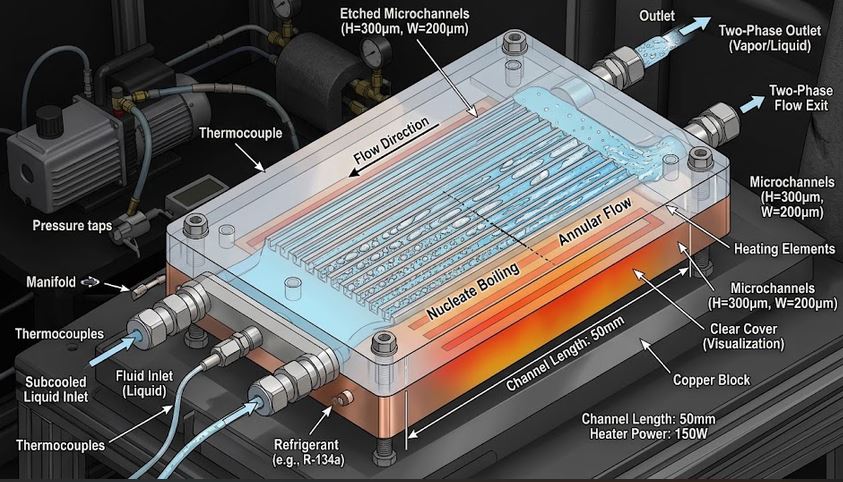
Model high-heat-flux two-phase flow boiling in microchannels: two-phase HTC (htp), confinement number (Co), boiling number (Bo), chip wall temperature, and pressure drop.
⚡ Fortran 90 Engine
Double Precision (IEEE 754)
✓ ISO / ASME Validated
 Convection
📊 Solver Telemetry
● ACTIVE
👁️ Views
36
⚡ Solves
29
💾 Downloads
407
📦 Fortran Code
10.8 KB
📅 Released
Jun 2026
⏱️ Latency
< 1 ms
💡
Hardware & Sizing Partner: Need to size a control valve or check ASME flange bolt torque for this line?
💻 Silicon Microchannel Cold Plate & Confined Vapor Slugs
Real-time visual simulation: High-heat-flux microchannel array with Taylor vapor slugs sweeping through micro-fins📝 Configuration & Presets
Kandlikar Microchannel Formulation:
• Confinement Number: Co = (1/Dh) √(σ / (g (ρL − ρV))) > 0.5
• Boiling Number: Bo = q″ / (G · hfg)
• Two-Phase HTC: htp = max( hNBD, hCBD ) [W/(m²·K)]
• Wall Temperature: Twall = Tsat + (q″ / htp) [°C]
• Confinement Number: Co = (1/Dh) √(σ / (g (ρL − ρV))) > 0.5
• Boiling Number: Bo = q″ / (G · hfg)
• Two-Phase HTC: htp = max( hNBD, hCBD ) [W/(m²·K)]
• Wall Temperature: Twall = Tsat + (q″ / htp) [°C]
📊 Microchannel Boiling Results
📊 Output Summary
Two-Phase Boiling HTC (htp)
htp = 112,266 W/(m²·K)
Base Wall Temp: 50.1 °C (Tsat = 32.3 °C) | Heat: 1280.0 W
Co = 4.16 (Microchannel)
Hydraulic Diameter (Dh)
0.600 mm
Microchannel regime
Boiling Number (Bo)
7.49e-4
q″ / (G · hfg)
Two-Phase Pressure Drop
89.23 kPa
0.892 bar
Liquid-Only HTC (hLO)
17,353 W/(m²·K)
Boiling enhancement = 6.5x
📈 Boiling HTC h_tp [W/(m²·K)] vs Vapor Quality x
📉 Two-Phase Pressure Drop ΔP (kPa) vs Mass Flux G
=================================================================
 THERMOFLUIDCALC — MICROCHANNEL FLOW BOILING (KANDLIKAR) REPORT
=================================================================
Case Title                 : EV Silicon Carbide (SiC) Inverter Power Module Water Boiling
Microchannel Array         : w = 0.40 mm, h = 1.20 mm, L = 40.0 mm (Dh = 0.600 mm, N = 40)
Operating Flow Conditions  : Mass Flux G = 1200.0 kg/(m2.s), Base Heat Flux q" = 200.0 W/cm2 (2000.0 kW/m2)
Thermodynamic State        : Vapor Quality x = 0.15, Saturation Pressure = 1.50 bar (Tsat = 32.3 C)
-----------------------------------------------------------------
CONFINEMENT NUMBER (Co)    : 4.161 [Confined Microchannel Flow]
BOILING NUMBER (Bo)        : 7.491e-4
TWO-PHASE BOILING HTC (htp): 112,265.9 W/(m2.K)
Liquid-Only Baseline HTC   : 17,353.4 W/(m2.K)
BASE WALL CHIP TEMPERATURE : 50.08 deg C (Overheat DeltaT = 17.81 C)
Two-Phase Pressure Drop    : 89.23 kPa (0.8923 bar)
Total Dissipated Heat Power: 1280.00 W
=================================================================
📘 Calculation Methodology & Microchannel Boiling Standards
Kandlikar Microchannel Correlation
Incorporates confinement effects ($Co$) and boiling number ($Bo$) to capture transition between nucleate bubble nucleation and thin-film evaporation:
htp = max( hNBD, hCBD )
Confinement Number Criterion
When $Co = \frac{1}{D_h}\sqrt{\frac{\sigma}{g(\rho_L - \rho_V)}} > 0.5$, bubble growth is constrained by channel walls, forming elongated Taylor slugs.
Key Engineering Assumptions
- Parallel rectangular microchannel heat sinks with uniform flow distribution.
- Saturated two-phase flow boiling regimes ($0.05 \le x \le 0.85$).
- Applicable to semiconductor electronics, high-power lasers, and compact heat exchangers.