
💻 Microchannel Two-Phase Flow Boiling
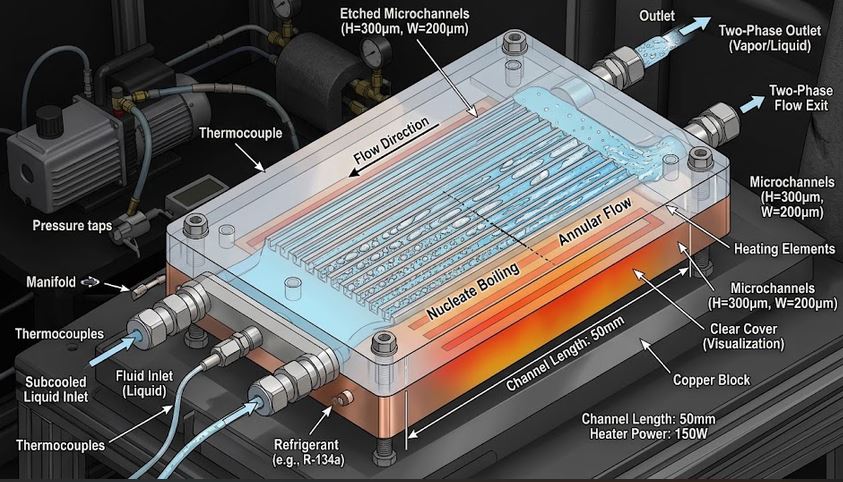
Model high-heat-flux two-phase flow boiling in microchannels: two-phase HTC (htp), confinement number (Co), boiling number (Bo), chip wall temperature, and pressure drop.
⚡ Fortran 90 Engine
Double Precision (IEEE 754)
✓ ISO / ASME Validated
 Convection
📊 Solver Telemetry
● ACTIVE
👁️ Views
36
⚡ Solves
29
💾 Downloads
407
📦 Fortran Code
10.8 KB
📅 Released
Jun 2026
⏱️ Latency
< 1 ms
💡
Hardware & Sizing Partner: Need to size a control valve or check ASME flange bolt torque for this line?
💻 Silicon Microchannel Cold Plate & Confined Vapor Slugs
Real-time visual simulation: High-heat-flux microchannel array with Taylor vapor slugs sweeping through micro-fins📝 Configuration & Presets
Kandlikar Microchannel Formulation:
• Confinement Number: Co = (1/Dh) √(σ / (g (ρL − ρV))) > 0.5
• Boiling Number: Bo = q″ / (G · hfg)
• Two-Phase HTC: htp = max( hNBD, hCBD ) [W/(m²·K)]
• Wall Temperature: Twall = Tsat + (q″ / htp) [°C]
• Confinement Number: Co = (1/Dh) √(σ / (g (ρL − ρV))) > 0.5
• Boiling Number: Bo = q″ / (G · hfg)
• Two-Phase HTC: htp = max( hNBD, hCBD ) [W/(m²·K)]
• Wall Temperature: Twall = Tsat + (q″ / htp) [°C]
📊 Microchannel Boiling Results
Configure inputs and click Compute to view results.
📘 Calculation Methodology & Microchannel Boiling Standards
Kandlikar Microchannel Correlation
Incorporates confinement effects ($Co$) and boiling number ($Bo$) to capture transition between nucleate bubble nucleation and thin-film evaporation:
htp = max( hNBD, hCBD )
Confinement Number Criterion
When $Co = \frac{1}{D_h}\sqrt{\frac{\sigma}{g(\rho_L - \rho_V)}} > 0.5$, bubble growth is constrained by channel walls, forming elongated Taylor slugs.
Key Engineering Assumptions
- Parallel rectangular microchannel heat sinks with uniform flow distribution.
- Saturated two-phase flow boiling regimes ($0.05 \le x \le 0.85$).
- Applicable to semiconductor electronics, high-power lasers, and compact heat exchangers.