🔥 Heat Transfer Reference Guide
Standard formulations, academic textbooks, boundary correlations, and heat sink references.
📚 Recommended Textbooks
Essential texts for engineering classrooms and industrial consulting portfolios:

Fundamentals of Heat and Mass Transfer
Theodore L. Bergman, Adrienne S. Lavine, Frank P. Incropera, & David P. DeWitt
The gold standard reference for conduction resistance networks, composite shell geometries, boundary layer analogies, and exact 1D radial fin equations utilizing modified Bessel functions.
- Latest Edition: 8th Edition (2017)
- Publisher: John Wiley & Sons
- ISBN-13: 978-1119320425
- Format: Hardcover / Digital
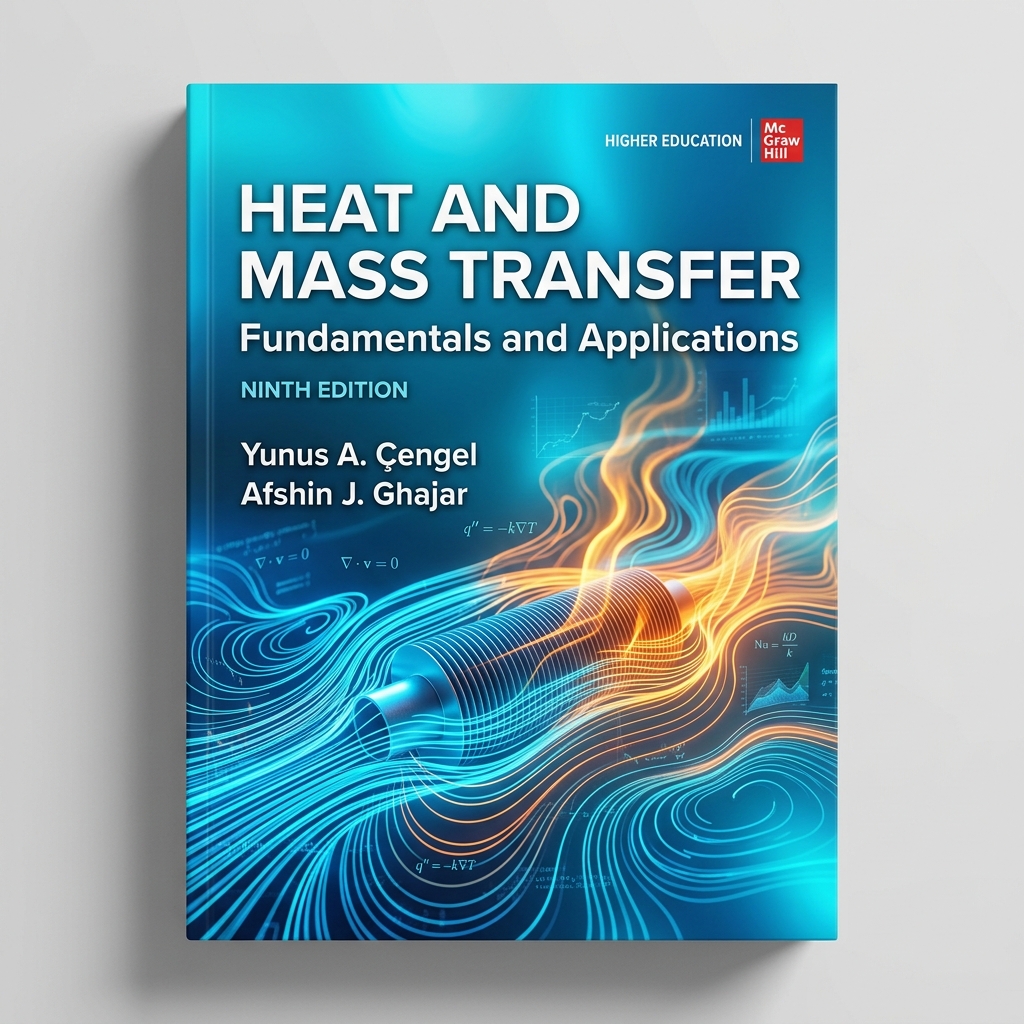
Heat and Mass Transfer: Fundamentals and Applications
Yunus A. Çengel & Afshin J. Ghajar
Renowned for its intuitive physical descriptions, illustrative heat-maps, and real-world engineering projects. Provides comprehensive correlations for natural buoyancy flows and transient lumped systems.
- Latest Edition: 7th Edition (2026 Copyright)
- Publisher: McGraw Hill (Higher Education)
- ISBN-13: 978-1264953745
- Format: Print / SmartBook
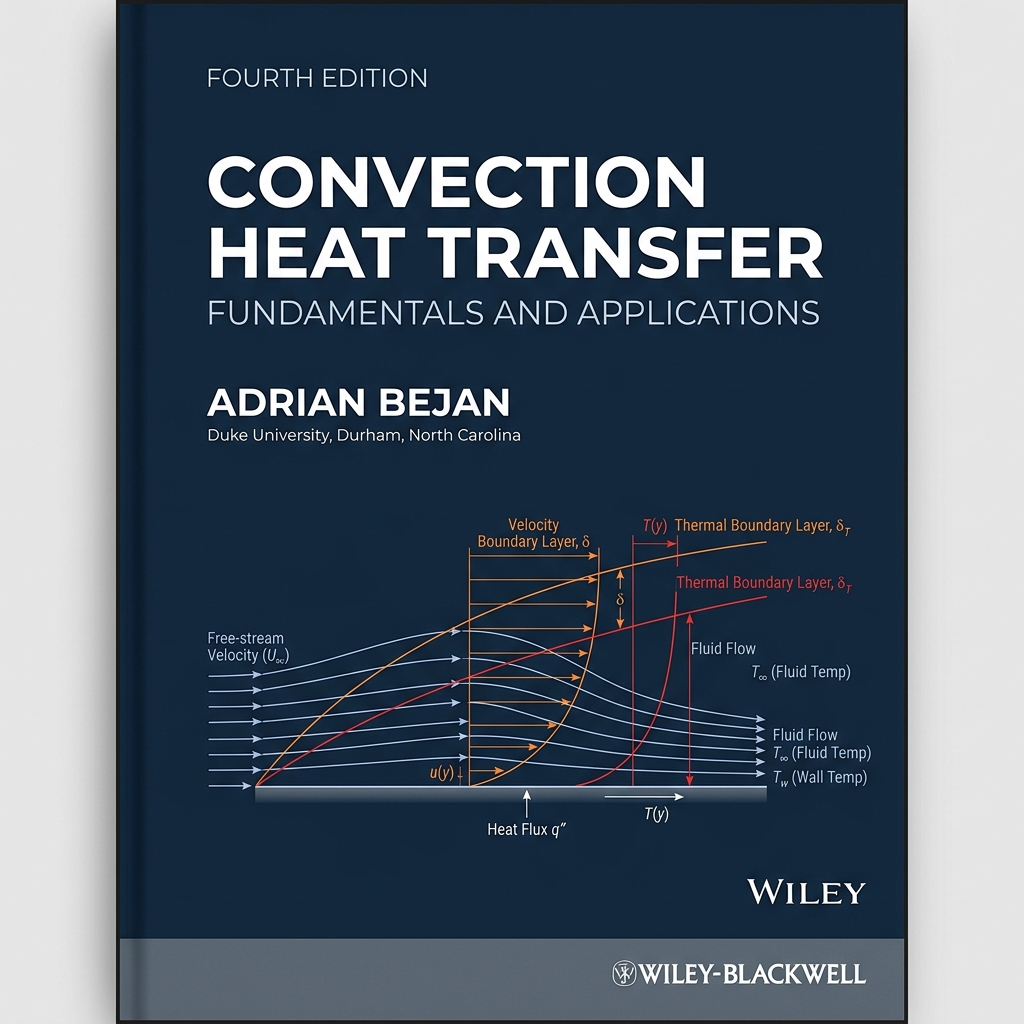
Convection Heat Transfer
Adrian Bejan
Advanced mathematical guide focused on convective momentum and thermal boundary layers. Ideal for researchers analyzing scale analysis, laminar/turbulent transitions, and optimized spacing for fin channels.
- Latest Edition: 4th Edition (2013)
- Publisher: John Wiley & Sons
- ISBN-13: 978-1118332825
- Format: Hardcover / e-Book
📄 Key Publications & Papers
| Subject | Reference Paper | Used in Calculator |
|---|---|---|
| Turbulent Internal Flows | Gnielinski, V. (1976). New equations for heat and mass transfer in turbulent pipe and channel flow. Int. Chem. Eng. | Internal Flow Convection |
| Free Convection (Plates) | Churchill, S. W., & Chu, H. H. (1975). Correlating equations for laminar and turbulent free convection from a vertical plate. IJHMT. | Natural Convection Solver |
| Forced Plate Fin Heat Sinks | Teertstra, P., Yovanovich, M. M., & Culham, J. R. (1999). Analytical forced convection modeling of plate fin heat sinks. ASME Proceedings. | Heat Sink & Fin Array |
| Optimum Fin Spacings | Bar-Cohen, A., & Rohsenow, W. M. (1984). Thermally optimum spacing of vertical, natural convection cooled parallel plates. Journal of Heat Transfer. | Heat Sink & Fin Array |
| Annular Tip Convection | Incropera et al. Table 3.5 Case 4: Corrected tip radius $r_{2c}$ for 1D radial profiles using Bessel functions. | Annular Fin Efficiency |
📊 Governing Equations & Correlations
Fourier's Law (Conduction)
Calculates steady-state 1D heat conduction through a material media:
Where conduction thermal resistance $R_{cond}$ is:
- Plane Wall: $R = \frac{L}{k A}$
- Cylindrical Shell: $R = \frac{\ln(r_2/r_1)}{2\pi k L}$
- Spherical Shell: $R = \frac{r_2 - r_1}{4\pi k r_1 r_2}$
Dittus-Boelter Equation (Internal Flow)
A simple, widely-used correlation for fully-developed turbulent flow in smooth circular tubes:
Limits of Validity:
- Reynolds number: $Re_D \ge 10,000$
- Prandtl number: $0.7 \le Pr \le 160$
- $n = 0.4$ for heating of the fluid ($T_{wall} > T_{fluid}$)
- $n = 0.3$ for cooling of the fluid ($T_{wall} < T_{fluid}$)
Gnielinski Correlation (Internal Flow)
A much more precise formulation for internal tube convection, particularly in transition zones:
Where $f$ is the Darcy friction factor. Valid for $3000 \le Re_D \le 5 \times 10^6$ and $0.5 \le Pr \le 2000$.
Churchill-Chu Correlation (Natural Convection)
Computes the average Nusselt number for free convection buoyancy boundary layers on a vertical plate:
Valid over the entire range of Rayleigh numbers: $10^{-1} < Ra_L < 10^{12}$.
🧠 Pedagogical Notes
1. Boundary Layer Thicknesses
Fluid flow over surfaces establishes three distinct boundary layer thickness scales:
- Velocity boundary layer ($\delta$): Region where viscous shear stresses slow the fluid down. Scale grows as $x^{1/2}$ for laminar flow.
- Thermal boundary layer ($\delta_t$): Region where temperature gradients are present.
- Prandtl Number coupling ($Pr$): Ratios are governed by the Prandtl number: $$\frac{\delta}{\delta_t} \approx Pr^{1/3}$$ For liquid metals ($Pr \ll 1$), thermal effects propagate far faster than viscous ones ($\delta_t \gg \delta$). For heavy oils ($Pr \gg 1$), thermal layers are nested deep inside velocity boundaries ($\delta_t \ll \delta$).
2. The Nusselt Number ($Nu$)
Represents the enhancement of heat transfer through a fluid layer due to convection relative to conduction across the same layer: $$Nu = \frac{h L_c}{k_{fluid}}$$ A Nusselt number of $Nu = 1$ indicates pure conduction (stagnant fluid). Higher values denote strong convective mixing.
🌐 Academic & Online Resources
- MIT OpenCourseWare: Mechanical Engineering Portal - High-quality lecture slides and exam sets.
- Thermal Fluids Central: Free online repository containing thermal properties databases.
- Stanford Online Lectures: Structural transport phenomena courses available on YouTube.
💬 Forums & Communities
- Eng-Tips Forums: eng-tips.com - Professional engineering forums discussing HVAC sizing, heat exchanger fouling, and standards.
- Physics StackExchange: Excellent for discussions on multi-dimensional conduction derivations and eigenvalue problems.
- Reddit: r/engineering and r/MechanicalEngineering communities.