🚿 Spray & Droplet Atomization
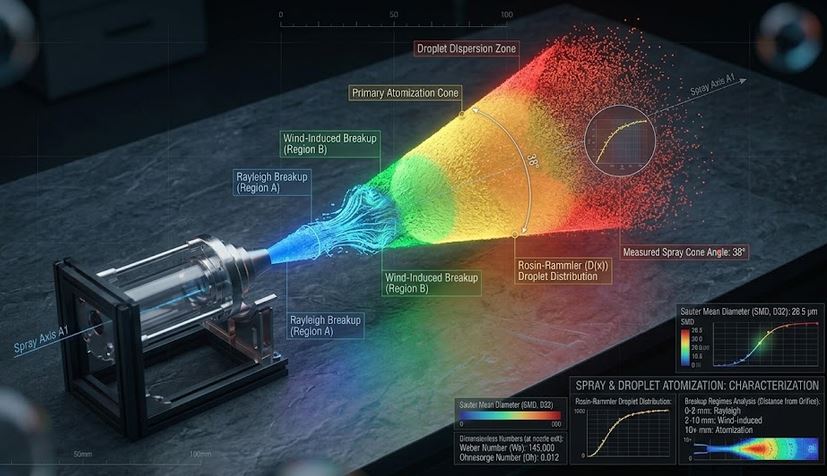
Calculate Sauter Mean Diameter (SMD, D32), liquid jet breakup regimes (Rayleigh, Wind-Induced, Atomization), spray cone angle, Rosin-Rammler droplet distribution, Weber and Ohnesorge numbers.
⚡ Fortran 90 Engine
Double Precision (IEEE 754)
✓ ISO / ASME Validated
 Fluid Mechanics
📊 Solver Telemetry
● ACTIVE
🚿 Spray Jet & Droplet Atomization Dynamics
Real-time particle & wave breakup simulation📝 Configuration & Presets
Key Formulations:
• Velocity: Vinj = Cd √(2ΔP/ρL)
• Sauter Mean Diameter: D32 = 2.25 σ0.25 μL0.16 ρL0.20 ṁ0.22 ΔP−0.43
• Weber Number: Weg = ρg Vinj² d0 / σ
• Ohnesorge Number: Oh = μL / √(ρL σ d0)
• Velocity: Vinj = Cd √(2ΔP/ρL)
• Sauter Mean Diameter: D32 = 2.25 σ0.25 μL0.16 ρL0.20 ṁ0.22 ΔP−0.43
• Weber Number: Weg = ρg Vinj² d0 / σ
• Ohnesorge Number: Oh = μL / √(ρL σ d0)
📊 Atomization & Spray Results
📊 Output Summary
Identified Breakup Regime
Atomization / Catastrophic Shear Breakup
Complete instantaneous aerodynamic disintegration at nozzle exit forming a fine dense spray.
Sauter Mean Diameter (D32)
67.7 µm
MMD (Dv50) = 79.9 µm
Spray Cone Angle (θ)
51.6°
Liquid Core Length = 7.4 mm
Injection Velocity (Vinj)
449.55 m/s
Flow = 9.552e-3 kg/s (0.69 L/min)
Dimensionless Numbers
Weg = 32479.7 | Oh = 0.0432
ReL = 2.41e+4 | WeL = 1.08e+6
📈 Rosin-Rammler Droplet Size Distribution
📉 Sauter Mean Diameter D32 vs Injection ΔP
=================================================================
 THERMOFLUIDCALC — SPRAY & DROPLET ATOMIZATION REPORT
=================================================================
Case Title                 : Common-Rail Diesel Direct Injector
Nozzle Orifice Diameter    : 0.180 mm (1.8000e-4 m)
Injection Pressure Drop    : 1500.00 bar (1.500e+8 Pa)
Discharge Coefficient Cd   : 0.750
-----------------------------------------------------------------
Liquid Velocity (V_inj)    : 449.551 m/s
Mass Flow Rate (mdot)      : 9.5521e-3 kg/s (9.552 g/s)
Volumetric Flow Rate (Q)   : 1.1440e-5 m3/s (0.686 L/min)
-----------------------------------------------------------------
Liquid Reynolds Number ReL : 2.413e+4
Liquid Weber Number WeL    : 1.085e+6
Gas Weber Number Weg       : 3.248e+4
Ohnesorge Number Oh        : 0.04316
Breakup Regime             : Atomization / Catastrophic Shear Breakup
-----------------------------------------------------------------
Sauter Mean Diameter (D32) : 67.70 microns (µm)
Arithmetic Mean (D10)      : 44.01 microns (µm)
Mass Median Diameter (Dv50): 79.89 microns (µm)
Spray Cone Angle           : 51.59 deg
Liquid Core Breakup Length : 7.41 mm
=================================================================
📘 Calculation Methodology & Engineering Theory
Breakup Regimes & Ohnesorge Diagram
The transition from a continuous liquid column to finely dispersed droplets is governed by the competing forces of inertia, surface tension, viscous shear, and aerodynamic drag:
- Rayleigh Regime (Oh < 0.1, WeL < 10): Capillary instabilities pinch off droplets larger than the nozzle.
- First & Second Wind-Induced: Aerodynamic interaction with surrounding gas causes surface wave shearing.
- Catastrophic Atomization (Weg > 40): Instantaneous chaotic stripping of ligaments into micro-droplets.
Sauter Mean Diameter (D32)
The Sauter Mean Diameter represents the ratio of droplet volume to surface area, critical for mass transfer, evaporation, and combustion:
D32 = ∑ di³ / ∑ di² = 2.25 · σ0.25 · μL0.16 · ρL0.20 · ṁL0.22 · ΔP−0.43
The cumulative volumetric distribution follows the Rosin-Rammler distribution with dispersion parameter q ≈ 2.85.
Key Engineering Assumptions
- Single-component liquid atomizing in a stagnant or co-flowing gas.
- Newtonian liquid behavior (constant dynamic viscosity μL).
- Pressure-swirl / plain orifice discharge correlation valid for ReL > 500.
- Secondary droplet coalescence and wall impingement are not modeled.