
📐 Aerodynamic Lift & Drag Solver
Compute lift force, drag force, and respective coefficients for 2D airfoils and 3D wings.
⚡ Fortran 90 Engine
Double Precision (IEEE 754)
✓ ISO / ASME Validated
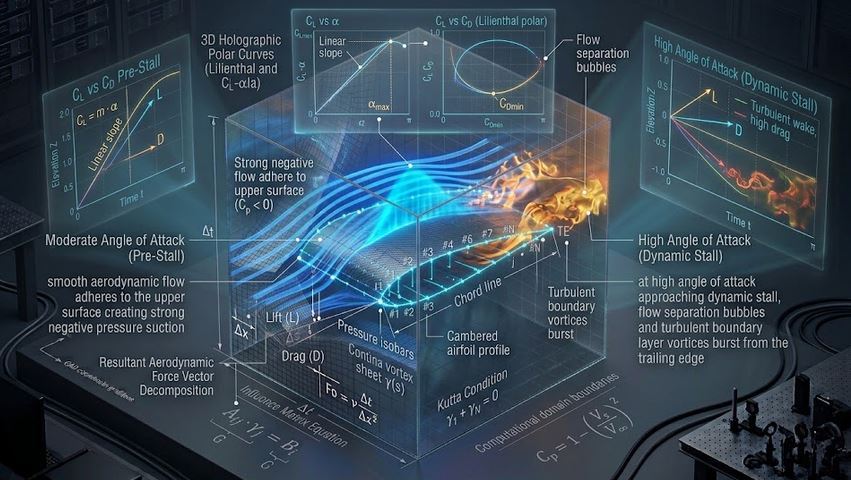 Cfd
Cfd
📊 Solver Telemetry
● ACTIVE
📥 Wing Geometry & Flow Conditions
📖 Aerodynamic Formulations (Gupta §7.8):
$$AR = \frac{b^2}{S}, \quad C_L = C_{L,\alpha}(\alpha - \alpha_0)$$
$$C_{D,i} = \frac{C_L^2}{\pi e AR}, \quad C_D = C_{D,0} + C_{D,i}$$
$$L = C_L \left(\tfrac{1}{2}\rho V^2\right) S, \quad D = C_D \left(\tfrac{1}{2}\rho V^2\right) S$$
677.28 kN
Total Lift Force ($L$)
39.038 kN
Total Drag Force ($D$)
17.3 : 1
Glide Ratio ($L/D$)
9.41
Aspect Ratio ($AR$)
📊 Aerodynamic Coefficients Breakdown ($\alpha = 2.5^\circ$)
| Parameter | Symbol | Value | Share of Total Drag |
|---|---|---|---|
| Lift Coefficient | C_L | 0.4555 | - |
| Zero-Lift Parasitic Drag | C_D0 | 0.0180 | 68.6% |
| Induced Vortex Drag | C_Di | 0.0083 | 31.4% |
| Total Drag Coefficient | C_D | 0.0263 | 100.0% |
📈 Parabolic Drag Polar Curve ($C_L$ vs $C_D$)
$(L/D)_{\text{max}} = 18.7$ at $C_L = 0.673$🔍 View Raw GNU Fortran Double-Precision Solver Output
MODE=1
MODE_NAME=Single Point
AR=    9.411920
Q= 1.18944000E+04
ALPHA_DEG=    2.500000
ALPHA0_DEG=   -2.000000
CL=    0.455531
CDI=    0.008256
CD0=    0.018000
CD=    0.026256
LIFT= 6.77283394E+05
DRAG= 3.90379590E+04
LD=     17.3494
📘 Calculation Methodology: Aerodynamic Lift & Drag Polars
Mathematical Model & Theory
Aerodynamic forces are normalized by freestream dynamic pressure and reference wing area $S$. Total drag comprises profile parasite drag $C_{D,0}$ and lift-induced drag $C_{D,i}$:
$$L = \frac{1}{2} \rho_\infty V_\infty^2 S C_L, \quad D = \frac{1}{2} \rho_\infty V_\infty^2 S C_D$$
$$C_D = C_{D,0} + \frac{C_L^2}{\pi e AR}, \quad AR = \frac{b^2}{S}$$
Assumptions
- Linear lift range prior to stall.
- Prandtl lifting-line theory for straight/tapered wings with Oswald efficiency $e$.
Academic References
- Anderson, J. D.: Introduction to Flight, McGraw-Hill.
- Raymer, D. P.: Aircraft Design, AIAA.
Worked Engineering Example
Problem Statement:
A UAV flies at $V = 45\text{ m/s}$ ($\rho = 1.225\text{ kg/m}^3$) with $S = 2.0\text{ m}^2$, $AR = 8.0$, $e = 0.85$, $C_{D,0} = 0.022$, and $C_L = 0.60$. Calculate lift and drag.
Step-by-step Solution:
1. $q_\infty = 0.5 \times 1.225 \times 45^2 = 1240.3\text{ Pa}$.
2. $L = 1240.3 \times 2.0 \times 0.60 = 1488.4\text{ N}$.
3. $C_D = 0.022 + 0.60^2 / (\pi \times 0.85 \times 8.0) = 0.022 + 0.01685 = 0.03885$.
4. $D = 1240.3 \times 2.0 \times 0.03885 = 96.38\text{ N}$.
Final Result:
Lift is 1488.4 N and Drag is 96.4 N ($L/D = 15.44$).
A UAV flies at $V = 45\text{ m/s}$ ($\rho = 1.225\text{ kg/m}^3$) with $S = 2.0\text{ m}^2$, $AR = 8.0$, $e = 0.85$, $C_{D,0} = 0.022$, and $C_L = 0.60$. Calculate lift and drag.
Step-by-step Solution:
1. $q_\infty = 0.5 \times 1.225 \times 45^2 = 1240.3\text{ Pa}$.
2. $L = 1240.3 \times 2.0 \times 0.60 = 1488.4\text{ N}$.
3. $C_D = 0.022 + 0.60^2 / (\pi \times 0.85 \times 8.0) = 0.022 + 0.01685 = 0.03885$.
4. $D = 1240.3 \times 2.0 \times 0.03885 = 96.38\text{ N}$.
Final Result:
Lift is 1488.4 N and Drag is 96.4 N ($L/D = 15.44$).