
🌊 Francis & Kaplan Turbine Cavitation Sizer
Calculate Francis and Kaplan reaction turbine cavitation limits: Thoma critical cavitation coefficient sigma, metric specific speed nq, and maximum setting height above tailwater.
⚡ Fortran 90 Engine
Double Precision (IEEE 754)
✓ ISO / ASME Validated
 Turbomachinery
📊 Solver Telemetry
● ACTIVE
💡
Hardware & Sizing Partner: Need to size a control valve or check ASME flange bolt torque for this line?
🌊 Reaction Turbine Runner, Draft Tube & Tailwater Elevation
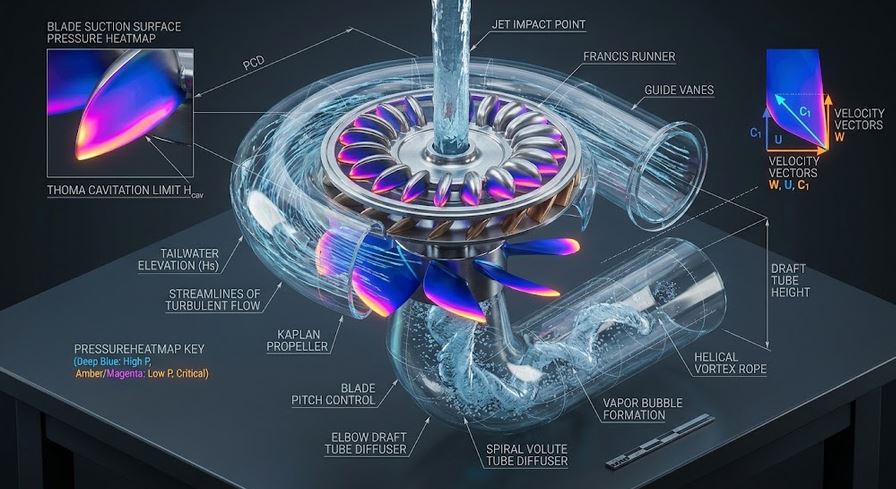
Real-time visual simulation: Runner elevation setting zs relative to tailwater level to avoid cavitation📝 Configuration & Presets
🏔️ Medium-Head Francis (85m)
⚡ Pumped-Storage (220m)
🏞️ River Kaplan (18m)
🌊 Bulb Tidal Turbine (6.5m)
Thoma Cavitation & Setting Height Formulation:
• Metric Specific Speed: nq = N · √Q / Hnet0.75 [rpm]
• Thoma Critical Coeff: σc = 0.0437·(nq/100)1.64 + 0.015 (Francis)
• Permissible Setting Height: zs = (Hatm − Hvap) − σc·Hnet − 0.50 [m]
• If zs < 0: Powerhouse runner must be submerged below tailwater.
• Metric Specific Speed: nq = N · √Q / Hnet0.75 [rpm]
• Thoma Critical Coeff: σc = 0.0437·(nq/100)1.64 + 0.015 (Francis)
• Permissible Setting Height: zs = (Hatm − Hvap) − σc·Hnet − 0.50 [m]
• If zs < 0: Powerhouse runner must be submerged below tailwater.
📊 Performance Results
📊 Output Summary
Max Allowable Setting Height (zs)
+1.04 m
Power: 70.23 MW | Thoma σc: 0.0350
ABOVE TAILWATER (POSITIVE ZS)
Metric Specific Speed (nq)
62.1 rpm
HIGH-HEAD FRANCIS RUNNER
Cavitation Head Drop (σc·H)
7.71 m
Dynamic pressure drop in runner
Atmospheric Pressure Head
9.39 m w.c.
Altitude = 800 m
Shaft Power Generated
70.23 MW
η = 93% efficiency
📈 Setting Height zs (m) vs Net Water Head H (m)
📊 Thoma Cavitation Coeff σc vs Specific Speed nq
=================================================================
 THERMOFLUIDCALC — HYDRO TURBINE CAVITATION REPORT
=================================================================
Case Title                 : High-Head Pumped-Storage Francis Runner
Turbine Architecture       : Francis Reaction Runner
Hydro Operating Point      : Hnet = 220.0 m, Q = 35.00 m3/s, N = 600 rpm
Site Conditions            : Altitude = 800 m, Water Temp = 12.0 C (H_atm = 9.39 m w.c.)
-----------------------------------------------------------------
MAX SETTING HEIGHT (zs)    : +1.04 m (ABOVE TAILWATER (POSITIVE ZS))
Thoma Critical Cavitation  : sigma_c = 0.0350 (Cavitation Drop: 7.71 m)
Metric Specific Speed (nq) : 62.1 rpm (HIGH-HEAD FRANCIS RUNNER)
Shaft Power Generated      : 70.23 MW
=================================================================
📘 Calculation Methodology & Hydro Cavitation Standards
Thoma Cavitation Parameter ($\sigma$)
Cavitation occurs when local pressure on the suction side of runner blades drops below vapor pressure $P_v$. The Thoma parameter $\sigma_c$ links dynamic pressure depressions to the net head $H_{net}$.
Setting Height ($z_s$) & Submergence
If $z_s < 0$, the runner must be excavated and placed below the downstream tailwater canal level to provide positive static suction head against cavitation pitting and vibrations.
Key Engineering Assumptions
- IEC 60193 / USBR Monograph empirical cavitation coefficients.
- Atmospheric barometric pressure correction for powerhouse altitude.
- Widely used in hydroelectric dam powerhouse design and pumped storage plants.