⚡ Supercritical Organic Rankine Cycle (sORC)
Size supercritical Organic Rankine Cycles (sORC): continuous glide vapor generation without pinch point, net electrical power output (kW), thermal efficiency, and recuperator duty.
⚡ Fortran 90 Engine
Double Precision (IEEE 754)
✓ ISO / ASME Validated
 Thermodynamics
📊 Solver Telemetry
● ACTIVE
👁️ Views
43
⚡ Solves
37
💾 Downloads
468
📦 Fortran Code
11.4 KB
📅 Released
Jun 2026
⏱️ Latency
< 1 ms
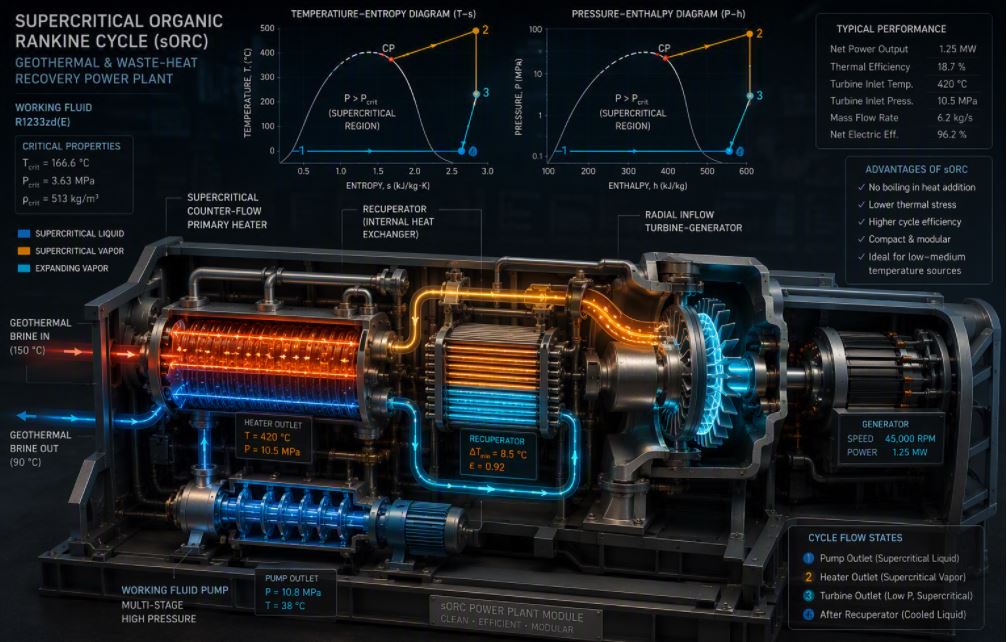
⚡ Supercritical ORC Cycle Flow Diagram & Supercritical Heating Glide
Real-time visual simulation: Continuous glide supercritical vapor generator without pinch-point limitation📝 Configuration & Presets
🌋 Geothermal Brine (R1233zd)
🏭 Steel Waste Heat (n-Pentane)
☀️ Solar Thermal CSP (Toluene)
🚢 Marine Diesel sORC (R245fa)
sORC Thermodynamic Formulation:
• Net Cycle Work: wnet = wturb − wpump [kJ/kg]
• Thermal Efficiency: ηth = wnet / (hTIT − hheater,in) [%]
• Power Output: Ẇnet = ṁ · wnet [kW]
• Eliminates isothermal evaporation pinch-point bottleneck.
• Net Cycle Work: wnet = wturb − wpump [kJ/kg]
• Thermal Efficiency: ηth = wnet / (hTIT − hheater,in) [%]
• Power Output: Ẇnet = ṁ · wnet [kW]
• Eliminates isothermal evaporation pinch-point bottleneck.
📊 sORC Cycle Results
Configure inputs and click Compute to view results.
📘 Calculation Methodology & Supercritical ORC Standards
Supercritical Heat Addition Advantage
Heating above the critical pressure ($P > P_{crit}$) eliminates the isothermal phase change plateau, allowing the working fluid temperature to glide continuously with the heat source profile.
Internal Recuperation (IHX)
Dry organic vapors exit the expander with significant superheat. The recuperator transfers this waste heat to preheat the high-pressure liquid before entering the vapor generator.
Key Engineering Assumptions
- Supercritical heating without boiling pinch-point limitations.
- Dry expansion avoiding liquid droplet erosion in turbine blades.
- Applicable to geothermal brine, biomass, solar thermal CSP, and engine waste heat.