🔄 Supercritical CO2 Recompression Brayton
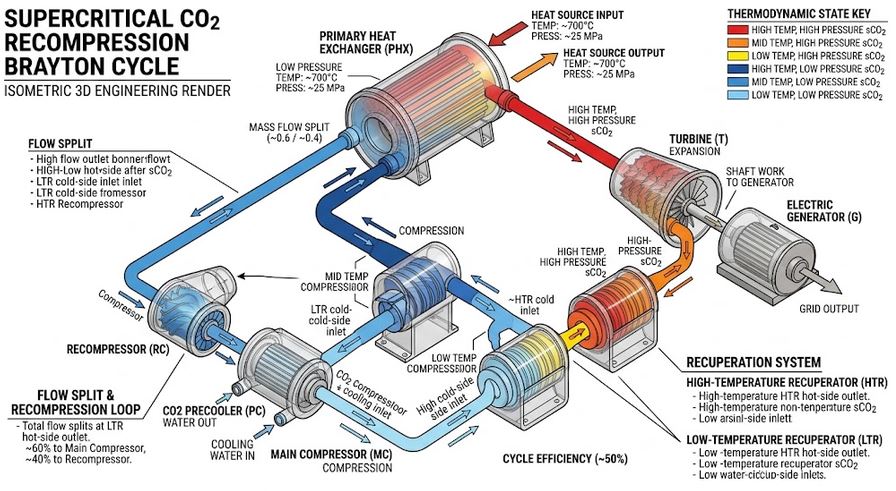
Size closed-loop supercritical CO2 (sCO2) recompression Brayton power loops: thermal efficiency (>45%), net electrical power (MW), split recompression ratio, and dual recuperator duties.
⚡ Fortran 90 Engine
Double Precision (IEEE 754)
✓ ISO / ASME Validated
 Thermodynamics
📊 Solver Telemetry
● ACTIVE
👁️ Views
38
⚡ Solves
33
💾 Downloads
469
📦 Fortran Code
11.4 KB
📅 Released
Jun 2026
⏱️ Latency
< 1 ms
⚛️ Closed-Loop sCO2 Recompression Power Cycle & Dual Recuperators
Real-time visual simulation: Dense-phase main compressor + bypass recompressor with LTR/HTR heat recovery📝 Configuration & Presets
⚛️ Gen-IV Nuclear (650°C)
☀️ Solar Tower CSP (700°C)
🔥 Allam Oxy-Fuel (1100°C)
🏭 SMR Compact sCO2 (550°C)
sCO2 Recompression Brayton Formulation:
• Net Cycle Work: wnet = wt − (1−γ)·wMC − γ·wRC [kJ/kg]
• Thermal Efficiency: ηth = wnet / qheater [%]
• Dense-phase compression near critical point (ρ ≈ 600 kg/m³) drastically cuts pump work.
• Dual recuperators (LTR & HTR) eliminate pinch-point heat exchange mismatch.
• Net Cycle Work: wnet = wt − (1−γ)·wMC − γ·wRC [kJ/kg]
• Thermal Efficiency: ηth = wnet / qheater [%]
• Dense-phase compression near critical point (ρ ≈ 600 kg/m³) drastically cuts pump work.
• Dual recuperators (LTR & HTR) eliminate pinch-point heat exchange mismatch.
📊 sCO2 Cycle Results
Configure inputs and click Compute to view results.
📘 Calculation Methodology & sCO2 Brayton Standards
Near-Critical Compression Advantage
Compressing supercritical $CO_2$ just above its critical point ($31.1^\circ\text{C}, 7.38\,\text{MPa}$) exploits high density ($\sim 600\,\text{kg/m}^3$), reducing compressor power consumption by over $60\%$ compared to ideal gases.
Split-Flow Recompression Architecture
The recompression compressor (RC) takes a fraction $\gamma$ of hot low-pressure fluid directly from the LTR outlet without cooling, perfectly matching the specific heat capacitance rates ($mc_p$) across the recuperator.
Key Engineering Assumptions
- Closed-loop closed Brayton cycle with pure $CO_2$.
- Dual printed-circuit heat exchangers (PCHE) for LTR and HTR.
- Applicable to Gen-IV nuclear reactors, solar tower CSP, and waste heat recovery.