🔋 PCM Latent Heat Thermal Storage
Size Phase Change Material (PCM) latent heat thermal batteries: total stored energy (kWh), average charging thermal power (kW), melt time, NTU effectiveness, and state of charge (SOC).
⚡ Fortran 90 Engine
Double Precision (IEEE 754)
✓ ISO / ASME Validated
 Thermodynamics
📊 Solver Telemetry
● ACTIVE
👁️ Views
35
⚡ Solves
28
💾 Downloads
316
📦 Fortran Code
11.4 KB
📅 Released
Jun 2026
⏱️ Latency
< 1 ms
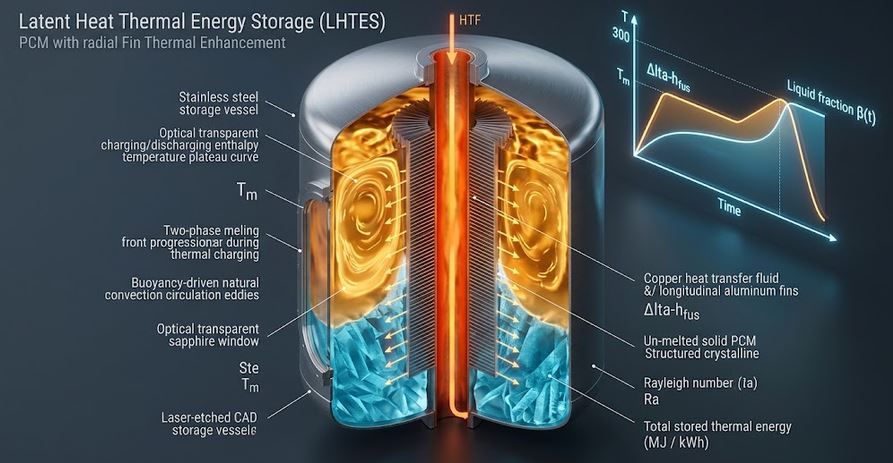
🔋 Latent Heat PCM Storage Module & Melting Mushy Zone
Real-time visual simulation: Heat transfer fluid tubes charging the PCM matrix through progressive phase change📝 Configuration & Presets
☀️ Solar Paraffin Wax (58°C)
❄️ HVAC Salt Hydrate (29.5°C)
🏭 Waste Steam Erythritol (118°C)
🌋 Solar Molten Salt (220°C)
PCM Thermal Energy Storage Formulation:
• Total Stored Energy: Etot = Mpcm [ cps(Tm−Ti) + Lf + cpl(Tin−Tm) ] / 3600 [kWh]
• Charging Effectiveness: ε = 1 − e−NTU, where NTU = UA / (ṁ · cp,htf)
• Average Charging Power: Q̇avg = ṁ · cp,htf · (Tin − Tm) · ε [kW]
• Total Charging Time: tcharge = Etot / Q̇avg [hours]
• Total Stored Energy: Etot = Mpcm [ cps(Tm−Ti) + Lf + cpl(Tin−Tm) ] / 3600 [kWh]
• Charging Effectiveness: ε = 1 − e−NTU, where NTU = UA / (ṁ · cp,htf)
• Average Charging Power: Q̇avg = ṁ · cp,htf · (Tin − Tm) · ε [kW]
• Total Charging Time: tcharge = Etot / Q̇avg [hours]
📊 Storage Performance Results
📊 Output Summary
Total Stored Thermal Energy
80.95 kWh
Latent Portion: 63.33 kWh (78.2%) | Charging Power: 31.28 kW
tcharge = 155.3 min
Full Charging Duration
2.59 hours
155 minutes
Average Thermal Power
31.28 kW
Charging rate
Heat Exchanger Effectiveness
16.1 %
NTU = 0.175
PCM Melting Temperature
29.5 °C
Lf = 190 kJ/kg
📈 State of Charge SOC (%) vs Charging Time (hours)
📉 Instantaneous Charging Power Q (kW) vs Time (hours)
=================================================================
 THERMOFLUIDCALC — PCM LATENT HEAT THERMAL STORAGE REPORT
=================================================================
Case Title                 : Building HVAC Peak-Shaving Salt Hydrate Storage
PCM Material Type          : Inorganic Salt Hydrate (CaCl2·6H2O)
Storage Sizing             : PCM Mass = 1200.0 kg, Melting Temp Tm = 29.5 C (Lf = 190.0 kJ/kg)
HTF Charging Loop          : Inlet Temp = 45.0 C, Mass Flow = 3.00 kg/s, UA = 2200.0 W/K (NTU = 0.175)
-----------------------------------------------------------------
TOTAL STORED THERMAL ENERGY: 80.95 kWh (291.4 MJ)
 - Latent Heat Portion (Lf): 63.33 kWh (78.2%)
 - Sensible Heat Portion   : 17.62 kWh (21.8%)
AVERAGE CHARGING POWER     : 31.28 kW
TOTAL CHARGING DURATION    : 2.59 hours (155.3 minutes)
=================================================================
📘 Calculation Methodology & Latent Storage Standards
High Energy Density at Constant Temperature
Latent storage absorbs or releases large amounts of thermal energy ($L_f \approx 150 - 350\,\text{kJ/kg}$) at nearly isothermal conditions, offering $3 - 5\times$ higher volumetric energy density than water tanks.
NTU-Effectiveness Charging Model
Computes the transient temperature evolution of the heat transfer fluid as it circulates through embedded finned tubes inside the solidifying or melting PCM core.
Key Engineering Assumptions
- Enthalpy-based phase change model with well-defined melting point $T_m$.
- Uniform PCM encapsulation without thermal degradation.
- Applicable to solar domestic hot water, HVAC peak load shifting, and industrial heat recovery.