
🚀 Solar Thermal Ejector Refrigeration
Model solar-driven supersonic ejector refrigeration: entrainment ratio (omega), thermal COP, required solar collector field area (m²), and compressor-free cooling capacity.
⚡ Fortran 90 Engine
Double Precision (IEEE 754)
✓ ISO / ASME Validated
 Thermodynamics
📊 Solver Telemetry
● ACTIVE
👁️ Views
43
⚡ Solves
36
💾 Downloads
509
📦 Fortran Code
11.4 KB
📅 Released
Jun 2026
⏱️ Latency
< 1 ms
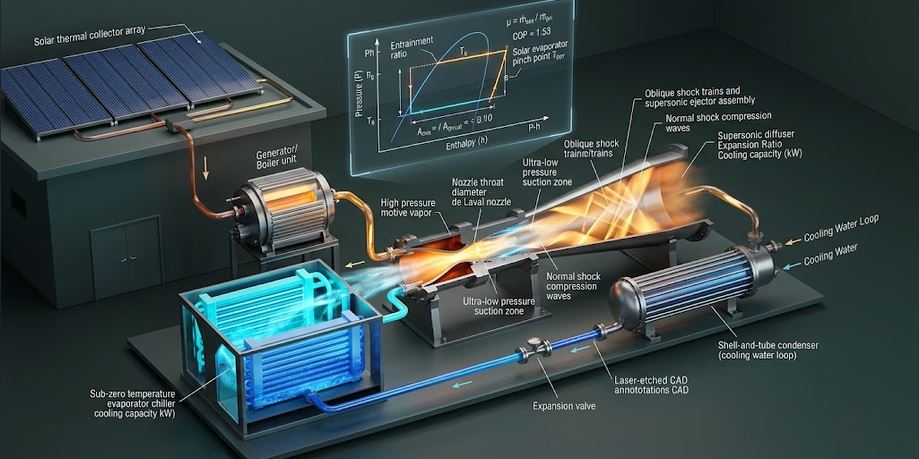
🚀 Supersonic Ejector Nozzle & Solar Thermal Refrigeration Loop
Real-time visual simulation: High-pressure primary motive steam entraining secondary evaporator vapor through supersonic mixing📝 Configuration & Presets
☀️ Solar Building AC (R245fa)
💨 Industrial Steam Jet Chiller (Water)
🔥 CSP Parabolic Trough (R600a)
🏠 Solar Flat Plate Cooler (R134a)
Solar Ejector Refrigeration Formulation:
• Entrainment Ratio: ω = ṁsec / ṁpri ∝ √[(Tg−Tc)/(Tc−Te)]
• Thermal COP: COPth = Q̇cool / Q̇solar_gen
• Required Solar Area: Asolar = Q̇gen / (G · ηcoll) [m²]
• Completely compressor-free thermal refrigeration.
• Entrainment Ratio: ω = ṁsec / ṁpri ∝ √[(Tg−Tc)/(Tc−Te)]
• Thermal COP: COPth = Q̇cool / Q̇solar_gen
• Required Solar Area: Asolar = Q̇gen / (G · ηcoll) [m²]
• Completely compressor-free thermal refrigeration.
📊 Solar Ejector Results
Configure inputs and click Compute to view results.
📘 Calculation Methodology & Solar Ejector Standards
Supersonic Jet Entrainment
High-pressure motive vapor expands through a convergent-divergent nozzle to supersonic speeds ($M > 2$), creating a low-pressure zone that sucks vapor from the evaporator.
100% Thermal Drive (No Compressor)
Solar thermal energy directly powers the cycle. Only a tiny liquid feed pump is required, consuming less than $1\%$ of the electrical energy of vapor compression chillers.
Key Engineering Assumptions
- 1D gas dynamic model of supersonic constant-pressure mixing.
- Saturated vapor conditions at generator and evaporator exits.
- Applicable to solar air conditioning, industrial steam ejectors, and food cold storage.