🛡️ Cryogenic Multilayer Insulation (MLI)
Size spacecraft and cryogenic Multilayer Insulation (MLI) blankets, computing total heat flux (W/m²), effective thermal conductivity keff, and daily cryogen boil-off rate (LH2, LN2, LHe).
⚡ Fortran 90 Engine
Double Precision (IEEE 754)
✓ ISO / ASME Validated
 Radiation
📊 Solver Telemetry
● ACTIVE
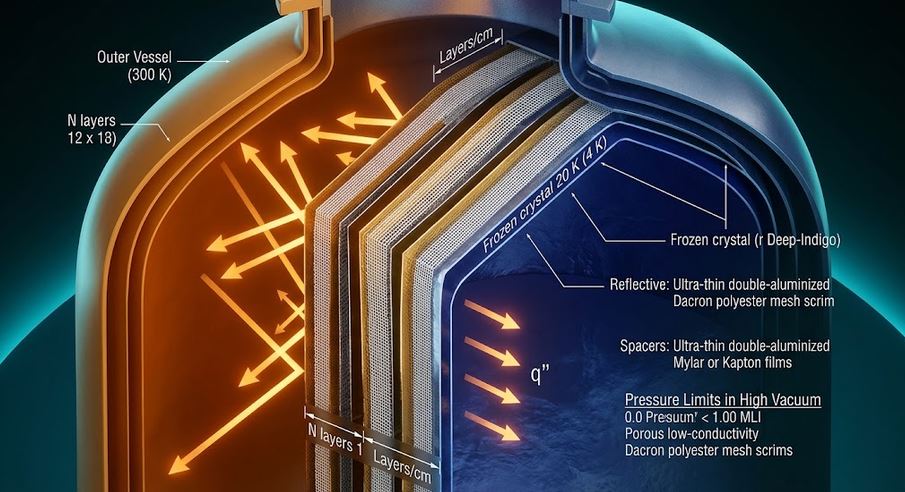
🛡️ Vacuum Multilayer Radiation Shields & Cryogenic Barrier
Real-time visual simulation of reflective foil radiation bounces, Dacron spacer mesh & residual gas conduction📝 Configuration & Presets
🚀 Liquid H2 (LH2) Rocket Tank
❄️ Liquid N2 (LN2) Dewar
🧲 Superconducting MRI (LHe)
🛰️ GEO Satellite Blanket
Lockheed / McIntosh MLI Formulation:
• Radiation: q″rad = σ (Th⁴ − Tc⁴) / [ (N+1)(2/ε − 1) ]
• Solid Spacers: q″solid = 7.3×10⁻⁵ N̄2.63 Tmean ΔT / N
• Residual Gas: q″gas = 14600 Pvac (Th0.52 − Tc0.52) / N
• Effective Conductivity: keff = q″tot · Δx / (Th − Tc) [W/(m·K)]
• Radiation: q″rad = σ (Th⁴ − Tc⁴) / [ (N+1)(2/ε − 1) ]
• Solid Spacers: q″solid = 7.3×10⁻⁵ N̄2.63 Tmean ΔT / N
• Residual Gas: q″gas = 14600 Pvac (Th0.52 − Tc0.52) / N
• Effective Conductivity: keff = q″tot · Δx / (Th − Tc) [W/(m·K)]
📊 MLI Thermal Results
📊 Output Summary
Total MLI Heat Flux (q″tot)
q″ = 206.104 W/m²
Effective Conductivity: 1.51e-2 W/(m·K) | Boil-Off: 479.12 kg/day
N = 40 layers (20.0 L/cm)
Radiation Component (q″rad)
0.155 W/m²
0.1 % of total
Solid Spacer Conduction
205.896 W/m²
99.9 % of total
Residual Gas Conduction
0.053 W/m²
0.0 % of total
Daily Cryogen Boil-Off
479.12 kg/day
Tank area A = 12 m²
📈 Total MLI Heat Flux q″ (W/m²) vs Number of Shields N
📉 Effective Conductivity k_eff (×10⁻⁵ W/m·K) vs log₁₀(P_vac)
=================================================================
 THERMOFLUIDCALC — CRYOGENIC MULTILAYER INSULATION (MLI) REPORT
=================================================================
Case Title                 : Liquid Hydrogen (LH2) Orbital Upper Stage Cryogenic Tank
Blanket Configuration      : N = 40 layers, Thickness = 20.0 mm (Density = 20.0 layers/cm)
Thermal Boundaries         : Warm Th = 293.0 K, Cold Tc = 20.0 K (DeltaT = 273.0 K)
Vacuum & Surface Properties: Emissivity eps = 0.030, Vacuum Pressure = 1.00e-5 Torr
-----------------------------------------------------------------
TOTAL HEAT FLUX (q_tot)    : 206.1043 W/m2
 - Radiation Flux (q_rad)  : 0.1552 W/m2 (0.1%)
 - Solid Conduction (q_sol): 205.8964 W/m2 (99.9%)
 - Gas Conduction (q_gas)  : 0.0527 W/m2 (0.0%)
EFFECTIVE CONDUCTIVITY keff: 1.510e-2 W/(m.K)
Cryogen Daily Boil-Off Rate: 479.123 kg/day
=================================================================
📘 Calculation Methodology & Cryogenic MLI Standards
Lockheed & McIntosh Semi-Empirical Model
Decomposes heat transfer through vacuum multilayer insulation into three distinct parallel mechanisms:
q″total = q″radiation + q″solid_spacers + q″residual_gas
Optimum Layer Density
Increasing shield density $\bar{N}$ suppresses radiation but increases solid spacer contact conduction. Optimum density is typically $20 - 30\,\text{layers/cm}$.
Key Engineering Assumptions
- Double-aluminized Mylar (DAM) or Kapton with Dacron mesh spacers.
- Free-molecular regime for residual gas ($Kn \gg 10$ at $P < 10^{-4}\,\text{Torr}$).
- Applicable to $LH_2, LN_2, LHe, LOX, LCH_4$ storage and satellites.