
❄️ Freeze Drying Sublimation (Pikal Lyophilization)
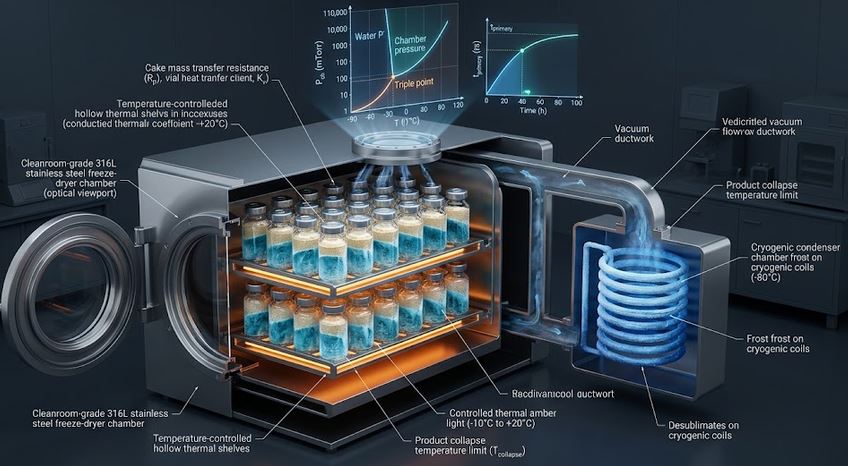
Simulate pharmaceutical primary freeze-drying sublimation cycle times, moving ice front temperature, dry cake vapor resistance (Rp), and vial heat flux.
⚡ Fortran 90 Engine
Double Precision (IEEE 754)
✓ ISO / ASME Validated
 Mass Transfer
📊 Solver Telemetry
● ACTIVE
❄️ Pharmaceutical Vial Sublimation Front Progression & Vapor Flow
Real-time visual simulation of ice sublimation interface descending through porous cake under chamber vacuum📝 Configuration & Presets
Pikal Lyophilization Formulations:
• Sublimation Mass Flux: ṁsub = (Psat(Tice) − Pch) / Rp [g/(cm²·h)]
• Shelf Heat Flux: q̇ = Kv · (Tshelf − Tbottom) = ṁsub · ΔHsub
• Primary Drying Time: tp = ∫ [ ρice (1 − cs) / ṁsub ] dLdry
• Collapse Constraint: Tice < Tcollapse
• Sublimation Mass Flux: ṁsub = (Psat(Tice) − Pch) / Rp [g/(cm²·h)]
• Shelf Heat Flux: q̇ = Kv · (Tshelf − Tbottom) = ṁsub · ΔHsub
• Primary Drying Time: tp = ∫ [ ρice (1 − cs) / ṁsub ] dLdry
• Collapse Constraint: Tice < Tcollapse
📊 Primary Drying Results
Configure inputs and click Compute to view results.
📘 Calculation Methodology & Pikal Lyophilization Standards
Pikal Coupled Heat & Mass Balance
During primary drying, latent heat of ice sublimation ($\Delta H_{sub} = 2835\,\text{J/g}$) supplied by shelf conduction must equal the vapor sublimation mass transfer:
Kv(Tshelf − Tbottom) = ΔHsub · [ (Psat(Tice) − Pch) / Rp ]
Micro-Collapse Prevention
If the ice sublimation interface exceeds the glass transition temperature $T_g'$ or collapse temperature $T_{collapse}$, the porous cake collapses, resulting in product degradation.
Key Engineering Assumptions
- Planar 1D moving sublimation front progressing from top to bottom.
- Vapor transport governed by dry cake Knudsen & viscous resistance $R_p$.
- Equilibrium Clausius-Clapeyron ice vapor pressure.