
💻 Microchannel Heat Sink Sizer (MCHE)
Design microchannel heat sinks for high-power electronics (CPU/GPU/SiC): junction temperature Tj, total thermal resistance Rth (K/W), heat flux density (W/cm2), and pressure drop.
⚡ Fortran 90 Engine
Double Precision (IEEE 754)
✓ ISO / ASME Validated
 Heat Exchangers
📊 Solver Telemetry
● ACTIVE
🔬 High-Density Microchannels & Thermal Heat Spreading
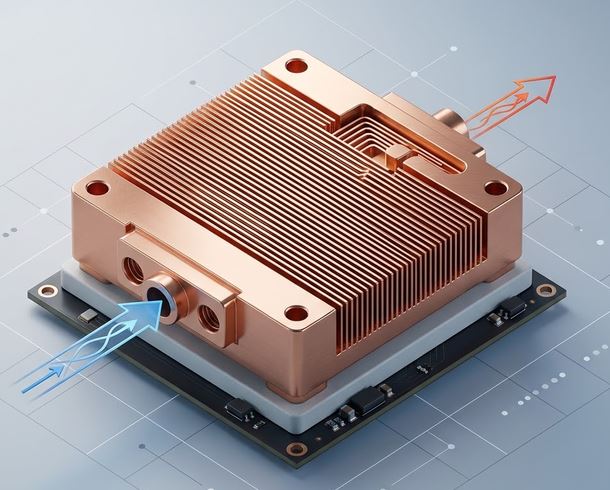
Real-time visual simulation: Micro-fin array with liquid coolant streams and heat conduction vectors📝 Configuration & Presets
🤖 700W AI Datacenter GPU
🖥️ 350W Server Direct-to-Silicon
🚗 1200W EV SiC Inverter
🧪 FC-72 Immersion Sink
Tuckerman & Pease Microchannel Formulation:
• Total Resistance: Rth = Rconv + Rcond + Rcaloric [K/W]
• Convective Resistance: Rconv = 1 / (h · Aeff) [K/W]
• Fin Efficiency: ηfin = tanh(m·Hc) / (m·Hc)
• Junction Temperature: Tj = Tin + Q · Rth [°C].
• Total Resistance: Rth = Rconv + Rcond + Rcaloric [K/W]
• Convective Resistance: Rconv = 1 / (h · Aeff) [K/W]
• Fin Efficiency: ηfin = tanh(m·Hc) / (m·Hc)
• Junction Temperature: Tj = Tin + Q · Rth [°C].
📊 Thermal Performance Results
Configure inputs and click Compute to view results.
📘 Calculation Methodology & Electronics Cooling Standards
Tuckerman & Pease Microchannel Paradigm
By reducing hydraulic diameter down to tens of micrometers, the convective heat transfer coefficient $h \propto k/D_h$ reaches astronomical values (> 15,000 W/m²·K), enabling heat removal from ultra-dense processors exceeding $100\,\text{W/cm}^2$.
Three-Component Thermal Resistance Budget
The total junction-to-fluid thermal resistance includes $R_{cond}$ (substrate base conduction), $R_{conv}$ (fin convective resistance), and $R_{cal}$ (caloric fluid temperature rise along channel).
Key Engineering Assumptions
- Laminar flow with Kwak rectangular duct aspect-ratio corrections.
- 1D fin conduction efficiency across high aspect ratio micro-fins.
- Applicable to NVIDIA/AMD AI GPUs, Intel Xeon/AMD EPYC CPUs, and automotive EV SiC traction inverters.