🌀 Centrifugal Pump NPSH Available & Cavitation Sizer
Calculate centrifugal pump NPSH available (NPSHa), cavitation safety margin (NPSHa - NPSHr), vapor pressure, suction pipe friction losses, and Thoma cavitation parameter.
⚡ Fortran 90 Engine
Double Precision (IEEE 754)
✓ ISO / ASME Validated
 Fluid Mechanics
📊 Solver Telemetry
● ACTIVE
💡
Hardware & Sizing Partner: Need to size a control valve or check ASME flange bolt torque for this line?
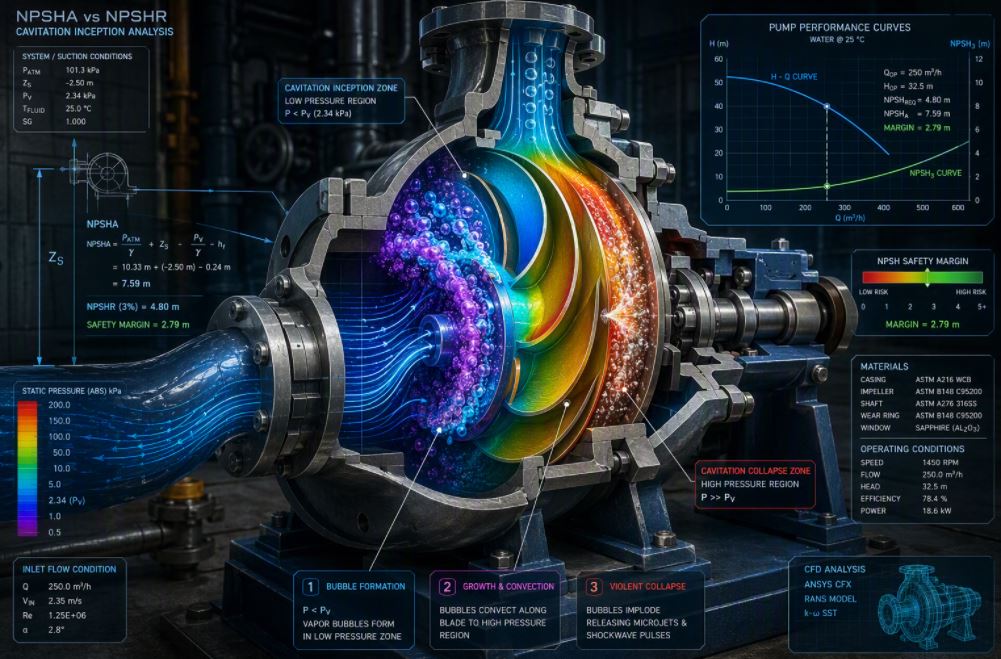
🌀 Centrifugal Pump Suction Hydraulics & Impeller Eye Cavitation Zone
Real-time visual simulation: Suction tank liquid level, line losses, and vapor bubble collapse in impeller eye📝 Configuration & Presets
💧 Flooded Suction Water (Safe)
⚠️ River Suction Lift (-4m)
🔥 Boiler Feed Deaerator (130°C)
⛽ Volatile Gasoline Solvent
Hydraulic Institute (HI 9.6.1) NPSH Formulation:
• NPSH Available: NPSHa = (Pvessel − Pv(T)) / (ρ g) + zs − hloss [m]
• Cavitation Margin: ΔNPSH = NPSHa − NPSHr ≥ 0.6 m (or CMR ≥ 1.2 - 1.5)
• Thoma Cavitation Number: σ = NPSHa / Hpump
• Velocity Limit: Suction velocity V should remain between 1.0 - 2.5 m/s.
• NPSH Available: NPSHa = (Pvessel − Pv(T)) / (ρ g) + zs − hloss [m]
• Cavitation Margin: ΔNPSH = NPSHa − NPSHr ≥ 0.6 m (or CMR ≥ 1.2 - 1.5)
• Thoma Cavitation Number: σ = NPSHa / Hpump
• Velocity Limit: Suction velocity V should remain between 1.0 - 2.5 m/s.
📊 NPSH & Cavitation Results
📊 Output Summary
Net Positive Suction Head Available (NPSHa)
1.83 meters
NPSHr: 2.50 m | Margin: -0.67 m (CMR = 0.73)
SEVERE CAVITATION (HEAD DROP & EROSION)
Cavitation Safety Margin
-0.67 m
HI Target: ≥ +0.60 m
Suction Line Flow Velocity
3.59 m/s
Recommended: 1.0 - 2.5 m/s
Fluid Vapor Pressure Pv
3.77 kPa
At 28 °C
Suction Piping Head Loss
4.13 m
Friction + Minor losses
📈 NPSHa & NPSHr (m) vs Flow Rate Q (m³/h)
📉 NPSHa (m) vs Fluid Temperature T (°C)
=================================================================
 THERMOFLUIDCALC — PUMP NPSHa & CAVITATION ANALYSIS REPORT
=================================================================
Case Title                 : River Intake Lift Pump (Negative Static Head)
Fluid Medium               : Water (Clean Potable / Industrial)
Operating State            : P_vessel = 1.013 bar abs, Temp = 28.0 C (Vapor Press Pv = 3.769 kPa)
Suction Line Geometry      : ID = 80.0 mm, Length = 12.0 m, sum K = 3.5, Static Head zs = -4.00 m
Flow & Velocity            : Q = 65.00 m3/h (18.06 L/s), Suction Velocity V = 3.59 m/s
-----------------------------------------------------------------
NPSH AVAILABLE (NPSHa)     : 1.831 meters (17.927 kPa)
NPSH REQUIRED (NPSHr)      : 2.500 meters (3% Head Drop Curve)
CAVITATION SAFETY MARGIN   : -0.669 meters (NPSHa - NPSHr)
Cavitation Margin Ratio    : 0.732 (NPSHa / NPSHr)
Thoma Cavitation Number    : 0.0610 (NPSHa / H_pump = 30.0 m)
Total Suction Head Losses  : 4.131 meters (Friction + Minor)
CAVITATION RISK STATUS     : SEVERE CAVITATION (HEAD DROP & EROSION)
=================================================================
📘 Calculation Methodology & Hydraulic Institute Standards
Hydraulic Institute NPSH Margin (HI 9.6.1)
NPSH margin is the difference between $NPSH_a$ and $NPSH_r$. A margin of at least $0.6 - 1.5\,\text{m}$ (or $CMR \ge 1.3$) prevents vapor cavity collapse, impeller pitting erosion, and high-frequency vibration.
Vapor Pressure & Temperature Impact
As fluid temperature rises, vapor pressure $P_v(T)$ increases exponentially according to the Antoine equation, reducing $NPSH_a$ dramatically and demanding higher suction elevation or pressurization.
Key Engineering Assumptions
- Swamee-Jain / Darcy-Weisbach pipe friction model.
- Sum of minor losses $\sum K$ includes strainer, foot valve, elbows, and reducer.
- Applicable to water supply, chemical transfer, hydrocarbon pumps, and boiler feed deaerators.