
🚰 Darby 2K & 3K Pipe Fittings Minor Head Loss
Calculate accurate minor head losses in pipe fittings using Darby 3-K method (2001): loss coefficient K, total head loss (m), pressure drop (kPa), and equivalent length (Leq) across laminar, transitional, and turbulent regimes.
⚡ Fortran 90 Engine
Double Precision (IEEE 754)
✓ ISO / ASME Validated
 Fluid Mechanics
📊 Solver Telemetry
● ACTIVE
💡
Hardware & Sizing Partner: Need to size a control valve or check ASME flange bolt torque for this line?
🚰 Pipe Fitting Flow Separation & Minor Head Loss
Real-time visual simulation: Elbow streamline curvature, secondary eddy vortices, and pressure dissipation📝 Configuration & Presets
💧 6× 90° Elbows (Water)
♨️ 2× Globe Valves (Steam)
🛢️ Swing Check (Laminar Oil)
🌿 4× Branch Tees (HVAC)
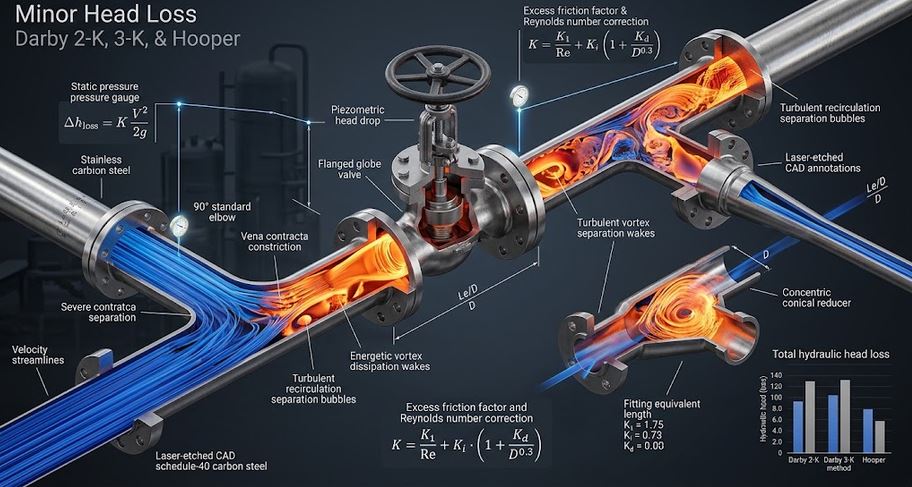
Darby (2001) 3-K Method Formulation:
• Loss Coefficient: K3K = K₁ / Re + K∞ · (1 + Kd / Din0.3)
• Head Loss: hL = K3K · V² / (2 g) [meters per fitting]
• Total Pressure Drop: ΔP = N · ρ · g · hL [kPa]
• Equivalent Pipe Length: Leq = (K3K · D / fdarcy) · N.
• Loss Coefficient: K3K = K₁ / Re + K∞ · (1 + Kd / Din0.3)
• Head Loss: hL = K3K · V² / (2 g) [meters per fitting]
• Total Pressure Drop: ΔP = N · ρ · g · hL [kPa]
• Equivalent Pipe Length: Leq = (K3K · D / fdarcy) · N.
📊 Fitting Loss Results
📊 Output Summary
Total Minor Pressure Drop (4 Fittings)
19.05 kPa (0.191 bar)
Total Head Loss: 1.943 meters | Single K: 1.541
Leq = 25.0 m
Darby 3K Loss Factor (K)
1.541
Per individual fitting
Total Equivalent Length (Leq)
25.0 m
312 × Pipe Diameters
Pipe Flow Velocity (V)
2.49 m/s
Velocity Head = 0.315 m
Flow Regime
TURBULENT
Re = 153034
📈 Loss Factor K vs Reynolds Number Re
📉 Total Pressure Drop ΔP (kPa) vs Flow Rate Q (m³/h)
=================================================================
 THERMOFLUIDCALC — DARBY 3K PIPE FITTINGS LOSS REPORT
=================================================================
Case Title                 : HVAC Chilled Water Distribution Branch Tees
Fitting Selection          : Standard Tee (Flow through Branch) (Quantity = 4)
Piping Dimensions          : ID = 80.0 mm (3.15 inches), Flow Q = 45.00 m3/h
Fluid State                : Density = 1000.0 kg/m3, Viscosity = 0.00130 Pa.s
-----------------------------------------------------------------
DARBY 3K LOSS FACTOR (K)   : 1.5406 per fitting
TOTAL FITTING HEAD LOSS    : 1.943 meters (19.05 kPa)
TOTAL EQUIVALENT LENGTH    : 24.98 meters (Leq)
Pipe Flow Velocity (V)     : 2.487 m/s (Re = 153034)
=================================================================
📘 Calculation Methodology & Darby 3K Standards
Darby 3K vs Classical Crane K-Factors
Classical Crane method assumes constant $K$ values for turbulent flow, causing severe underpredictions in laminar and transitional regimes. Darby 3K incorporates Reynolds scaling $K_1/Re$ and diameter scaling $K_d/D^{0.3}$.
Laminar-to-Turbulent Continuous Transition
Ensures seamless accuracy across HVAC, high-viscosity oil transfer, chemical polymer piping, and municipal potable water distribution networks.
Key Engineering Assumptions
- Commercial steel absolute roughness ($\epsilon = 0.045\,\text{mm}$).
- Darby (2001) empirical coefficients for standard ANSI/ASME fittings.
- Swamee-Jain explicit Darcy friction factor used for equivalent length determination.