
🌪️ Industrial Cyclone Particle Separator Sizer (Leith-Licht)
Size industrial cyclone dust collectors: 50% cut-off particle diameter (d50), fractional grade collection efficiency curve, inlet velocity, and pressure drop across Stairmand, Swift, and Lapple geometries.
⚡ Fortran 90 Engine
Double Precision (IEEE 754)
✓ ISO / ASME Validated
 Fluid Mechanics
📊 Solver Telemetry
● ACTIVE
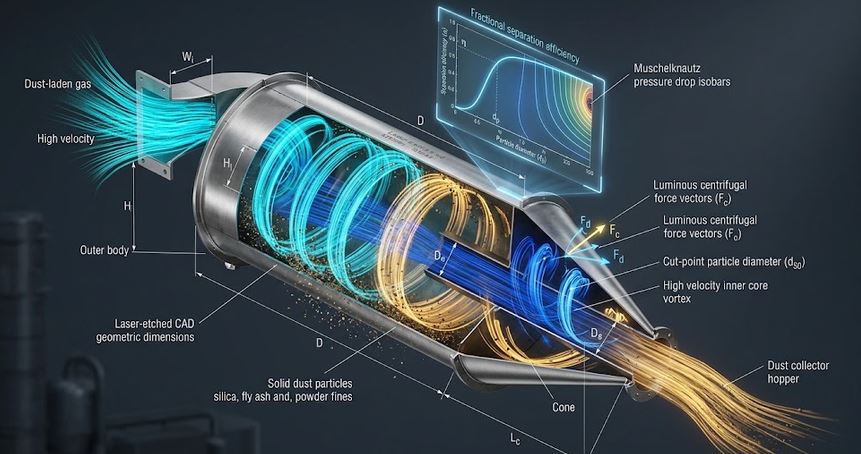
🌪️ Reverse-Flow Cyclone Double Vortex & Centrifugal Separation
Real-time visual simulation: Outer descending dust vortex, inner clean gas vortex core, and hopper collection📝 Configuration & Presets
Lapple & Leith-Licht Formulation:
• Cut-off Diameter: d₅₀ = √[ 9 μg b / (2 π Ne Vin (ρp − ρg)) ] [μm]
• Grade Collection Efficiency: η(dp) = 1 / [ 1 + (d₅₀/dp)² ]
• Pressure Drop: ΔPc = ½ ρg Vin² · NH [mbar]
• Recommended Inlet Velocity: Vin ≈ 15 − 22 m/s.
• Cut-off Diameter: d₅₀ = √[ 9 μg b / (2 π Ne Vin (ρp − ρg)) ] [μm]
• Grade Collection Efficiency: η(dp) = 1 / [ 1 + (d₅₀/dp)² ]
• Pressure Drop: ΔPc = ½ ρg Vin² · NH [mbar]
• Recommended Inlet Velocity: Vin ≈ 15 − 22 m/s.
📊 Separation Results
📊 Output Summary
Grade Collection Efficiency (at 12 μm)
86.27 %
Cut-off Diameter d50: 4.79 μm | Pressure Drop: 7.6 mbar
Vin = 17.1 m/s
Cut-off Diameter (d50)
4.79 μm
50% capture threshold
Cyclone Pressure Drop (ΔP)
7.6 mbar
0.76 kPa
Inlet Duct Gas Velocity
17.15 m/s
Target: 15 - 22 m/s
Overall Cyclone Height
3.60 m
4.0 × Dc
📈 Fractional Grade Efficiency η (%) vs Particle Size dp (μm)
📉 Cyclone Pressure Drop ΔP (mbar) vs Inlet Velocity Vin (m/s)
=================================================================
 THERMOFLUIDCALC — CYCLONE PARTICLE SEPARATOR REPORT
=================================================================
Case Title                 : Cement Kiln Clinker Dust Separation
Cyclone Geometry Standard  : Stairmand High-Efficiency (a=0.5D, b=0.2D, De=0.5D, NH=6.4)
Barrel Diameter (Dc)       : 0.90 m (Inlet = 0.45 m × 0.18 m)
Flow Conditions            : Q = 5000.0 m3/h (1.39 m3/s), Temp = 180.0 C, Pressure = 1.05 bar
Dust Characteristics       : dp = 12.00 microns, Solid Density = 2700.0 kg/m3
-----------------------------------------------------------------
CUT-OFF DIAMETER (d50)     : 4.788 microns
GRADE COLLECTION EFFICIENCY: 86.27 % (at 12.0 um)
CYCLONE PRESSURE DROP      : 7.59 mbar (0.759 kPa)
Inlet Duct Velocity (Vin)  : 17.15 m/s
=================================================================
📘 Calculation Methodology & Cyclone Dedusting Standards
Reverse-Flow Vortex Centrifugal Force
Tangential gas injection creates a powerful double vortex where centrifugal acceleration pushes solid particles outwards to the conical wall, falling into the bottom dust hopper.
Stairmand vs Swift Proportions
Standardized geometric proportions balance collection efficiency against pressure drop ($N_H = 6.4 - 9.2$ velocity heads), ensuring optimal fan electrical consumption.
Key Engineering Assumptions
- Lapple / Leith-Licht semi-empirical grade efficiency formulation.
- Ideal Stokes drag on micron-sized solid dust particles.
- Applicable to cement kilns, biomass boilers, woodworking shops, and spray dryers.