🌊 Fluid Mechanics Reference Guide
Standard formulations, academic textbooks, boundary correlations, and pipe design standards.
📚 Recommended Textbooks
Essential texts for engineering classrooms and industrial consulting portfolios:
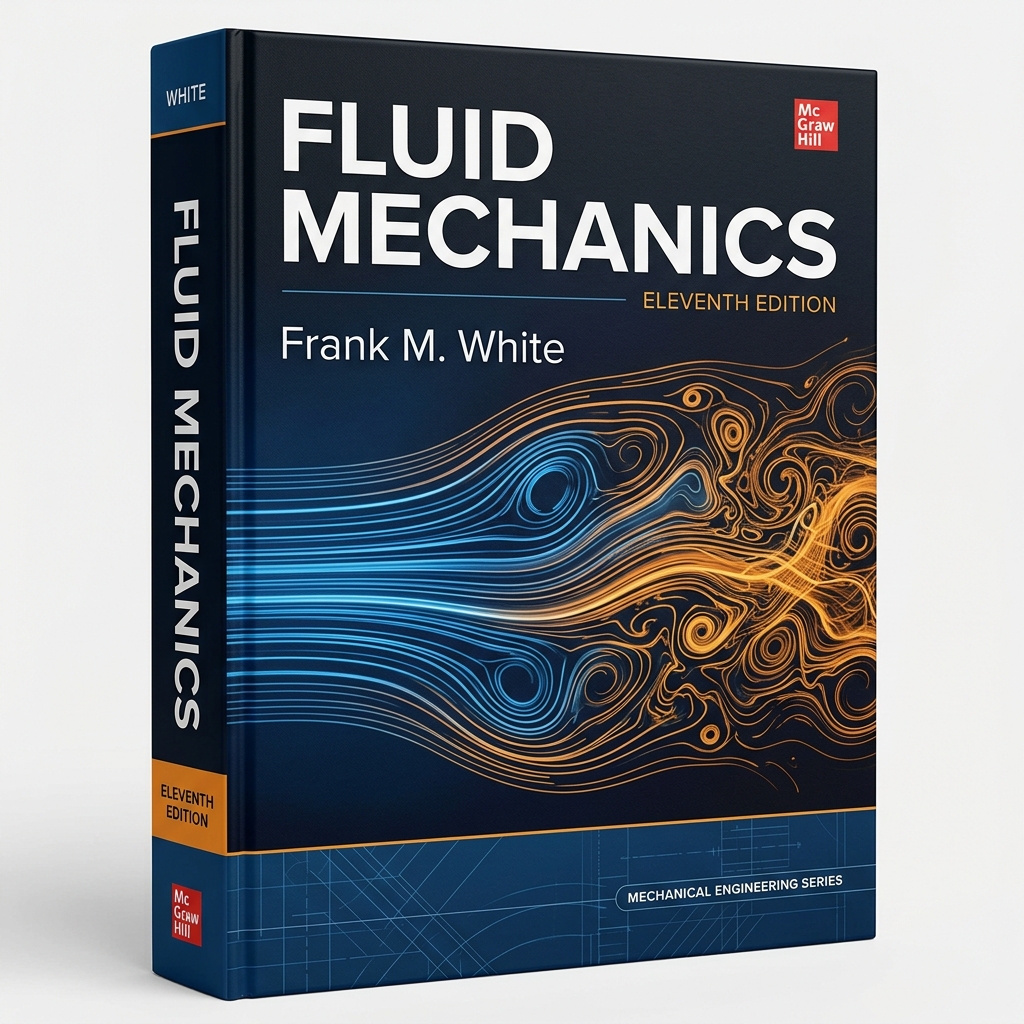
Fluid Mechanics
Frank M. White
The definitive work on boundary layer velocity developments, Colebrook pipe frictions, minor pipe fittings losses, and external drag coefficients over cylinders and spheres.
- Latest Edition: 9th Edition (2021)
- Publisher: McGraw Hill
- ISBN-13: 978-1260575545
- Format: Hardcover / Digital
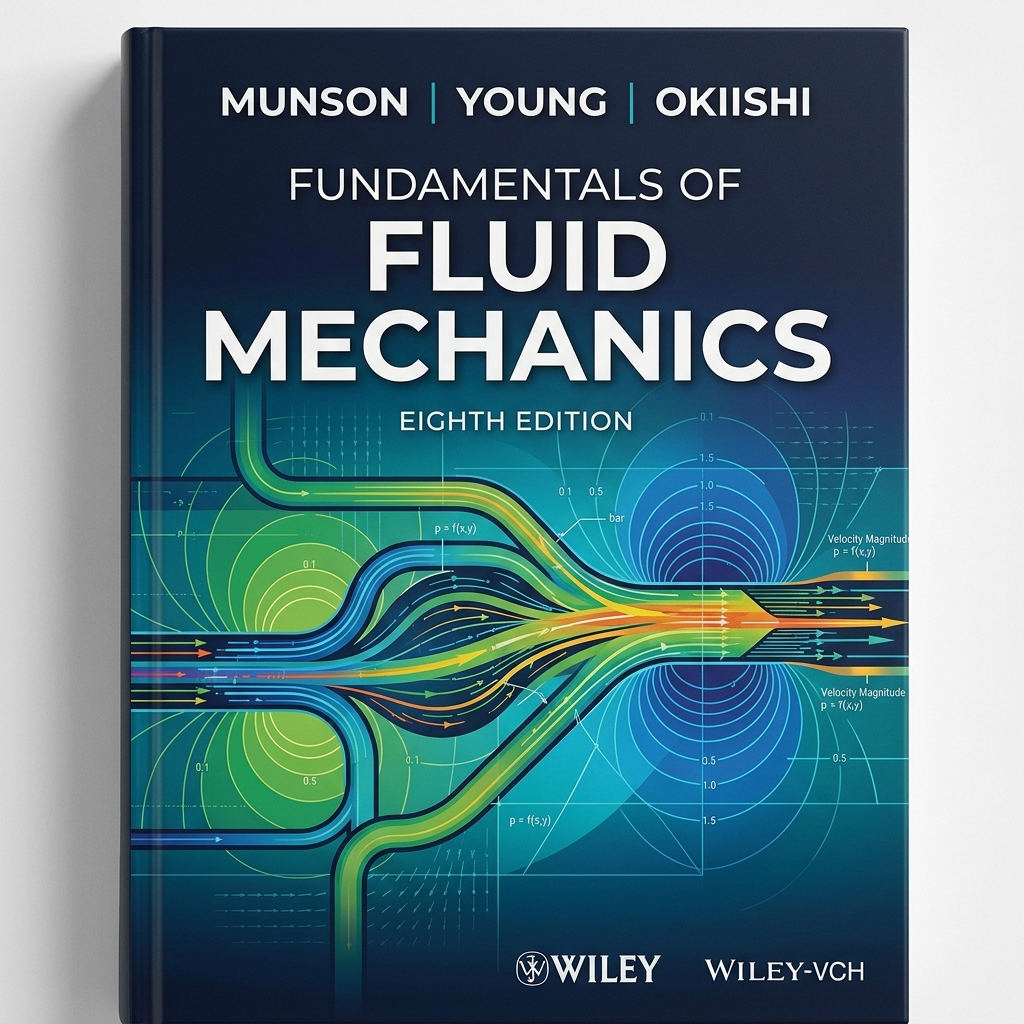
Fundamentals of Fluid Mechanics
Munson, Young, Okiishi, & Huebsch
Acclaimed for its extensive visual animations, step-by-step problem workflows, and real-world fluids applications. Offers highly structured guidelines for piping loops networks and uniform open channel hydraulics.
- Latest Edition: 9th Edition (2021)
- Publisher: John Wiley & Sons
- ISBN-13: 978-1119597308
- Format: Print / WileyPLUS

Introduction to Fluid Mechanics
Fox, McDonald, & Pritchard
Excellent mathematical manual for 1D integral control volumes analysis, compressible sonic gas parameters, shock-waves boundaries, and converging-diverging nozzles behavior.
- Latest Edition: 10th Edition (2020)
- Publisher: John Wiley & Sons
- ISBN-13: 978-1119603207
- Format: Hardcover / e-Book
📄 Key Publications & Papers
| Subject | Reference Paper | Used in Calculator |
|---|---|---|
| Pipe Friction Solvers | Colebrook, C. F. (1939). Turbulent flow in pipes, with particular reference to the transition region between the smooth and rough pipe laws. Journal of the Institution of Civil Engineers. | Pipe Flow Loss Sizer |
| Hardy-Cross Networks | Cross, H. (1936). Analysis of flow in networks of conduits or conductors. University of Illinois Bulletin. | Hardy-Cross Loop Solver |
| Orifice Plate Coefficients | ISO 5167-2 / Reader-Harris, M. J. (1998). The Reader-Harris/Gallagher (1998) equation for the discharge coefficient of orifice plates. ISO Proceedings. | Orifice Flow Meter |
| Drag Coefficients on Spheres | Morrison, F. A. (2013). An introduction to fluid mechanics. Computes Cd over full Re ranges ($Re < 10^6$). | External Flow Drag |
📊 Governing Equations & Correlations
Darcy-Weisbach Equation (Head Loss)
Computes pressure head loss due to friction in a circular pipe line:
Where $f$ is the Darcy friction factor. For laminar flow ($Re_D < 2300$), $f = 64/Re_D$. For turbulent flows, $f$ is solved using Colebrook's equation.
Colebrook-White Correlation (Friction Factor)
An implicit non-linear correlation for turbulent friction factors in commercial rough pipes:
Where $\varepsilon$ is the surface pipe roughness. Solved iteratively in our Fortran solver using a Newton-Raphson scheme with a starting guess from the explicit Haaland correlation.
Manning's Equation (Open Channel Flow)
Predicts uniform gravity-driven flow velocity in open conduits:
Where $n$ is the Manning roughness coefficient, $S_0$ is the bed slope, $R_h = A_c / P_w$ is the hydraulic radius, and $k = 1.0$ (SI units) or $1.486$ (Imperial units).
🧠 Pedagogical Notes
1. Pipe Flow Transition Limits
The transition boundary between laminar and turbulent states in a circular pipe is governed by the Reynolds number:
- Laminar Flow: $Re_D < 2300$. Viscous forces dominate, resulting in a parabolic velocity profile.
- Transition Zone: $2300 \le Re_D \le 4000$. Flow is highly unstable, fluctuating between laminar and turbulent states.
- Turbulent Flow: $Re_D > 4000$. Inertial forces dominate, resulting in chaotic eddy structures and a flatter velocity profile.
2. Boundary Layer Thickness Parameters
The thickness of a boundary layer is characterized using three mathematical integrals:
- Disturbance Thickness ($\delta$): Physical distance where $u(y) = 0.99 U_\infty$.
- Displacement Thickness ($\delta^*$): Distance by which the external inviscid flow is displaced outward due to velocity deficits: $$\delta^* = \int_{0}^{\infty} \left( 1 - \frac{u}{U_\infty} \right) dy$$
- Momentum Thickness ($\theta$): Loss of momentum flux in the boundary layer: $$\theta = \int_{0}^{\infty} \frac{u}{U_\infty} \left( 1 - \frac{u}{U_\infty} \right) dy$$
🌐 Academic & Online Resources
- NPTEL Course Portal: Free online video lectures on fluid mechanics and boundary layers by IIT professors.
- eFluids: Visual resources and images detailing boundary layer separation and turbulence transition.
💬 Forums & Communities
- Eng-Tips Forums (Fluid/Piping): eng-tips.com - Professional discussions on piping hydraulic losses, control valves, and water hammer.
- Reddit: r/FluidMechanics and r/civilengineering.