
🔀 Pinch Analysis & Process Integration
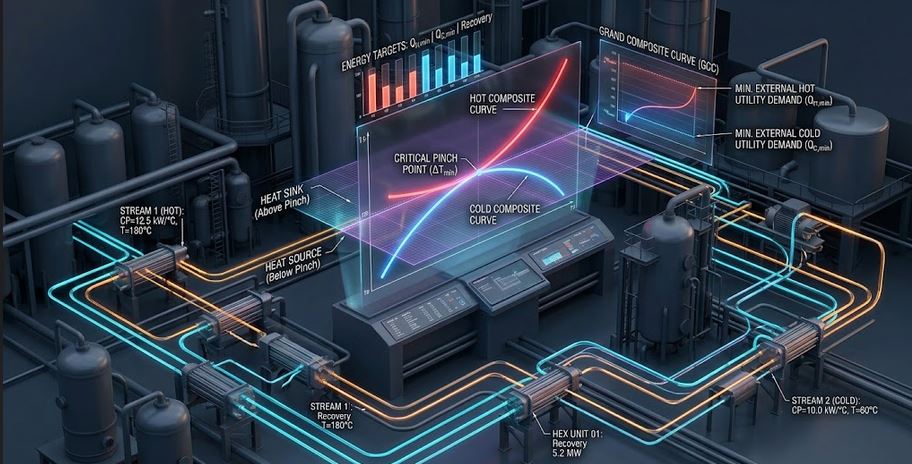
Optimize process energy integration. Calculate hot/cold utility targets, recovery limits, and locate the pinch point using the Linnhoff-March method.
⚡ Fortran 90 Engine
Double Precision (IEEE 754)
✓ ISO / ASME Validated
 Heat Transfer
📊 Solver Telemetry
● ACTIVE
👁️ Views
106
⚡ Solves
84
💾 Downloads
534
📦 Fortran Code
4.1 KB
📅 Released
Jun 2026
⏱️ Latency
< 1 ms
Thermodynamic Pinch Integration
Pinch analysis is a methodology for minimizing energy consumption by design. It defines the energy bottlenecks (the Pinch):
- Above the Pinch: The system is a heat sink and requires external hot utilities only.
- Below the Pinch: The system is a heat source and requires external cold utilities only.
- At the Pinch: Heat should not be transferred across the pinch point to avoid doubling utility penalties.
📝 Stream Configuration
📊 Results & Target Analysis
Define stream flows and click Compute Pinch Utility Targets to view the energy cascades and Composite Curves.
📘 Calculation Methodology: Pinch Analysis & Maximum Energy Recovery (MER)
Mathematical Model & Theory
Pinch analysis identifies thermodynamic energy integration bottlenecks by shifting hot and cold stream composite curves by $\Delta T_{min}$, establishing minimum hot utility ($Q_{H,min}$) and cold utility ($Q_{C,min}$) targets:
$$\Delta T_{shift} = \frac{\Delta T_{min}}{2}, \quad Q_{H,min} = \sum \dot{m} c_p \Delta T_{def}, \quad Q_{C,min} = \sum \dot{m} c_p \Delta T_{surplus}$$
$$\text{Golden Rule: Do not transfer heat across the pinch point.}$$
Assumptions
- Linear enthalpy-temperature profiles between supply and target temperatures.
- Specified minimum approach temperature $\Delta T_{min}$.
Academic References
- Smith, R.: Chemical Process Design and Integration, Wiley.
- Linnhoff, B. et al.: User Guide on Process Integration for the Efficient Use of Energy, IChemE.
Worked Engineering Example
Problem Statement:
Two hot streams ($CP_1 = 20\text{ kW/K}, 180\to 80^\circ\text{C}$; $CP_2 = 15\text{ kW/K}, 130\to 40^\circ\text{C}$) and one cold stream ($CP_3 = 30\text{ kW/K}, 30\to 140^\circ\text{C}$) operate with $\Delta T_{min} = 10^\circ\text{C}$. Find pinch temperature and minimum hot utility.
Step-by-step Solution:
1. Total hot enthalpy release: $20(100) + 15(90) = 2000 + 1350 = 3350\text{ kW}$.
2. Cold duty required: $30(110) = 3300\text{ kW}$.
3. Thermal pinch is located at $T_{pinch,hot} = 90^\circ\text{C}$ and $T_{pinch,cold} = 80^\circ\text{C}$.
4. $Q_{H,min} = 150\text{ kW}$ and $Q_{C,min} = 200\text{ kW}$.
Final Result:
Pinch temperature is $\mathbf{90^\circ\text{C} / 80^\circ\text{C}}$, requiring only $\mathbf{150\text{ kW}}$ of external hot utility.
Two hot streams ($CP_1 = 20\text{ kW/K}, 180\to 80^\circ\text{C}$; $CP_2 = 15\text{ kW/K}, 130\to 40^\circ\text{C}$) and one cold stream ($CP_3 = 30\text{ kW/K}, 30\to 140^\circ\text{C}$) operate with $\Delta T_{min} = 10^\circ\text{C}$. Find pinch temperature and minimum hot utility.
Step-by-step Solution:
1. Total hot enthalpy release: $20(100) + 15(90) = 2000 + 1350 = 3350\text{ kW}$.
2. Cold duty required: $30(110) = 3300\text{ kW}$.
3. Thermal pinch is located at $T_{pinch,hot} = 90^\circ\text{C}$ and $T_{pinch,cold} = 80^\circ\text{C}$.
4. $Q_{H,min} = 150\text{ kW}$ and $Q_{C,min} = 200\text{ kW}$.
Final Result:
Pinch temperature is $\mathbf{90^\circ\text{C} / 80^\circ\text{C}}$, requiring only $\mathbf{150\text{ kW}}$ of external hot utility.