
🗼 Cooling Tower Design
Design and rate wet cooling towers using the Merkel integration method with Simpson's 5-point rule.
⚡ Fortran 90 Engine
Double Precision (IEEE 754)
✓ ISO / ASME Validated
 Heat Transfer
📊 Solver Telemetry
● ACTIVE
👁️ Views
3,957
⚡ Solves
3,145
💾 Downloads
609
📦 Fortran Code
4.1 KB
📅 Released
Jun 2026
⏱️ Latency
< 1 ms
Sizing Inputs
Calculation Results
Results and visual trends will be displayed here upon completion of the computation.
Calculation Methodology
Mathematical Model & Theory
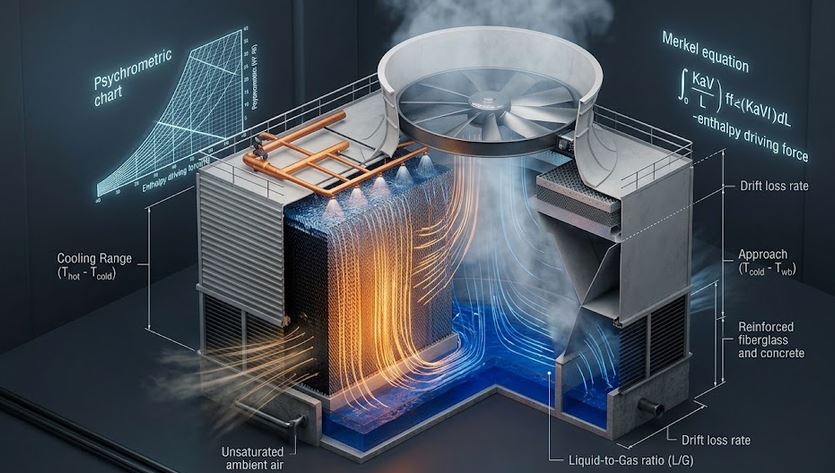
Wet cooling towers transfer heat by sensible heating of air and latent heat from water evaporation. The classical Merkel theory assumes that water is cooled by a driving force proportional to moist air enthalpy differences:
$$\frac{KaV}{L} = \int_{T_{w,out}}^{T_{w,in}} \frac{c_{p,w} \cdot dT_w}{h_{s,w} - h_a}$$
Where:
- $KaV/L$: Merkel Number (dimensionless tower characteristics).
- $h_{s,w}$: Enthalpy of saturated air at local water temperature $T_w$ [kJ/kg].
- $h_a$: Local enthalpy of moist air bulk [kJ/kg].
Air-side enthalpy rise is related by the energy balance:
$$h_{a,local} = h_{a,in} + \frac{L}{G} \cdot c_{p,w} (T_{w,local} - T_{w,out})$$
Moist air saturation pressure is computed using Antoine-type relations:
$$P_{vs} = 610.78 \cdot \exp\left( \frac{17.27 \cdot T_w}{T_w + 237.3} \right) \text{ Pa}$$
Academic References:
- Merkel, F. (1925). "Verdunstungskuehlung" (Evaporative Cooling), VDI-Forschungsarbeiten, No. 275, Berlin.
- Kloppers, J. C., & Kröger, D. G. (2005). "A critical investigation into the Merkel, e-NTU and Poppe methods of cooling tower design," International Journal of Heat and Mass Transfer.
- Cooling Technology Institute (CTI) standards, Acceptance Test Code ATC-105.
Worked Engineering Example
Problem Statement:
Calculate design parameters for an HVAC cooling tower. Hot water enters at $40$°C and must cool to $32$°C. The ambient wet bulb temperature is $27$°C. The water flow rate is $10$ kg/s, design $L/G$ is $1.5$, and fill height is $2$ m. Estimate the Merkel characteristics and evaporation water loss rate.
Step-by-Step Solution:
1. Identify Range & Approach:
$$\text{Range} = 40 - 32 = 8^\circ\text{C}$$ $$\text{Approach} = 32 - 27 = 5^\circ\text{C}$$
2. Setup numerical Merkel integral (Simpson 5-point):
Integrate from $T_w = 32$°C to $40$°C in steps of $dT = 2$°C. - Inlet air bulk enthalpy at $T_{wb}=27$°C: $h_{a,in} \approx 85.0$ kJ/kg. - For $T_w = 32$°C: $h_s(32^\circ\text{C}) \approx 110.9$ kJ/kg, $h_a = h_{a,in} \implies \text{driving force} = 25.9$ kJ/kg. - For $T_w = 40$°C: $h_s(40^\circ\text{C}) \approx 166.2$ kJ/kg, $h_a(40) = 85.0 + 1.5 \cdot 4.186 \cdot 8 \approx 135.2$ kJ/kg $\implies \text{driving force} = 31.0$ kJ/kg. Summing points yields Merkel Number: $$KaV/L \approx 1.25$$
3. Calculate Rejected Heat and Evaporation Loss:
$$Q_{rej} = \dot{m}_w \cdot c_{p,w} \cdot (T_{w,in} - T_{w,out})$$ $$Q_{rej} = 10 \text{ kg/s} \cdot 4.186 \text{ kJ/kgK} \cdot 8\text{ K} = 334.9 \text{ kW}$$ $$m_{evap} = \frac{Q_{rej}}{h_{fg}} = \frac{334.9 \text{ kW}}{2450 \text{ kJ/kg}} \approx 0.137 \text{ kg/s}$$ $$m_{makeup} \approx 1.3 \cdot m_{evap} = 0.178 \text{ kg/s}$$
Calculate design parameters for an HVAC cooling tower. Hot water enters at $40$°C and must cool to $32$°C. The ambient wet bulb temperature is $27$°C. The water flow rate is $10$ kg/s, design $L/G$ is $1.5$, and fill height is $2$ m. Estimate the Merkel characteristics and evaporation water loss rate.
Step-by-Step Solution:
1. Identify Range & Approach:
$$\text{Range} = 40 - 32 = 8^\circ\text{C}$$ $$\text{Approach} = 32 - 27 = 5^\circ\text{C}$$
2. Setup numerical Merkel integral (Simpson 5-point):
Integrate from $T_w = 32$°C to $40$°C in steps of $dT = 2$°C. - Inlet air bulk enthalpy at $T_{wb}=27$°C: $h_{a,in} \approx 85.0$ kJ/kg. - For $T_w = 32$°C: $h_s(32^\circ\text{C}) \approx 110.9$ kJ/kg, $h_a = h_{a,in} \implies \text{driving force} = 25.9$ kJ/kg. - For $T_w = 40$°C: $h_s(40^\circ\text{C}) \approx 166.2$ kJ/kg, $h_a(40) = 85.0 + 1.5 \cdot 4.186 \cdot 8 \approx 135.2$ kJ/kg $\implies \text{driving force} = 31.0$ kJ/kg. Summing points yields Merkel Number: $$KaV/L \approx 1.25$$
3. Calculate Rejected Heat and Evaporation Loss:
$$Q_{rej} = \dot{m}_w \cdot c_{p,w} \cdot (T_{w,in} - T_{w,out})$$ $$Q_{rej} = 10 \text{ kg/s} \cdot 4.186 \text{ kJ/kgK} \cdot 8\text{ K} = 334.9 \text{ kW}$$ $$m_{evap} = \frac{Q_{rej}}{h_{fg}} = \frac{334.9 \text{ kW}}{2450 \text{ kJ/kg}} \approx 0.137 \text{ kg/s}$$ $$m_{makeup} \approx 1.3 \cdot m_{evap} = 0.178 \text{ kg/s}$$