
📊 Compact Heat Exchanger
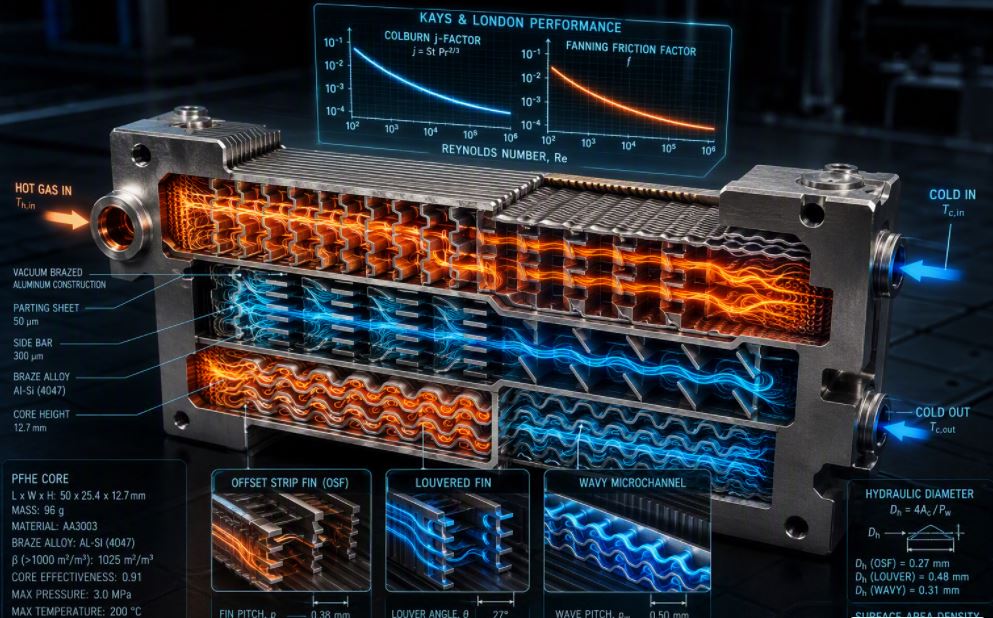
Colburn j and friction f factors for plain, louvered, offset strip, and wavy fins in compact heat exchangers.
⚡ Fortran 90 Engine
Double Precision (IEEE 754)
✓ ISO / ASME Validated
 Heat Transfer
📊 Solver Telemetry
● ACTIVE
👁️ Views
3,640
⚡ Solves
2,875
💾 Downloads
475
📦 Fortran Code
4.1 KB
📅 Released
Jun 2026
⏱️ Latency
< 1 ms
Rating Inputs
Calculation Results
Results and visual trends will be displayed here upon completion of the computation.
Calculation Methodology
Mathematical Model & Theory
Compact heat exchangers utilize intricate fin arrays to maximize heat transfer area per unit volume. The heat transfer performance is characterized by the Colburn $j$-factor:
$$j = \text{St} \cdot \text{Pr}^{2/3} = \frac{h_{air}}{G \cdot c_p} \cdot \text{Pr}^{2/3}$$
Kays & London compiled correlations for different surface geometries. For offset strip fins, the correlations relate to aspect ratios and spacing, commonly simplified as:
$$j = 0.652 \cdot Re_{Dh}^{-0.54}, \quad f = 1.12 \cdot Re_{Dh}^{-0.36}$$
The heat transfer coefficient is calculated via the Nusselt number:
$$Nu = j \cdot Re_{Dh} \cdot Pr^{1/3}, \quad h_{air} = \frac{Nu \cdot k_{air}}{D_h}$$
For cross-flow arrangements with both streams unmixed, the effectiveness is defined as:
$$\epsilon = 1 - \exp\left[ \frac{NTU^{0.78}}{C_r} \left( \exp(-C_r \cdot NTU^{0.22}) - 1 \right) \right]$$
Academic References:
- Kays, W. M., & London, A. L. (1984). Compact Heat Exchangers (3rd ed.). McGraw-Hill.
- Manglik, R. M., & Bergles, A. E. (1995). "Heat transfer and pressure drop correlations for the rectangular offset strip fin compact heat exchanger," Journal of Heat Transfer, 117(2), 461-467.
- Shah, R. K., & Sekulić, D. P. (2003). Fundamentals of Heat Exchanger Design.
Worked Engineering Example
Problem Statement:
An aircraft intercooler uses a compact core with offset strip fins. The core hydraulic diameter $D_h$ is $0.003$ m, area density $\alpha$ is $886$ m²/m³, and total surface area $A_{tot}$ is $10$ m². Air flows at $Re = 800$ ($Pr = 0.71$). Hot gas enters at $90$°C ($C_h = 2000$ W/K) and cold air enters at $25$°C ($C_c = 1500$ W/K). Sizing length is $0.05$ m. Calculate the heat transfer duty $Q$.
Step-by-Step Solution:
1. Calculate $j$ and $f$ factors:
Using the offset strip fin correlation: $$j = 0.652 \cdot (800)^{-0.54} \approx 0.0176$$ $$f = 1.12 \cdot (800)^{-0.36} \approx 0.101$$
2. Find heat transfer coefficient:
$$Nu = 0.0176 \cdot 800 \cdot (0.71)^{1/3} \approx 12.57$$ Assuming $k_{air} \approx 0.026$ W/mK: $$h_{air} = \frac{12.57 \cdot 0.026}{0.003} \approx 109 \text{ W/m²K}$$
3. Determine effectiveness ($\epsilon$):
$$C_{min} = C_c = 1500 \text{ W/K}, \quad C_{max} = C_h = 2000 \text{ W/K} \implies C_r = 0.75$$ $$NTU = \frac{h_{air} \cdot A_{tot}}{C_{min}} = \frac{109 \cdot 10}{1500} \approx 0.727$$ $$\epsilon = 1 - \exp\left[ \frac{0.727^{0.78}}{0.75} \left( \exp(-0.75 \cdot 0.727^{0.22}) - 1 \right) \right] \approx 0.650 \text{ (or } 65.0\%\text{)}$$
4. Calculate Heat Transfer ($Q$):
$$Q = \epsilon \cdot C_{min} (T_{h,in} - T_{c,in})$$ $$Q = 0.650 \cdot 1500 \cdot (90 - 25) = 63,375 \text{ W} = 63.38 \text{ kW}$$
An aircraft intercooler uses a compact core with offset strip fins. The core hydraulic diameter $D_h$ is $0.003$ m, area density $\alpha$ is $886$ m²/m³, and total surface area $A_{tot}$ is $10$ m². Air flows at $Re = 800$ ($Pr = 0.71$). Hot gas enters at $90$°C ($C_h = 2000$ W/K) and cold air enters at $25$°C ($C_c = 1500$ W/K). Sizing length is $0.05$ m. Calculate the heat transfer duty $Q$.
Step-by-Step Solution:
1. Calculate $j$ and $f$ factors:
Using the offset strip fin correlation: $$j = 0.652 \cdot (800)^{-0.54} \approx 0.0176$$ $$f = 1.12 \cdot (800)^{-0.36} \approx 0.101$$
2. Find heat transfer coefficient:
$$Nu = 0.0176 \cdot 800 \cdot (0.71)^{1/3} \approx 12.57$$ Assuming $k_{air} \approx 0.026$ W/mK: $$h_{air} = \frac{12.57 \cdot 0.026}{0.003} \approx 109 \text{ W/m²K}$$
3. Determine effectiveness ($\epsilon$):
$$C_{min} = C_c = 1500 \text{ W/K}, \quad C_{max} = C_h = 2000 \text{ W/K} \implies C_r = 0.75$$ $$NTU = \frac{h_{air} \cdot A_{tot}}{C_{min}} = \frac{109 \cdot 10}{1500} \approx 0.727$$ $$\epsilon = 1 - \exp\left[ \frac{0.727^{0.78}}{0.75} \left( \exp(-0.75 \cdot 0.727^{0.22}) - 1 \right) \right] \approx 0.650 \text{ (or } 65.0\%\text{)}$$
4. Calculate Heat Transfer ($Q$):
$$Q = \epsilon \cdot C_{min} (T_{h,in} - T_{c,in})$$ $$Q = 0.650 \cdot 1500 \cdot (90 - 25) = 63,375 \text{ W} = 63.38 \text{ kW}$$