
🔴 Convection Over a Sphere
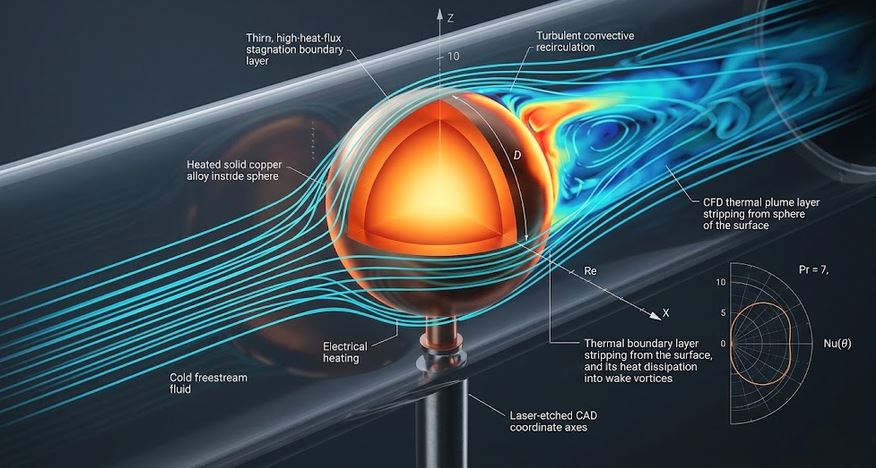
External forced convection heat transfer coefficient and rate over a sphere using Whitaker and Ranz-Marshall correlations.
 Heat Transfer
Parameters Setup
Results & Curves
Configure and run the calculator to see the computed results and velocity sweep curve.
Calculation Methodology
Mathematical Model & Theory
Convective heat transfer over a spherical object is evaluated using two primary models:
1. Whitaker Correlation:
$$\text{Nu}_D = 2 + \left(0.4 \text{Re}_D^{1/2} + 0.06 \text{Re}_D^{2/3}\right) \text{Pr}^{0.4} \left(\frac{\mu}{\mu_s}\right)^{1/4}$$
where fluid properties (except $\mu_s$) are evaluated at the free-stream temperature $T_\infty$.
2. Ranz-Marshall Correlation:
$$\text{Nu}_D = 2 + 0.6 \text{Re}_D^{1/2} \text{Pr}^{1/3}$$
This correlation is a classical simplification widely used for droplets and evaporating sprays.
Academic References:
- Incropera, F. P., & DeWitt, D. P. (2011). Fundamentals of Heat and Mass Transfer. 7th Edition, John Wiley & Sons.
- Whitaker, S. (1972). Forced Convection Heat Transfer Correlations for Flow in Pipes, Past Flat Plates, Single Cylinders, Single Spheres, and for Flow in Packed Beds and Tube Bundles. AIChE J.
Worked Engineering Example
Air at $25^\circ\text{C}$ flows at $5.0\text{ m/s}$ past a $50\text{ mm}$ sphere maintained at $100^\circ\text{C}$. Find the convective heat loss ($T_\infty = 25^\circ\text{C}$).
Step-by-step Solution:
1. Evaluate air properties at free-stream temp $25^\circ\text{C}$:
- $\rho = 1.177\text{ kg/m}^3, \mu = 1.85 \times 10^{-5}\text{ Pa·s}, k = 0.0263\text{ W/m·K}, Pr = 0.71$.
- At $T_s = 100^\circ\text{C}$, $\mu_s \approx 2.18 \times 10^{-5}\text{ Pa·s}$.
2. Calculate Reynolds number:
$$\text{Re}_D = \frac{\rho V D}{\mu} = \frac{1.177 \times 5.0 \times 0.05}{1.85 \times 10^{-5}} = 15,905$$ 3. Evaluate Nusselt number via Whitaker correlation:
$$\text{Nu}_D = 2 + \left[0.4 \times (15,905)^{1/2} + 0.06 \times (15,905)^{2/3}\right] \times (0.71)^{0.4} \times \left(\frac{1.85}{2.18}\right)^{1/4}$$ $$\text{Nu}_D = 2 + \left[50.4 + 37.9\right] \times 0.87 \times 0.96 = 75.8$$ 4. Convection coefficient $h$:
$$h = \frac{\text{Nu}_D k}{D} = \frac{75.8 \times 0.0263}{0.05} = 39.9\text{ W/m}^2\text{K}$$ 5. Surface area $A_s = \pi D^2 = \pi \times 0.05^2 = 0.00785\text{ m}^2$. Total heat loss:
$$Q = h A_s (T_s - T_\infty) = 39.9 \times 0.00785 \times (100-25) = 23.5\text{ W}$$