
📐 Non-Circular Duct & Annulus Convection
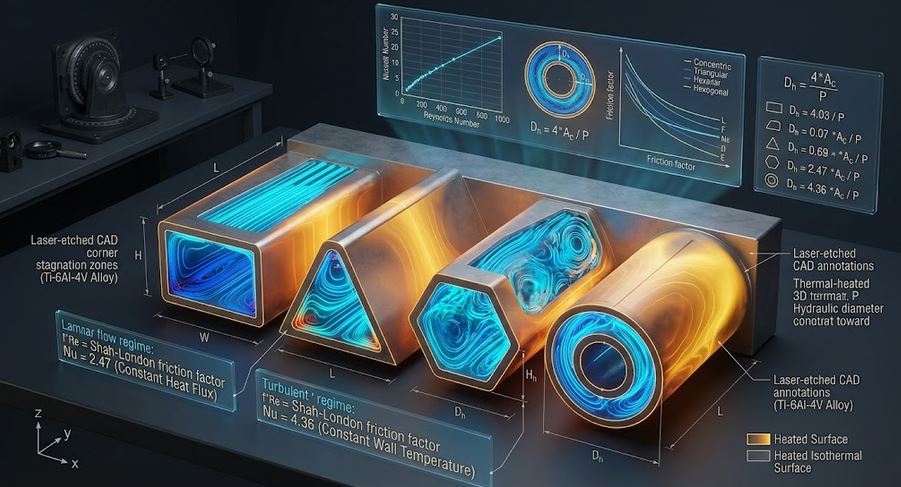
Forced convection in rectangular and equilateral triangular ducts, and concentric annuli using hydraulic diameter.
 Convection
Parameters Setup
Results & Curves
Configure and run the calculator to see the computed results and velocity sweep curve.
Calculation Methodology
Mathematical Model & Theory
Forced convection in non-circular ducts uses the hydraulic diameter:
$$D_h = \frac{4 A_c}{P}$$
- Laminar Regime ($\text{Re} \le 2300$): Nusselt numbers are constants interpolated from numerical geometry tables (Incropera Table 8.1 & 8.3) based on aspect ratio (rectangular) or radius ratio (annular).
- Turbulent Regime ($\text{Re} > 2300$): Gnielinski correlation is employed:
$$\text{Nu} = \frac{(f/8)(\text{Re} - 1000)\text{Pr}}{1 + 12.7\sqrt{f/8}\left(\text{Pr}^{2/3} - 1\right)}$$
where friction factor $f$ is:
$$f = (0.790 \ln \text{Re} - 1.64)^{-2}$$
Academic References:
- Incropera, F. P., & DeWitt, D. P. (2011). Fundamentals of Heat and Mass Transfer. 7th Edition, John Wiley & Sons.
- Gnielinski, V. (1976). New Equations for Heat and Mass Transfer in Turbulent Pipe and Channel Flow. Int. Chem. Eng.
Worked Engineering Example
Air at $25^\circ\text{C}$ flows at $3.0\text{ m/s}$ through a rectangular duct of $100\text{ mm} \times 50\text{ mm}$ wetted walls at $80^\circ\text{C}$. Find the convection coefficient ($T_f = 52.5^\circ\text{C}$).
Step-by-step Solution:
1. Evaluate air properties at film temp:
- $\rho = 1.177\text{ kg/m}^3, \mu = 1.85 \times 10^{-5}\text{ Pa·s}, k = 0.0263\text{ W/m·K}, Pr = 0.71$.
2. Calculate wetted perimeter, wetted area, and hydraulic diameter:
- $A_c = 0.1 \times 0.05 = 0.005\text{ m}^2$
- $P = 2 \times (0.1 + 0.05) = 0.3\text{ m}$
- $D_h = 4 \times 0.005 / 0.3 = 0.0667\text{ m}$
3. Calculate Reynolds number:
$$\text{Re} = \frac{\rho V D_h}{\mu} = \frac{1.177 \times 3.0 \times 0.0667}{1.85 \times 10^{-5}} = 12,735 \quad \text{(Turbulent)}$$ 4. Compute friction factor and Nusselt number (Gnielinski):
- $f = (0.790 \ln(12,735) - 1.64)^{-2} = 0.029$
$$\text{Nu} = \frac{(0.029/8) \times (12,735 - 1000) \times 0.71}{1 + 12.7\sqrt{0.029/8}(0.71^{2/3} - 1)} = 35.8$$ 5. Calculate $h$:
$$h = \frac{\text{Nu} k}{D_h} = \frac{35.8 \times 0.0263}{0.0667} = 14.1\text{ W/m}^2\text{K}$$