
📏 Thermal Entry Length Calculator
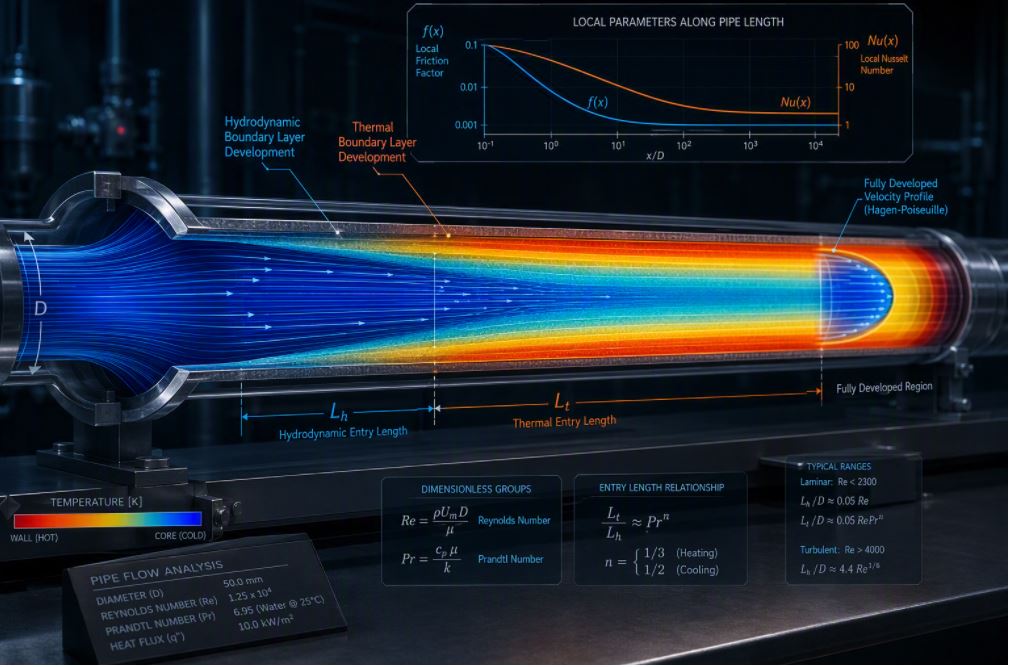
Hydrodynamic and thermal boundary layer entry length analysis in circular tubes under laminar and turbulent conditions.
 Heat Transfer
Parameters Setup
Results & Curves
Configure and run the calculator to see the computed results and local length sweep curve.
Calculation Methodology
Mathematical Model & Theory
The hydrodynamic entry length ($L_h$) and thermal entry length ($L_t$) for laminar flow ($\text{Re} \le 2300$) are calculated as: $$L_h \approx 0.05 \text{Re} D, \quad L_t = L_h \text{Pr}$$ For turbulent flows, both boundary layers develop much quicker due to eddy mixing: $$L_h \approx L_t \approx 10 D$$ In the laminar developing region, the local Nusselt number under constant wall temperature (UWT) is given by the Hausen correlation: $$\text{Nu}_x = 3.66 + \frac{0.0668 \text{Gz}_x}{1 + 0.04 \text{Gz}_x^{2/3}}$$ where $\text{Gz}_x = (D/x)\text{Re}\text{Pr}$ is the local Graetz number.
Academic References:
- Incropera, F. P., & DeWitt, D. P. (2011). Fundamentals of Heat and Mass Transfer. 7th Edition, John Wiley & Sons.
- Hausen, H. (1943). Darstellung des Wärmeüberganges in Rohren durch verallgemeinerte Potenzbeziehungen. VDI Z.
Worked Engineering Example
Air at $25^\circ\text{C}$ enters a $25\text{ mm}$ diameter tube at $0.5\text{ m/s}$. The wall is kept at $80^\circ\text{C}$. Find the local heat transfer coefficient at $x = 0.1\text{ m}$ ($T_f = 52.5^\circ\text{C}$).
Step-by-step Solution:
1. Evaluate air properties at film temperature:
- $\nu = 1.83 \times 10^{-5}\text{ m}^2\text{/s}, k = 0.0275\text{ W/m·K}, Pr = 0.70$.
2. Calculate Reynolds number:
$$\text{Re} = \frac{V_0 D}{\nu} = \frac{0.5 \times 0.025}{1.83 \times 10^{-5}} = 683 \quad \text{(Laminar)}$$ 3. Compute Graetz number at $x = 0.1\text{ m}$:
$$\text{Gz}_x = \frac{D}{x} \text{Re} \text{Pr} = \frac{0.025}{0.1} \times 683 \times 0.7 = 119.5$$ 4. Compute Nusselt number using Hausen correlation:
$$\text{Nu}_x = 3.66 + \frac{0.0668 \times 119.5}{1 + 0.04 \times (119.5)^{2/3}} = 3.66 + \frac{7.98}{1 + 0.97} = 7.71$$ 5. Convective coefficient $h_x$:
$$h_x = \frac{\text{Nu}_x k}{D} = \frac{7.71 \times 0.0275}{0.025} = 8.48\text{ W/m}^2\text{K}$$