
🚪 Free Convection in Enclosures
Natural convection in rectangular cavities (vertical and horizontal) and concentric cylinders/spheres using Catton and Globe-Dropkin correlations.
 Convection
Parameters Setup
Results & Curves
Configure and run the calculator to see the computed results and interactive sweep curve.
Calculation Methodology
Mathematical Model & Theory
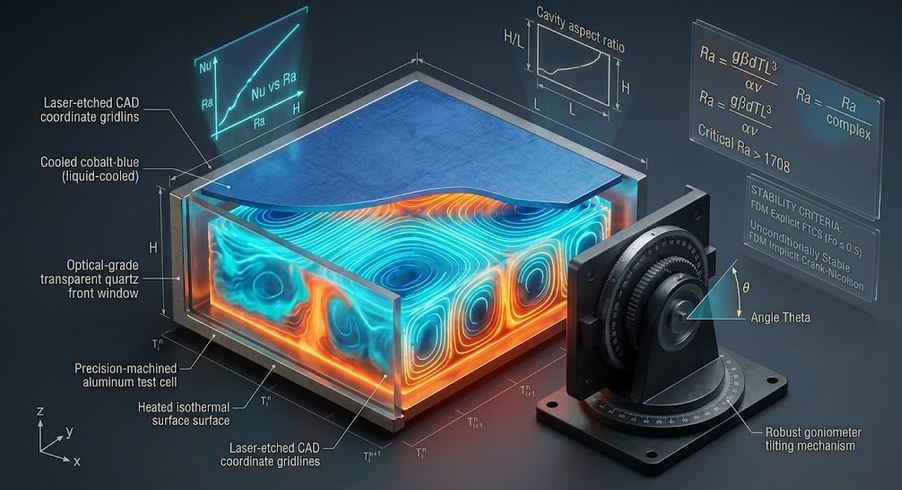
Natural convection in enclosures is governed by Rayleigh number $\text{Ra}_L = g \beta \Delta T L^3 / (\nu \alpha)$. Different correlations apply:
- Vertical Rectangular Cavities: Catton's correlations based on aspect ratio $H/L$:
$$\text{Nu} = C(Pr) \text{Ra}^{0.28-0.29} (H/L)^{-0.25-0.30}$$
- Horizontal Cavities (Hot Bottom): Globe-Dropkin correlation:
$$\text{Nu} = 0.069 \text{Ra}^{1/3} \text{Pr}^{0.074}$$
- Concentric Annulus: Raithby & Hollands formulation:
$$\frac{k_{eff}}{k} = 0.386 \left(\frac{\text{Pr}}{0.861 + \text{Pr}}\right)^{1/4} \text{Ra}_L^{1/4}$$
Academic References:
- Incropera, F. P., & DeWitt, D. P. (2011). Fundamentals of Heat and Mass Transfer. 7th Edition, John Wiley & Sons.
- Catton, I. (1978). Natural Convection in Enclosures. Proceedings of the 6th International Heat Transfer Conference.
Worked Engineering Example
A vertical double-pane window has a gap $L = 20\text{ mm}$ and height $H = 0.5\text{ m}$. The inner glass is at $60^\circ\text{C}$ and the outer glass is at $20^\circ\text{C}$. Find the heat transfer coefficient of the air slot ($T_f = 40^\circ\text{C}$).
Step-by-step Solution:
1. Evaluate properties at $40^\circ\text{C}$:
- Air: $\nu = 1.7 \times 10^{-5}\text{ m}^2\text{/s}$, $\alpha = 2.4 \times 10^{-5}\text{ m}^2\text{/s}$, $Pr = 0.707$, $\beta = 1/313.15 = 0.00319\text{ K}^{-1}$, $k = 0.0271\text{ W/m·K}$.
2. Calculate Rayleigh number $\text{Ra}_L$:
$$\text{Ra}_L = \frac{9.81 \times 0.00319 \times (60-20) \times 0.02^3}{1.7 \times 10^{-5} \times 2.4 \times 10^{-5}} = 24,534$$ 3. Evaluate aspect ratio and choose Catton correlation ($H/L = 0.5/0.02 = 25$):
Since $H/L > 10$, we use: $$\text{Nu} = 0.42 \text{Ra}_L^{0.25} \text{Pr}^{0.012} (H/L)^{-0.3}$$ $$\text{Nu} = 0.42 \times (24,534)^{0.25} \times (0.707)^{0.012} \times (25)^{-0.3} = 0.42 \times 12.52 \times 0.996 \times 0.38 = 1.99$$ 4. Convection coefficient $h_{eff}$:
$$h_{eff} = \frac{\text{Nu} k}{L} = \frac{1.99 \times 0.0271}{0.02} = 2.70\text{ W/m}^2\text{K}$$