
🌀 Flow Over Cylinder in Cross Flow
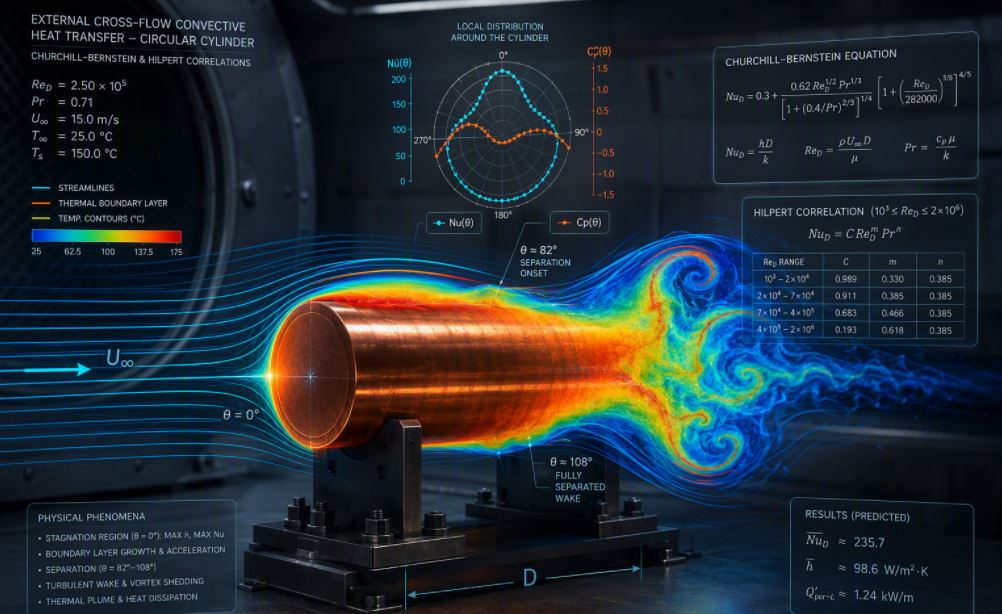
External forced convection heat transfer over cylinders in cross flow using Churchill-Bernstein and Hilpert correlations.
 Heat Transfer
Parameters Setup
Results & Curves
Configure and run the calculator to see the computed results and interactive sweep curve.
Calculation Methodology
Mathematical Model & Theory
Convection over a circular cylinder is determined by boundary layer development. The average Nusselt number is computed using two primary models:
1. Churchill-Bernstein Correlation (All $\text{Re}_D \text{Pr} > 0.2$):
$$\text{Nu}_D = 0.3 + \frac{0.62 \text{Re}_D^{1/2} \text{Pr}^{1/3}}{\left[1 + (0.4/\text{Pr})^{2/3}\right]^{1/4}} \left[1 + \left(\frac{\text{Re}_D}{282,000}\right)^{5/8}\right]^{4/5}$$
2. Hilpert Correlation:
$$\text{Nu}_D = C \text{Re}_D^m \text{Pr}^{1/3}$$
where $C$ and $m$ are constants evaluated based on the Reynolds number range.
Aerodynamic drag force per unit length is computed as:
$$F_D/L = \frac{1}{2} C_d \rho V^2 D$$
Academic References:
- Incropera, F. P., & DeWitt, D. P. (2011). Fundamentals of Heat and Mass Transfer. 7th Edition, John Wiley & Sons.
- Churchill, S. W., & Bernstein, M. (1977). A Correlating Equation for Forced Convection from Gases and Liquids to a Circular Cylinder in Crossflow. J. Heat Transfer.
Worked Engineering Example
Water at $20^\circ\text{C}$ flows at $1.0\text{ m/s}$ perpendicular to a circular tube of diameter $25\text{ mm}$ with surface temperature maintained at $80^\circ\text{C}$. Calculate the convective heat transfer coefficient.
Step-by-step Solution:
1. Evaluate properties at film temperature $T_f = (20+80)/2 = 50^\circ\text{C}$:
- Water: $\rho = 997\text{ kg/m}^3, \mu = 8.9 \times 10^{-4}\text{ Pa·s}, k = 0.613\text{ W/m·K}, Pr = 6.13$.
2. Calculate Reynolds number:
$$\text{Re}_D = \frac{\rho V D}{\mu} = \frac{997 \times 1.0 \times 0.025}{8.9 \times 10^{-4}} = 28,005$$ 3. Evaluate Nusselt number via Churchill-Bernstein correlation:
$$\text{Nu}_D = 0.3 + \frac{0.62 \times (28,005)^{1/2} \times (6.13)^{1/3}}{\left[1 + (0.4/6.13)^{2/3}\right]^{1/4}} \left[1 + \left(\frac{28,005}{282,000}\right)^{5/8}\right]^{4/5}$$ $$\text{Nu}_D = 0.3 + \frac{0.62 \times 167.3 \times 1.83}{1.037} \times 1.17 = 227.1$$ 4. Calculate convection coefficient $h$:
$$h = \frac{\text{Nu}_D k}{D} = \frac{227.1 \times 0.613}{0.025} = 5,572\text{ W/m}^2\text{K}$$