
🌀 Combined Free & Forced Convection
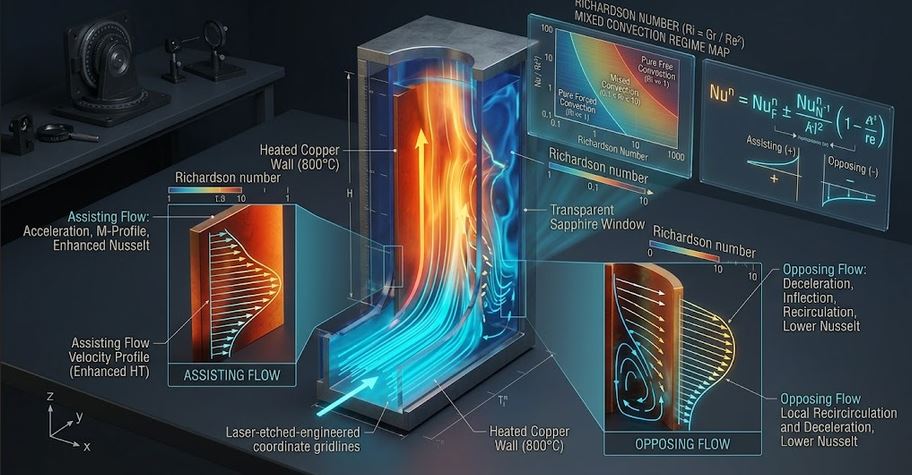
Mixed convection boundary layer analysis combining forced and natural convection with assisting, opposing, and transverse flows.
 Heat Transfer
Parameters Setup
Results & Curves
Configure and run the calculator to see the computed results and interactive sweep curve.
Calculation Methodology
Mathematical Model & Theory
In mixed convection, the Nusselt numbers for forced ($\text{Nu}_f$) and natural ($\text{Nu}_n$) convection are computed separately and then superposed using a power-law exponent of $3$ (Incropera Ch. 9): $$\text{Nu}_c^3 = \text{Nu}_f^3 \pm \text{Nu}_n^3$$ - Assisting Flow ($+$): Buoyancy acts in the direction of the forced flow, enhancing heat transfer. $$\text{Nu}_c = \left(\text{Nu}_f^3 + \text{Nu}_n^3\right)^{1/3}$$ - Opposing Flow ($-$): Buoyancy acts against the forced flow, creating turbulent shear layers or retarding flow. $$\text{Nu}_c = \left|\text{Nu}_f^3 - \text{Nu}_n^3\right|^{1/3}$$ - Transverse Flow ($+$): Buoyancy acts perpendicular to forced flow, inducing secondary cross-flow currents. $$\text{Nu}_c = \left(\text{Nu}_f^3 + \text{Nu}_n^3\right)^{1/3}$$
Academic References:
- Incropera, F. P., & DeWitt, D. P. (2011). Fundamentals of Heat and Mass Transfer. 7th Edition, John Wiley & Sons.
- Churchill, S. W. (1977). A Comprehensive Correlating Equation for Laminar, Assisting, Natural Convection on a Vertical Plate.
Worked Engineering Example
Air flows upwards at $0.5\text{ m/s}$ along a vertical flat plate of length $0.5\text{ m}$ at a surface temperature of $100^\circ\text{C}$ in assisting flow, with ambient air at $25^\circ\text{C}$. Calculate the combined convection coefficient.
Step-by-step Solution:
1. Evaluate properties at film temp $T_f = (100+25)/2 = 62.5^\circ\text{C}$:
- Air $\nu \approx 1.95 \times 10^{-5}\text{ m}^2\text{/s}$, $\beta \approx 1/(62.5+273.15) = 0.00298\text{ K}^{-1}$, $k_f = 0.028\text{ W/mK}$, $Pr = 0.7$.
2. Calculate Reynolds and Grashof numbers:
$$\text{Re} = \frac{V L_c}{\nu} = \frac{0.5 \times 0.5}{1.95 \times 10^{-5}} = 12,820$$ $$\text{Gr} = \frac{g \beta (T_s - T_\infty) L_c^3}{\nu^2} = \frac{9.81 \times 0.00298 \times (100-25) \times 0.5^3}{(1.95 \times 10^{-5})^2} = 7.2 \times 10^8$$ 3. Evaluate Richardson number:
$$\text{Ri} = \frac{\text{Gr}}{\text{Re}^2} = \frac{7.2 \times 10^8}{12,820^2} = 4.38$$ Since $0.1 < \text{Ri} < 10$, mixed convection governs the flow.
4. Compute Nusselt numbers and combine:
- Forced: $\text{Nu}_f \approx 67.5$, Natural: $\text{Nu}_n \approx 94.2$
- Combined: $\text{Nu}_c = (67.5^3 + 94.2^3)^{1/3} = 104.6$
5. Calculate heat transfer coefficient $h$:
$$h = \frac{\text{Nu}_c k_f}{L_c} = \frac{104.6 \times 0.028}{0.5} = 5.86\text{ W/m}^2\text{K}$$