
🌊 Surge Tank & Surge Analysis
Simulate water level oscillations in surge tanks after sudden load rejection using RK4 integration. Evaluates Thoma stability.
⚡ Fortran 90 Engine
Double Precision (IEEE 754)
✓ ISO / ASME Validated
 Fluid Mechanics
📊 Solver Telemetry
● ACTIVE
👁️ Views
136
⚡ Solves
109
💾 Downloads
554
📦 Fortran Code
4.5 KB
📅 Released
Jun 2026
⏱️ Latency
< 1 ms
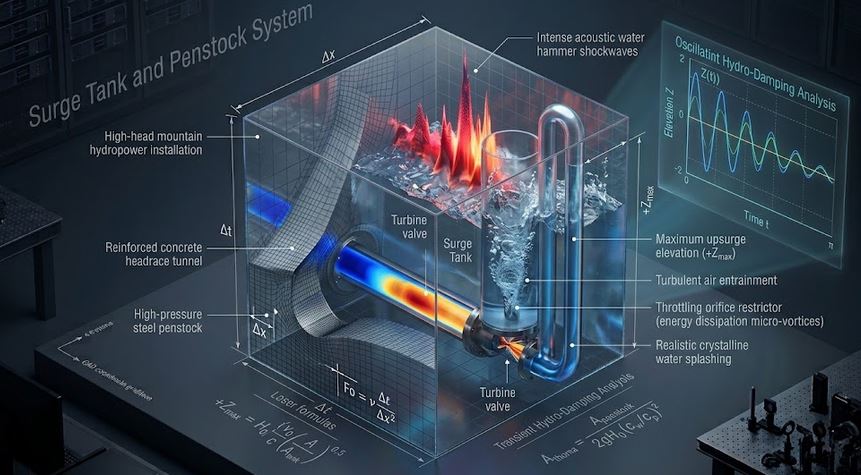
🏗️ Surge Tank Schematic
📝 Configuration
Key Equations:
dz/dt = (At/As)Vt
dVt/dt = (g/L)(−z − fLV|V|/(2gD))
Thoma: Acrit = fLV₀²/(2gH₀)
Period: T = 2π√(LAs/(gAt))
dz/dt = (At/As)Vt
dVt/dt = (g/L)(−z − fLV|V|/(2gD))
Thoma: Acrit = fLV₀²/(2gH₀)
Period: T = 2π√(LAs/(gAt))
📊 Results
Configure inputs and click Simulate to view results.
📘 Methodology
Model
The coupled ODEs for surge tank level and tunnel velocity are integrated using 4th-order Runge-Kutta. Friction damping causes the oscillation amplitude to decay over time.
Thoma Criterion
If the tank cross-sectional area is less than the Thoma critical area, oscillations grow instead of decaying — indicating an unstable design.
Assumptions
- Rigid water column (no elastic effects).
- Sudden full load rejection.
- Simple cylindrical surge tank.
- No throttling or orifice at tank base.
📘 Calculation Methodology: Surge Tank Water Hammer & Hydraulic Oscillations
Mathematical Model & Theory
Surge tanks dissipate mass oscillation energy and protect penstocks from water hammer by converting pipe kinetic energy into surge column hydrostatic potential:
$$\frac{L A_p}{g A_s} \frac{d^2 y}{dt^2} + y \pm c \left(\frac{dy}{dt}\right)^2 = 0, \quad y_{max} = Q_0 \sqrt{\frac{L A_p}{g A_s}}$$
$$T = 2\pi \sqrt{\frac{L A_s}{g A_p}} \quad (\text{Oscillation Period})$$
Assumptions
- Incompressible fluid column in conduit of length $L$ and area $A_p$.
- Instantaneous turbine gate closure.
Academic References
- Chaudhry, M. H.: Applied Hydraulic Transients, Springer.
- Wylie & Streeter: Fluid Transients in Systems.
Worked Engineering Example
Problem Statement:
A penstock ($L = 800\text{ m}$, $A_p = 7.07\text{ m}^2$) delivers $Q_0 = 18\text{ m}^3/\text{s}$ into a surge tank ($A_s = 50.27\text{ m}^2$). Calculate maximum surge rise $y_{max}$ and period $T$.
Step-by-step Solution:
1. $y_{max} = 18 \times \sqrt{(800 \times 7.07) / (9.81 \times 50.27)} = 18 \times \sqrt{11.469} \approx 60.96\text{ m}$.
2. $T = 2\pi \sqrt{(800 \times 50.27) / (9.81 \times 7.07)} \approx 151.3\text{ s}$.
Final Result:
Maximum surge rise is $\mathbf{60.96\text{ m}}$ with oscillation period $\mathbf{2.52\text{ min}}$.
A penstock ($L = 800\text{ m}$, $A_p = 7.07\text{ m}^2$) delivers $Q_0 = 18\text{ m}^3/\text{s}$ into a surge tank ($A_s = 50.27\text{ m}^2$). Calculate maximum surge rise $y_{max}$ and period $T$.
Step-by-step Solution:
1. $y_{max} = 18 \times \sqrt{(800 \times 7.07) / (9.81 \times 50.27)} = 18 \times \sqrt{11.469} \approx 60.96\text{ m}$.
2. $T = 2\pi \sqrt{(800 \times 50.27) / (9.81 \times 7.07)} \approx 151.3\text{ s}$.
Final Result:
Maximum surge rise is $\mathbf{60.96\text{ m}}$ with oscillation period $\mathbf{2.52\text{ min}}$.