
⬇️ Sedimentation & Terminal Velocity
Compute terminal settling velocity for single or hindered particles through Stokes, intermediate, and Newton drag regimes. Includes shape factors.
⚡ Fortran 90 Engine
Double Precision (IEEE 754)
✓ ISO / ASME Validated
 Fluid Mechanics
📊 Solver Telemetry
● ACTIVE
👁️ Views
119
⚡ Solves
96
💾 Downloads
529
📦 Fortran Code
4.5 KB
📅 Released
Jun 2026
⏱️ Latency
< 1 ms
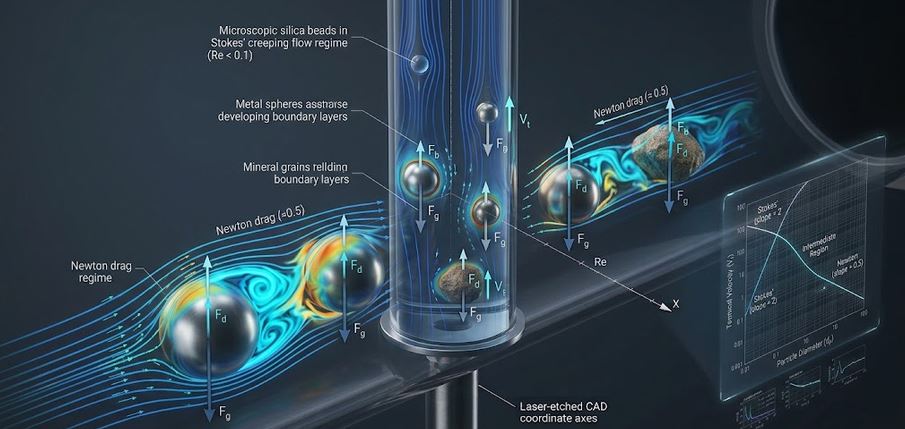
🔬 Particle Settling Schematic
📝 Configuration
Key Equations:
Stokes: Vt = (ρp−ρf)gd²/(18μ)
Schiller-Naumann: CD = 24/Re(1+0.15Re0.687)
Newton: CD = 0.44
Richardson-Zaki: Vh = Vt(1−c)n
Ar = ρf(ρp−ρf)gd³/μ²
Stokes: Vt = (ρp−ρf)gd²/(18μ)
Schiller-Naumann: CD = 24/Re(1+0.15Re0.687)
Newton: CD = 0.44
Richardson-Zaki: Vh = Vt(1−c)n
Ar = ρf(ρp−ρf)gd³/μ²
📊 Results
Configure inputs and click Compute to view results.
📘 Methodology
Drag Regimes
Three classical regimes: Stokes (Re < 0.1) with CD = 24/Re, intermediate (0.1 < Re < 1000) using Schiller-Naumann correlation, and Newton (Re > 1000) with CD ≈ 0.44. The engine iterates to convergence.
Hindered Settling
Richardson-Zaki correlation accounts for particle-particle interactions in concentrated suspensions: Vh = Vt(1−c)n, where n depends on Rep.
Assumptions
- Spherical particle (shape factor adjusts drag).
- Steady terminal velocity (no acceleration phase).
- Infinite fluid domain (no wall effects).
- Newtonian fluid.
- No particle rotation or lift.
📘 Calculation Methodology: Particle Terminal Settling Velocity & Stokes' Law
Mathematical Model & Theory
Terminal settling velocity $v_t$ of a particle in a quiescent fluid is achieved when submerged buoyant gravitational force balances viscous drag:
$$v_t = \frac{g d_p^2 (\rho_p - \rho_f)}{18 \mu_f} \quad (\text{Stokes: } Re_p < 0.1)$$
$$Re_p = \frac{\rho_f v_t d_p}{\mu_f}, \quad C_D = \frac{24}{Re_p}(1 + 0.15 Re_p^{0.687})$$
Assumptions
- Rigid spherical particle in dilute Newtonian suspension.
- Unbounded fluid without wall effects.
Academic References
- Rhodes, M.: Introduction to Particle Technology, Wiley.
- Coulson & Richardson: Chemical Engineering Vol. 2.
Worked Engineering Example
Problem Statement:
A sand grain ($d_p = 50\ \mu\text{m}$, $\rho_p = 2650\text{ kg/m}^3$) settles in water ($\rho_f = 1000\text{ kg/m}^3$, $\mu = 1.0\times 10^{-3}\text{ Pa}\cdot\text{s}$). Find settling velocity.
Step-by-step Solution:
1. $v_t = 9.81 \times (50\times 10^{-6})^2 \times (2650 - 1000) / (18 \times 0.001) \approx 0.002248\text{ m/s} = 2.25\text{ mm/s}$.
2. $Re_p = 1000 \times 0.002248 \times 50\times 10^{-6} / 0.001 = 0.112 \approx 0.1$.
Final Result:
Terminal settling velocity is $\mathbf{2.25\text{ mm/s}}$ ($8.1\text{ m/h}$).
A sand grain ($d_p = 50\ \mu\text{m}$, $\rho_p = 2650\text{ kg/m}^3$) settles in water ($\rho_f = 1000\text{ kg/m}^3$, $\mu = 1.0\times 10^{-3}\text{ Pa}\cdot\text{s}$). Find settling velocity.
Step-by-step Solution:
1. $v_t = 9.81 \times (50\times 10^{-6})^2 \times (2650 - 1000) / (18 \times 0.001) \approx 0.002248\text{ m/s} = 2.25\text{ mm/s}$.
2. $Re_p = 1000 \times 0.002248 \times 50\times 10^{-6} / 0.001 = 0.112 \approx 0.1$.
Final Result:
Terminal settling velocity is $\mathbf{2.25\text{ mm/s}}$ ($8.1\text{ m/h}$).