
🌊 Turbulent Free Jet & Impingement Force
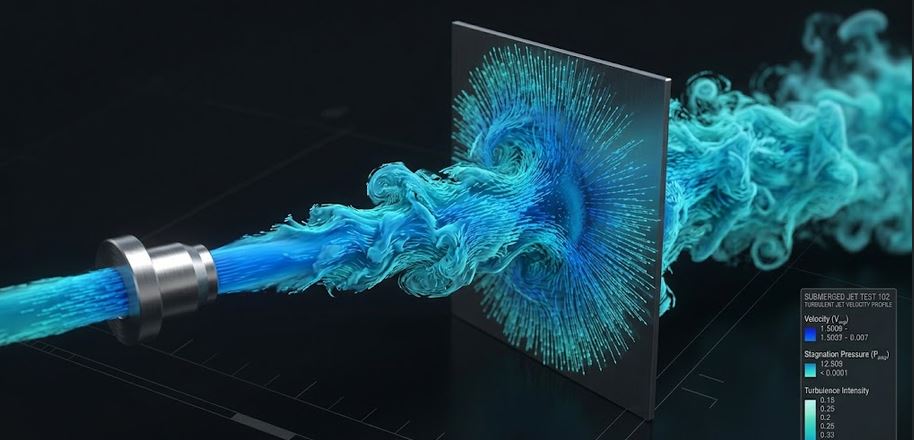
Compute turbulent submerged free jet expansion, potential core length, Schlichting self-similar velocity profile, ambient fluid entrainment, and dynamic impact thrust on target plates.
⚡ Fortran 90 Engine
Double Precision (IEEE 754)
✓ ISO / ASME Validated
 Fluid Mechanics
📊 Solver Telemetry
● ACTIVE
🌊 Free Jet Spreading, Potential Core & Target Impingement
Real-time velocity field & target deflection physics📝 Configuration & Presets
Key Formulations:
• Potential Core: Lcore ≈ 5.5 · D0
• Axial Decay: umax(x) / U0 = 5.8 / (x / D0)
• Spread Radius: r1/2(x) = 0.097 · x
• Stagnation Pressure: qstag = ½ ρ umax(X)²
• Impact Force: F = ṁ U0 (flat 90°) or 2 ṁ U0 (180° Pelton)
• Potential Core: Lcore ≈ 5.5 · D0
• Axial Decay: umax(x) / U0 = 5.8 / (x / D0)
• Spread Radius: r1/2(x) = 0.097 · x
• Stagnation Pressure: qstag = ½ ρ umax(X)²
• Impact Force: F = ṁ U0 (flat 90°) or 2 ṁ U0 (180° Pelton)
📊 Simulation Results
Configure inputs and click Calculate to view results.
📘 Calculation Methodology & Engineering Theory
Submerged Turbulent Jet Structure
A turbulent jet issuing into a stagnant ambient fluid experiences strong shear-layer mixing, developing three distinct hydrodynamic zones:
- Potential Core ($x \le 5.5 D_0$): Wedge-shaped inner core where fluid velocity remains equal to initial exit speed $U_0$.
- Transition Zone ($5.5 D_0 < x < 8 D_0$): Core decay and turbulence saturation.
- Fully Developed Similarity Zone ($x \ge 8 D_0$): Centerline velocity decays inversely with distance: $$\frac{u_{max}(x)}{U_0} \approx \frac{5.8}{x / D_0}$$
Schlichting Self-Similar Profile
In the similarity region, radial velocity profiles normalized by centerline velocity and half-width $r_{1/2}(x)$ collapse onto a single universal curve:
u(x, r) / umax(x) = [1 + 0.414 (r / r1/2)²]−2
Impact Force & Momentum Conservation
Applying the control-volume momentum theorem to target impingement:
- Flat Plate ($90^\circ$ deflection): $F_N = \dot{m} U_0$.
- Inclined Plate ($\theta$): $F_N = \dot{m} U_0 \sin(\theta)$.
- Reversing Bucket ($180^\circ$): $F_N = 2 \dot{m} U_0$.