
🌀 Flow Around Cylinders
Compute vortex shedding frequency, Strouhal number, drag/lift coefficients, and lock-in velocity range for circular cylinders in cross-flow.
⚡ Fortran 90 Engine
Double Precision (IEEE 754)
✓ ISO / ASME Validated
 Fluid Mechanics
📊 Solver Telemetry
● ACTIVE
👁️ Views
124
⚡ Solves
98
💾 Downloads
600
📦 Fortran Code
4.5 KB
📅 Released
Jun 2026
⏱️ Latency
< 1 ms
💡
Hardware & Sizing Partner: Need to size a control valve or check ASME flange bolt torque for this line?
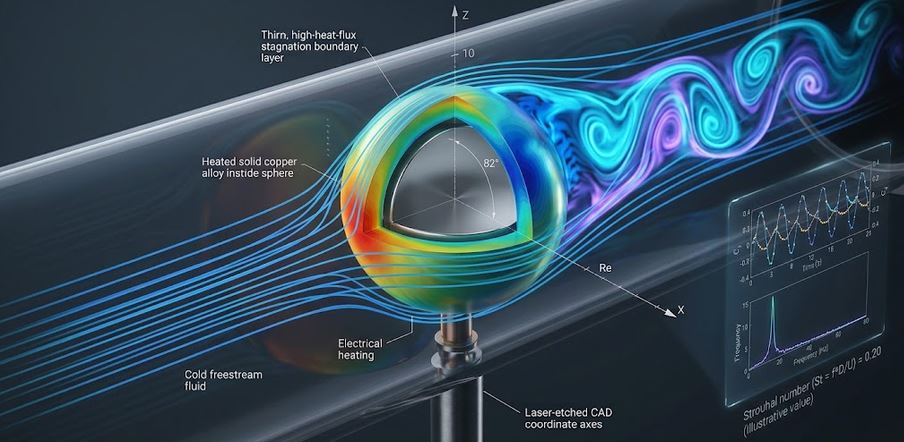
🌬️ Vortex Shedding Schematic
📝 Configuration
Key Equations:
St = fD/V∞ (Strouhal number)
St ≈ 0.198(1−19.7/Re) subcritical
Lock-in: 0.8fn < fshed < 1.2fn
FD/L = ½ρV²DCD
St = fD/V∞ (Strouhal number)
St ≈ 0.198(1−19.7/Re) subcritical
Lock-in: 0.8fn < fshed < 1.2fn
FD/L = ½ρV²DCD
📊 Results
Configure inputs and click Analyze to view results.
📘 Methodology
Vortex Shedding
Periodic vortex shedding from a cylinder creates alternating lift forces. The Strouhal number St ≈ 0.20 in the subcritical range (300 < Re < 3×10⁵) and increases during the drag crisis.
Lock-in / VIV
When shedding frequency approaches the structure's natural frequency (0.8fn to 1.2fn), vortex-induced vibration can cause resonance and fatigue failure.
Regime Classification
- Re < 5: creeping flow
- 5–40: steady twin vortices
- 40–200: laminar vortex street
- 200–3×10⁵: subcritical
- 3×10⁵–3.5×10⁶: critical/supercritical
- >3.5×10⁶: transcritical
📘 Calculation Methodology: Cross-Flow Over Circular Cylinder & Vortex Shedding
Mathematical Model & Theory
Flow over a circular cylinder transitions from potential streamlines to unsteady boundary layer separation and periodic vortex shedding at Strouhal frequency $f_s$:
$$C_p(\theta) = 1 - 4\sin^2\theta, \quad f_s = \frac{St \cdot U_\infty}{D}$$
$$St \approx 0.198\left(1 - \frac{19.7}{Re_D}\right) \quad (\text{for } 250 < Re_D < 2 \times 10^5)$$
Assumptions
- 2D cross-flow perpendicular to circular cylinder.
- Subcritical Reynolds number with laminar separation.
Academic References
- White, F. M.: Fluid Mechanics, Ch. 7.
- Blevins, R. D.: Flow-Induced Vibration.
Worked Engineering Example
Problem Statement:
Wind at $U_\infty = 20\text{ m/s}$ ($\nu = 1.5 \times 10^{-5}\text{ m}^2/\text{s}$) flows past a cable of diameter $D = 25\text{ mm}$. Calculate vortex shedding frequency.
Step-by-step Solution:
1. $Re_D = 20 \times 0.025 / (1.5 \times 10^{-5}) = 33,333$.
2. $f_s = 0.20 \times 20 / 0.025 = 160\text{ Hz}$.
Final Result:
Vortex shedding frequency is $\mathbf{160\text{ Hz}}$.
Wind at $U_\infty = 20\text{ m/s}$ ($\nu = 1.5 \times 10^{-5}\text{ m}^2/\text{s}$) flows past a cable of diameter $D = 25\text{ mm}$. Calculate vortex shedding frequency.
Step-by-step Solution:
1. $Re_D = 20 \times 0.025 / (1.5 \times 10^{-5}) = 33,333$.
2. $f_s = 0.20 \times 20 / 0.025 = 160\text{ Hz}$.
Final Result:
Vortex shedding frequency is $\mathbf{160\text{ Hz}}$.