
🌬️ Drag Force Calculator
Drag coefficients and forces for spheres, cylinders, and flat plates. Stokes, intermediate, and turbulent flow regimes.
 Fluid Mechanics
Drag & Aerodynamic Boundaries
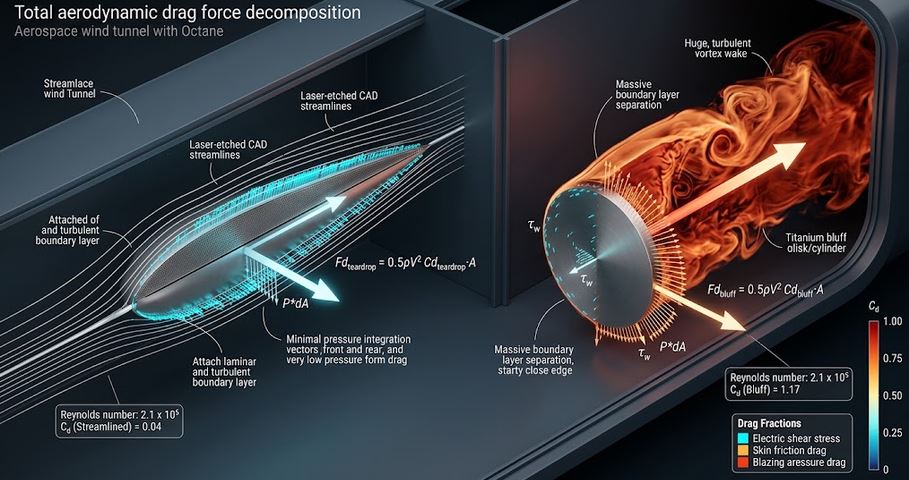
Viscous friction and pressure differentials along moving shapes combine to produce a net resistance drag force. Drag coefficients correlate directly with the Reynolds number.
• Friction Drag: Viscous wall shear stress boundaries across surface area elements.
• Streamlining: Delaying flow separation points to minimize wake pressure differences.
📝 Configuration
$F_D = C_d \frac{\rho U_\infty^2}{2} A_{ref}$
Sphere:
Stokes ($Re \lt 1$): $C_d = \frac{24}{Re}$
Intermediate: $C_d = \frac{24}{Re}(1 + 0.15 Re^{0.687})$
Newton: $C_d \approx 0.44$
Cylinder: $C_d \approx 1.2$ ($Re \gt 10^3$)
Flat plate: $C_d \approx 1.17$ (normal)
📊 Results & Visualization
Configure inputs and click Calculate Drag Force to view results.
📘 Calculation Methodology
Mathematical Model & Theory
A body moving through a fluid experiences a drag force opposing its motion, defined by the drag equation:
Where $C_d$ is the drag coefficient, which depends on shape and the Reynolds number ($Re$). At low Reynolds numbers ($Re < 0.1$), viscous forces dominate and the drag coefficient of a sphere follows Stokes' Law ($C_d = 24/Re$). Streamlined profiles delay boundary layer separation, reducing pressure drag at high Reynolds numbers.
Assumptions
- Steady and uniform free-stream flow conditions.
- Rigid body with smooth surface finish (no surface roughness corrections).
- No wall interference effects (free boundary fluid domain).
Academic References
- White, F. M.: Fluid Mechanics, McGraw-Hill, 8th Edition.
- Schlichting, H.: Boundary-Layer Theory, McGraw-Hill.
Worked Engineering Example
A 100 mm diameter sphere is placed in a wind tunnel with air flowing at 20 m/s ($\rho = 1.2$ kg/m³, $\mu = 1.8 \times 10^{-5}$ Pa·s). If the drag coefficient is $C_d = 0.45$, calculate the drag force.
Step-by-step Solution:
1. Calculate projected area $A_{ref}$:
$$A_{ref} = \frac{\pi D^2}{4} = \frac{\pi \times 0.1^2}{4} = 0.007854 \text{ m}^2$$ 2. Apply the drag equation:
$$F_D = C_d A_{ref} \frac{\rho U_\infty^2}{2}$$ $$F_D = 0.45 \times 0.007854 \times \frac{1.2 \times 20^2}{2} = 0.848 \text{ N}$$
Final Result:
The drag force is 0.848 N.