
🚀 Rocket Nozzle Design (De Laval)
Size converging-diverging nozzles using isentropic compressible relations. Compute throat/exit areas, expansion ratio, thrust, and specific impulse.
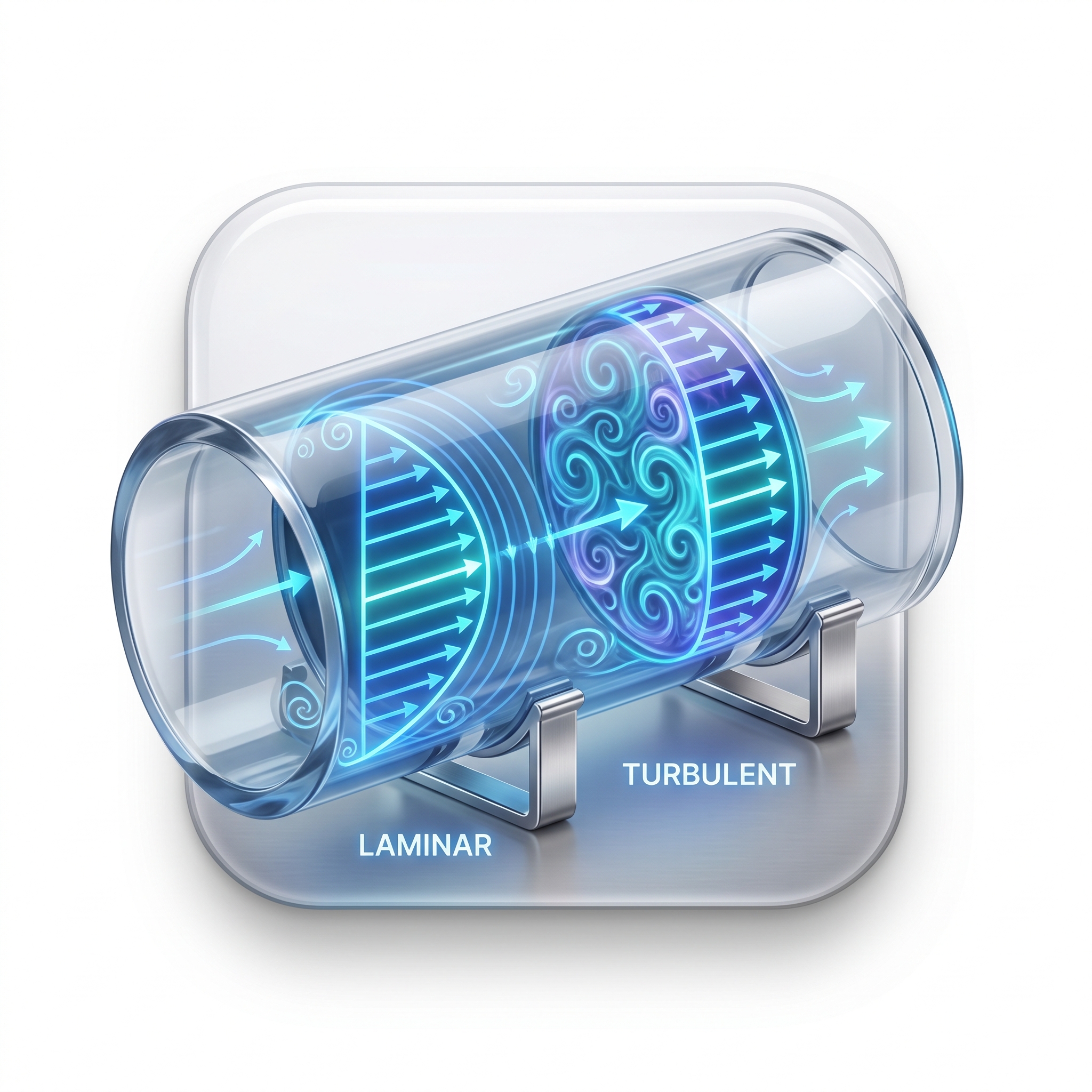 Fluid Mechanics
🔥 De Laval Nozzle Schematic
📝 Configuration
A/A* = (1/M)[(2+(γ−1)M²)/(γ+1)](γ+1)/(2(γ−1))
F = ṁVe + (Pe−Pa)Ae
CF = F/(PcAt)
Isp = F/(ṁg₀)
c* = √(γRTc)/γ/√[(2/(γ+1))(γ+1)/(γ−1)]
📊 Results
Configure inputs and click Design to view results.
📘 Methodology
Isentropic Relations
The De Laval nozzle accelerates flow from subsonic to supersonic through a converging-diverging geometry. All thermodynamic properties along the nozzle follow from the local Mach number and isentropic relations.
Thrust & Isp
Thrust includes both momentum flux ṁVe and pressure thrust (Pe−Pa)Ae. Specific impulse Isp = F/(ṁg₀) characterizes propellant efficiency. The thrust coefficient CF normalizes thrust by chamber conditions.
Assumptions
- Steady, quasi-1D isentropic flow.
- Calorically perfect gas (constant γ).
- No boundary layer, friction, or heat loss.
- Fully expanded nozzle at design Pe.
- Choked flow at throat (M = 1).
📘 Calculation Methodology: De Laval Rocket Nozzle Isentropic Expansion
Mathematical Model & Theory
Converging-diverging de Laval nozzles accelerate chamber combustion gases isentropically to sonic speed at the throat and supersonic speed at exit:
Assumptions
- 1D steady isentropic gas expansion.
- Choked flow at throat ($M=1$).
Academic References
- Sutton, G. P., & Biblarz, O.: Rocket Propulsion Elements, Wiley.
- Anderson, J. D.: Modern Compressible Flow.
Worked Engineering Example
A rocket chamber has $P_c = 6.0\text{ MPa}$, $T_c = 3400\text{ K}$, $\gamma = 1.22$, $M_w = 22.0\text{ g/mol}$, expanding $\dot{m} = 50\text{ kg/s}$ to $p_e = 100\text{ kPa}$. Calculate exhaust velocity and thrust.
Step-by-step Solution:
1. $V_e = \sqrt{\frac{2(1.22)}{0.22} \times 377.9 \times 3400 \times (1 - 0.01667^{0.1803})} \approx 2726.4\text{ m/s}$.
2. $F = 50 \times 2726.4 = 136,320\text{ N} = 136.32\text{ kN}$.
Final Result:
Exhaust velocity is $\mathbf{2726\text{ m/s}}$, delivering $\mathbf{136.3\text{ kN}}$ thrust.