
🔺 Nozzle Flow
Compressible nozzle flow through converging-diverging nozzles, evaluating mass flow rate, choking condition, and exit shock locations.
 Fluid Mechanics
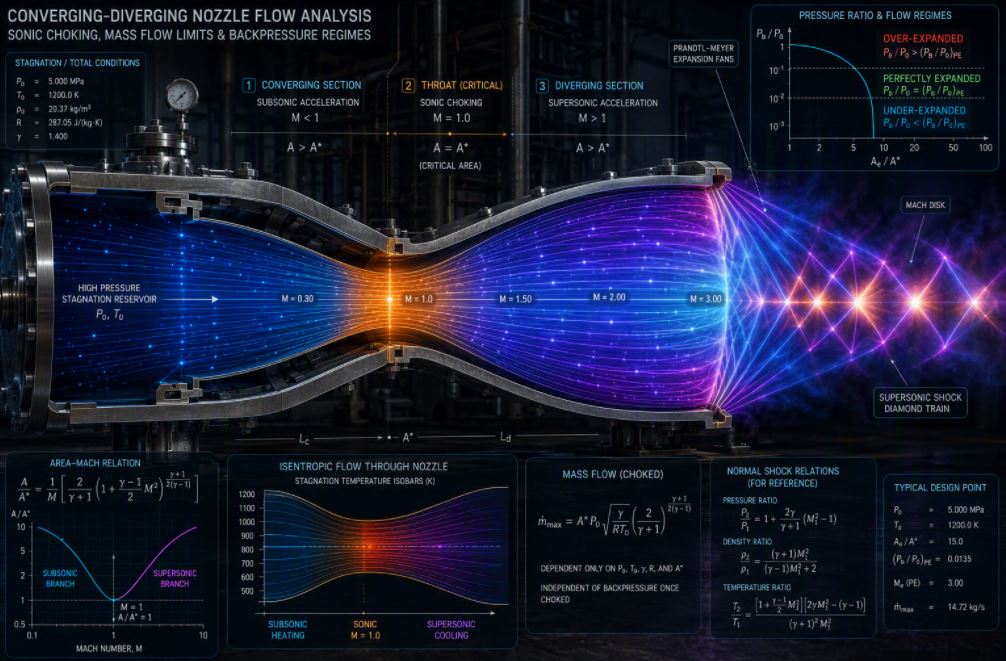
Converging-Diverging Nozzle
Accelerates gas streams isentropically. The flow transitions to supersonic velocities downstream of the throat if critical choking pressure ratio limits are satisfied.
• Shock Stand: A normal shock will form in the diverging section if back pressure is high.
• Operating Regimes: Ranges from fully subsonic to overexpanded, design expanded, and underexpanded flows.
📝 Configuration
$A/A^* = \frac{1}{M} \left[\frac{2}{\gamma+1}\left(1 + \frac{\gamma-1}{2} M^2\right)\right]^{\frac{\gamma+1}{2(\gamma-1)}}$
Choked Mass Flow:
$\dot{m} = \frac{P_0 A^* \sqrt{\gamma}}{\sqrt{R T_0}} \left(\frac{2}{\gamma+1}\right)^{\frac{\gamma+1}{2(\gamma-1)}}$
Normal Shock:
$M_2^2 = \frac{(\gamma-1) M_1^2 + 2}{2\gamma M_1^2 - (\gamma-1)}$
$P_2/P_1 = 1 + \frac{2\gamma}{\gamma+1}(M_1^2-1)$
📊 Results & Visualization
Configure inputs and click Analyze Nozzle Flow to view results.
📘 Calculation Methodology
Mathematical Model & Theory
Compressible flow in a converging-diverging (de Laval) nozzle accelerates gas to supersonic velocities. The relationship between local cross-sectional area and Mach number is governed by the Area-Mach relation:
Under choked flow conditions, Mach number equals 1.0 at the throat ($A = A^*$), and mass flow rate is maximized.
Assumptions
- Ideal gas behavior with constant specific heat ratio ($\gamma$).
- Steady, one-dimensional, isentropic flow (except across shock waves).
- Nozzle walls are smooth and adiabatic.
Academic References
- Anderson, J. D.: Modern Compressible Flow: With Historical Perspective, McGraw-Hill.
- Zucker, R. D., and Biblarz, O.: Fundamentals of Gas Dynamics, John Wiley & Sons.
Worked Engineering Example
Air ($\gamma = 1.4$) flows through a CD nozzle. The exit area is 2 times the throat area ($A_e/A^* = 2.0$). Find the isentropic supersonic exit Mach number.
Step-by-step Solution:
1. Solve the Area-Mach relation for $A/A^* = 2.0$ (supersonic branch, $M > 1$):
$$2.0 = \frac{1}{M} \left[ \frac{2}{2.4} \left( 1 + 0.2 M^2 \right) \right]^{3.0}$$ 2. By numerical solver / bisection:
$$M \approx 2.197$$
Final Result:
Supersonic exit Mach number is 2.20.