
📐 Rankine-Hugoniot Shock Relations
Compute normal shock wave property jumps (pressure, density, temperature) using Rankine-Hugoniot relations.
⚡ Fortran 90 Engine
Double Precision (IEEE 754)
✓ ISO / ASME Validated
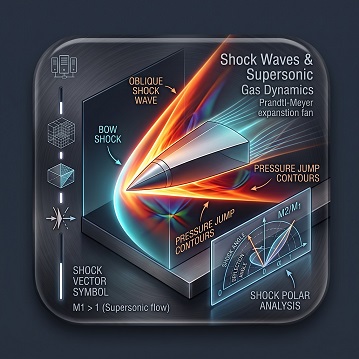 Cfd
Cfd
📊 Solver Telemetry
● ACTIVE
🌊 Normal Shock Wave Schematic
📝 Configuration
Key Equations (Rankine-Hugoniot):
Pressure ratio:
$\dfrac{p_2}{p_1} = 1 + \dfrac{2\gamma}{\gamma+1}\left(M_1^2 - 1\right)$
Density ratio:
$\dfrac{\rho_2}{\rho_1} = \dfrac{(\gamma+1)M_1^2}{(\gamma-1)M_1^2 + 2}$
Temperature ratio:
$\dfrac{T_2}{T_1} = \dfrac{p_2/p_1}{\rho_2/\rho_1}$
Downstream Mach:
$M_2^2 = \dfrac{(\gamma-1)M_1^2 + 2}{2\gamma M_1^2 - (\gamma-1)}$
Pressure ratio:
$\dfrac{p_2}{p_1} = 1 + \dfrac{2\gamma}{\gamma+1}\left(M_1^2 - 1\right)$
Density ratio:
$\dfrac{\rho_2}{\rho_1} = \dfrac{(\gamma+1)M_1^2}{(\gamma-1)M_1^2 + 2}$
Temperature ratio:
$\dfrac{T_2}{T_1} = \dfrac{p_2/p_1}{\rho_2/\rho_1}$
Downstream Mach:
$M_2^2 = \dfrac{(\gamma-1)M_1^2 + 2}{2\gamma M_1^2 - (\gamma-1)}$
📊 Results & Visualization
Configure inputs and click Calculate to view results.
ℹ️ About Normal Shock Waves
A normal shock is a thin, nearly discontinuous region in a supersonic flow where the gas decelerates abruptly to subsonic speed. Across the shock:
- Static pressure, temperature, and density increase.
- Mach number drops below 1.
- Total pressure decreases (irreversible process).
- Total temperature is conserved (adiabatic).
The Rankine-Hugoniot relations link upstream (state 1) and downstream (state 2) conditions using conservation of mass, momentum, and energy for a calorically perfect gas.
A normal shock is a thin, nearly discontinuous region in a supersonic flow where the gas decelerates abruptly to subsonic speed. Across the shock:
- Static pressure, temperature, and density increase.
- Mach number drops below 1.
- Total pressure decreases (irreversible process).
- Total temperature is conserved (adiabatic).
The Rankine-Hugoniot relations link upstream (state 1) and downstream (state 2) conditions using conservation of mass, momentum, and energy for a calorically perfect gas.
📘 Calculation Methodology
Mathematical Model & Theory
The Rankine-Hugoniot equations are derived from the integral conservation laws (mass, momentum, energy) applied across a stationary normal shock in a steady, one-dimensional, adiabatic flow of a calorically perfect gas ($c_p, c_v = \text{const}$).
$$\frac{p_2}{p_1} = 1 + \frac{2\gamma}{\gamma+1}\left(M_1^2 - 1\right)$$
$$\frac{\rho_2}{\rho_1} = \frac{(\gamma+1)M_1^2}{(\gamma-1)M_1^2 + 2}$$
$$M_2^2 = \frac{(\gamma-1)M_1^2 + 2}{2\gamma M_1^2 - (\gamma-1)}$$
$$\frac{p_{02}}{p_{01}} = \left(\frac{\rho_2}{\rho_1}\right)^{\!\gamma/(\gamma-1)} \!\cdot \left(\frac{p_2}{p_1}\right)^{\!-1/(\gamma-1)}$$
$$\frac{\Delta s}{R} = -\ln\!\left(\frac{p_{02}}{p_{01}}\right)$$
Worked Engineering Example
Problem:
Air ($\gamma = 1.4$) at $M_1 = 2.0$ passes through a normal shock. Upstream conditions: $p_1 = 101{,}325$ Pa, $T_1 = 300$ K.
Step-by-step:
1. Pressure ratio:
$p_2/p_1 = 1 + \frac{2(1.4)}{2.4}(4 - 1) = 1 + 3.5 = 4.500$
2. Density ratio:
$\rho_2/\rho_1 = \frac{2.4 \times 4}{0.4 \times 4 + 2} = \frac{9.6}{3.6} = 2.6667$
3. Temperature ratio:
$T_2/T_1 = 4.500 / 2.6667 = 1.6875$
4. Downstream Mach:
$M_2^2 = \frac{0.4(4) + 2}{2(1.4)(4) - 0.4} = \frac{3.6}{10.8} \Rightarrow M_2 = 0.5774$
Results: $p_2 = 455{,}963\;\text{Pa}$, $T_2 = 506.25\;\text{K}$, $M_2 = 0.5774$.
Air ($\gamma = 1.4$) at $M_1 = 2.0$ passes through a normal shock. Upstream conditions: $p_1 = 101{,}325$ Pa, $T_1 = 300$ K.
Step-by-step:
1. Pressure ratio:
$p_2/p_1 = 1 + \frac{2(1.4)}{2.4}(4 - 1) = 1 + 3.5 = 4.500$
2. Density ratio:
$\rho_2/\rho_1 = \frac{2.4 \times 4}{0.4 \times 4 + 2} = \frac{9.6}{3.6} = 2.6667$
3. Temperature ratio:
$T_2/T_1 = 4.500 / 2.6667 = 1.6875$
4. Downstream Mach:
$M_2^2 = \frac{0.4(4) + 2}{2(1.4)(4) - 0.4} = \frac{3.6}{10.8} \Rightarrow M_2 = 0.5774$
Results: $p_2 = 455{,}963\;\text{Pa}$, $T_2 = 506.25\;\text{K}$, $M_2 = 0.5774$.
Assumptions & References
Assumptions: Steady, one-dimensional flow. Calorically perfect gas ($\gamma = \text{const}$). Adiabatic (no heat transfer). Negligible body forces. Thin shock (viscous/thermal effects confined to the shock itself).
References:
- Anderson, J. D. Modern Compressible Flow: With Historical Perspective, McGraw-Hill, 4th ed., 2021.
- Shapiro, A. H. The Dynamics and Thermodynamics of Compressible Fluid Flow, Vol. 1, Wiley, 1953.
- Gupta, S. C. Applied Computational Fluid Dynamics — §1.19, Eq. 1.73 (Rankine-Hugoniot jump conditions).