
📐 Prandtl-Meyer Expansion Fan
Evaluate Mach number, pressure, and temperature ratios downstream of a supersonic expansion corner.
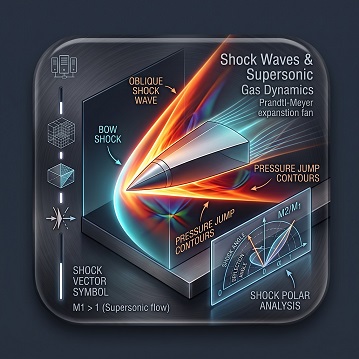 Cfd
Cfd
🌊 Expansion Fan Schematic
📝 Configuration
Prandtl-Meyer function:
$\nu(M) = \sqrt{\dfrac{\gamma+1}{\gamma-1}}\;\arctan\!\sqrt{\dfrac{\gamma-1}{\gamma+1}(M^2-1)}\;-\;\arctan\!\sqrt{M^2-1}$
Expansion fan:
$\nu_2 = \nu_1 + \delta$
Maximum turning:
$\nu_{\max} = \dfrac{\pi}{2}\left(\sqrt{\dfrac{\gamma+1}{\gamma-1}} - 1\right)$
Isentropic ratios:
$\dfrac{p_2}{p_1} = \left[\dfrac{1 + \frac{\gamma-1}{2}M_1^2}{1 + \frac{\gamma-1}{2}M_2^2}\right]^{\!\gamma/(\gamma-1)}$
📊 Results & Visualization
Configure inputs and click Calculate to view results.
When a supersonic flow encounters a convex corner (expansion corner), it accelerates through a continuous, isentropic expansion fan — a centered wave of infinite Mach lines diverging from the corner.
Key properties:
- The process is isentropic: total pressure and temperature are conserved.
- The downstream Mach number is always higher than upstream.
- Static pressure, temperature, and density all decrease.
- The Prandtl-Meyer function ν(M) is a monotonically increasing function used to relate upstream and downstream Mach numbers.
- A maximum turning angle νmax exists (≈ 130.45° for γ = 1.4) corresponding to M → ∞.
📘 Calculation Methodology
Mathematical Model & Theory
The Prandtl-Meyer function describes the relationship between Mach number and the turning angle through an isentropic expansion fan. It is derived from the characteristic equations of supersonic flow.
Inversion of ν(M₂) = ν₂ is performed via Newton-Raphson iteration using the analytical derivative above (typically < 10 iterations to machine precision).
Worked Engineering Example
Air (γ = 1.4) at M₁ = 2.0 turns through a 10° expansion corner. Find M₂ and the isentropic pressure ratio.
Step-by-step:
1. Compute ν₁ = ν(2.0):
$\nu_1 = \sqrt{6}\;\arctan\!\sqrt{\tfrac{3}{6}} - \arctan\!\sqrt{3} = 26.3798°$
2. ν₂ = 26.3798° + 10° = 36.3798°
3. Invert ν(M₂) = 36.3798° via Newton-Raphson:
$M_2 = 2.3854$
4. Isentropic pressure ratio:
$\frac{p_2}{p_1} = \left[\frac{1 + 0.2(4)}{1 + 0.2(5.690)}\right]^{3.5} = 0.5685$
Result: M₂ = 2.385, p₂/p₁ = 0.569 (pressure drops, flow accelerates).
Assumptions & References
Assumptions: Steady, two-dimensional flow. Calorically perfect gas (γ = const). Isentropic process (no shocks within the fan). Sharp convex corner (centered expansion). Uniform upstream conditions.
References:
- Anderson, J. D. Modern Compressible Flow, McGraw-Hill, 4th ed. — Ch. 4, §4.14 (Prandtl-Meyer Expansion Waves).
- Shapiro, A. H. The Dynamics and Thermodynamics of Compressible Fluid Flow, Vol. 1, Wiley, 1953.
- Gupta, S. C. Applied Computational Fluid Dynamics — §7.11, Eq. 7.175.
- NACA Report 1135 — Equations, Tables, and Charts for Compressible Flow, 1953.