
📐 Transonic Similarity Parameter
Evaluate the transonic similarity parameter (K) for thin airfoils at near-sonic flow speeds.
⚡ Fortran 90 Engine
Double Precision (IEEE 754)
✓ ISO / ASME Validated
 Cfd
Cfd
📊 Solver Telemetry
● ACTIVE
👁️ Views
107
⚡ Solves
87
💾 Downloads
775
📦 Fortran Code
4.4 KB
📅 Released
Jun 2026
⏱️ Latency
< 1 ms
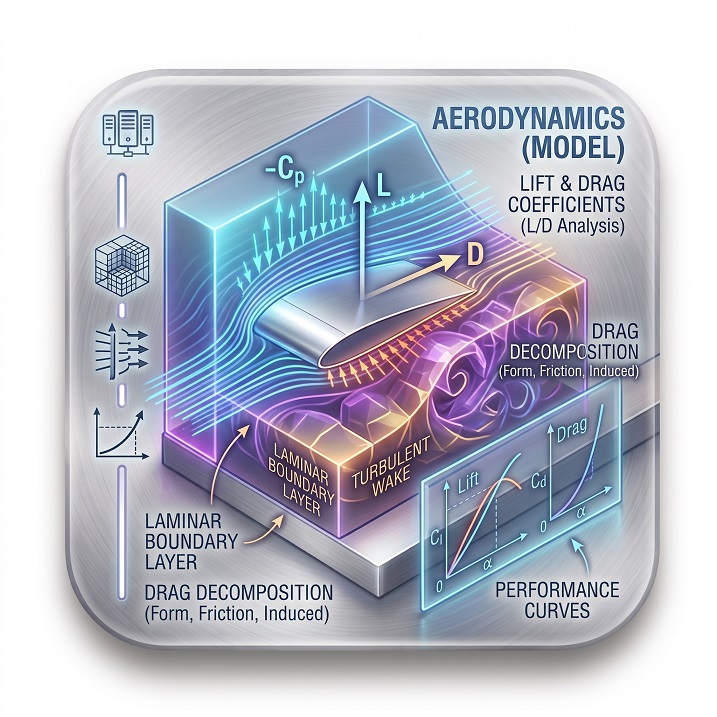
🌀 Transonic Flow Schematic
📝 Configuration
Key Equations:
Transonic similarity parameter:
$K = \dfrac{1 - M_\infty^2}{\tau^{2/3}}$
Scaled Cp:
$\bar{C}_p = \dfrac{C_p}{\tau^{2/3}}$
Korn equation:
$M_{dd} + \dfrac{C_L}{10} + \dfrac{t}{c} = \kappa$
$\kappa = 0.87$ (conventional), $0.95$ (supercritical)
Transonic similarity parameter:
$K = \dfrac{1 - M_\infty^2}{\tau^{2/3}}$
Scaled Cp:
$\bar{C}_p = \dfrac{C_p}{\tau^{2/3}}$
Korn equation:
$M_{dd} + \dfrac{C_L}{10} + \dfrac{t}{c} = \kappa$
$\kappa = 0.87$ (conventional), $0.95$ (supercritical)
📊 Results & Visualization
Configure inputs and click Calculate.
ℹ️ About Transonic Similarity
Near Mach 1, the Prandtl-Glauert correction diverges to infinity. The transonic similarity parameter K provides a framework to compare different airfoils in this regime.
- K >> 0: subsonic-like behavior
- K ≈ 0: transonic regime — nonlinear effects dominate
- K << 0: supersonic-like behavior
The Korn equation estimates the drag-divergence Mach number Mdd.
Near Mach 1, the Prandtl-Glauert correction diverges to infinity. The transonic similarity parameter K provides a framework to compare different airfoils in this regime.
- K >> 0: subsonic-like behavior
- K ≈ 0: transonic regime — nonlinear effects dominate
- K << 0: supersonic-like behavior
The Korn equation estimates the drag-divergence Mach number Mdd.
📘 Calculation Methodology
Theory
The transonic small-disturbance (TSD) equation, after scaling, yields a single governing parameter K:
$$K = \frac{1 - M_\infty^2}{\tau^{2/3}}$$
$$\bar{C}_p = \frac{C_p}{\tau^{2/3}} = f(K) \quad\text{(universal function)}$$
$$\text{TSD: } (1-M^2)\phi_{xx} + \phi_{yy} = M^2(\gamma+1)\phi_x\phi_{xx}$$
$$\text{Korn: } M_{dd} + \frac{C_L}{10} + \frac{t}{c} = \kappa$$
The Korn equation is empirical: κ ≈ 0.87 for conventional airfoils, ≈ 0.95 for supercritical designs (NASA SC series).
Worked Example
Problem: Conventional airfoil, τ = 0.12, CL₀ = 0.5, Cp₀ = −1.0, M∞ = 0.8
1. τ2/3 = 0.120.667 = 0.2432
2. K = (1 − 0.64) / 0.2432 = 1.480 → subsonic-like
3. β = √(1−0.64) = 0.6000
4. Cp_PG = −1.0/0.6 = −1.6667
5. Korn (conv): Mdd = 0.87 − 0.05 − 0.12 = 0.700
6. Korn (SC): Mdd = 0.95 − 0.05 − 0.12 = 0.780
Since M∞ = 0.8 > Mdd,conv, this airfoil is past drag divergence.
1. τ2/3 = 0.120.667 = 0.2432
2. K = (1 − 0.64) / 0.2432 = 1.480 → subsonic-like
3. β = √(1−0.64) = 0.6000
4. Cp_PG = −1.0/0.6 = −1.6667
5. Korn (conv): Mdd = 0.87 − 0.05 − 0.12 = 0.700
6. Korn (SC): Mdd = 0.95 − 0.05 − 0.12 = 0.780
Since M∞ = 0.8 > Mdd,conv, this airfoil is past drag divergence.
Assumptions & References
Assumptions: Steady, irrotational, isentropic. Small perturbations. Thin airfoil (τ << 1). 2D flow. Perfect gas. TSD uses mixed-type PDE — solved numerically in practice.
- Anderson, J. D. Fundamentals of Aerodynamics — Ch. 11 §11.6.
- Gupta, S. C. Applied CFD — §7.10.
- Korn, D. G. NASA TN D-6643, 1972.
- Cole, J. D. & Cook, L. P. Transonic Aerodynamics, 1986.