
📐 Mach Angle Calculator
Compute Mach angle for supersonic flows. Features interactive shock angle vector visualizations.
 Cfd
Cfd
🔺 Mach Cone & Wavefront Animation
📝 Configuration
Mach angle:
$\mu = \sin^{-1}\!\left(\dfrac{1}{M}\right) = \sin^{-1}\!\left(\dfrac{a}{u}\right)$
Cone radius at distance $x$:
$r = x \cdot \tan\mu = \dfrac{x}{\sqrt{M^2 - 1}}$
Full cone opening angle:
$2\mu$
Limiting cases:
$M = 1 \Rightarrow \mu = 90°$ (plane wave)
$M \to \infty \Rightarrow \mu \to 0°$ (infinitely narrow cone)
📊 Results & Visualization
Configure inputs and click Calculate to view results.
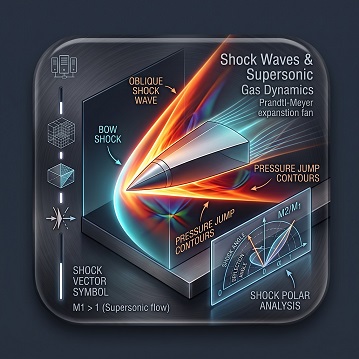
When an object (or point disturbance source) travels through a gas at supersonic speed (M > 1), the pressure disturbances it creates cannot propagate upstream. Instead they are confined within a conical region called the Mach cone.
Key concepts:
- Mach angle μ: the half-angle of the cone, given by μ = sin⁻¹(1/M).
- Zone of action: the region inside the cone where disturbances can be felt.
- Zone of silence: the region outside the cone, undisturbed.
- At M = 1, μ = 90° (plane wave — entire downstream region is affected).
- As M → ∞, μ → 0° (infinitely narrow cone).
- A Mach wave is an infinitesimally weak wave inclined at angle μ — it is isentropic.
📘 Calculation Methodology
Mathematical Model & Theory
The Mach angle is the fundamental geometric property of supersonic flow. It represents the angle between the Mach wave (an infinitesimally weak pressure wave) and the local flow direction.
The Mach wave is the weakest possible oblique shock (θ → 0). All stronger waves (oblique shocks) are inclined at angles β > μ with respect to the flow.
Worked Engineering Example
A bullet travels at Mach 2.0 through air at T = 300 K, p = 101.325 kPa. Compute the Mach angle and the cone radius 1 m behind the bullet.
Step-by-step:
1. Speed of sound: $a = \sqrt{1.4 \times 287.058 \times 300} = 347.2$ m/s
2. Flow velocity: $u = 2.0 \times 347.2 = 694.4$ m/s
3. Mach angle:
$\mu = \sin^{-1}(1/2) = 30.00°$
4. Full cone angle: $2\mu = 60.00°$
5. Cone radius at x = 1 m:
$r = 1.0 \times \tan(30°) = 0.5774$ m
Result: μ = 30°, cone radius = 0.577 m at 1 m downstream.
Assumptions & References
Assumptions: Inviscid flow. Infinitesimally small disturbances (linear acoustics). Steady supersonic flow (M ≥ 1). Calorically perfect gas. Uniform freestream. The Mach wave itself is isentropic (no entropy change).
References:
- Anderson, J. D. Modern Compressible Flow, McGraw-Hill, 4th ed. — Ch. 4 (Mach waves and Mach angle).
- Shapiro, A. H. The Dynamics and Thermodynamics of Compressible Fluid Flow, Vol. 1, Wiley, 1953.
- Gupta, S. C. Applied Computational Fluid Dynamics — §7.11 (Mach angle definitions).
- Liepmann, H. W., & Roshko, A. Elements of Gasdynamics, Dover, 2001.