
💨 Steam Turbine Wilson Loss & Baumann Sizer
Size multi-stage steam turbines: Baumann wetness efficiency degradation, Wilson condensation line, exhaust dryness fraction, and LP blade erosion risk.
⚡ Fortran 90 Engine
Double Precision (IEEE 754)
✓ ISO / ASME Validated
 Turbomachinery
📊 Solver Telemetry
● ACTIVE
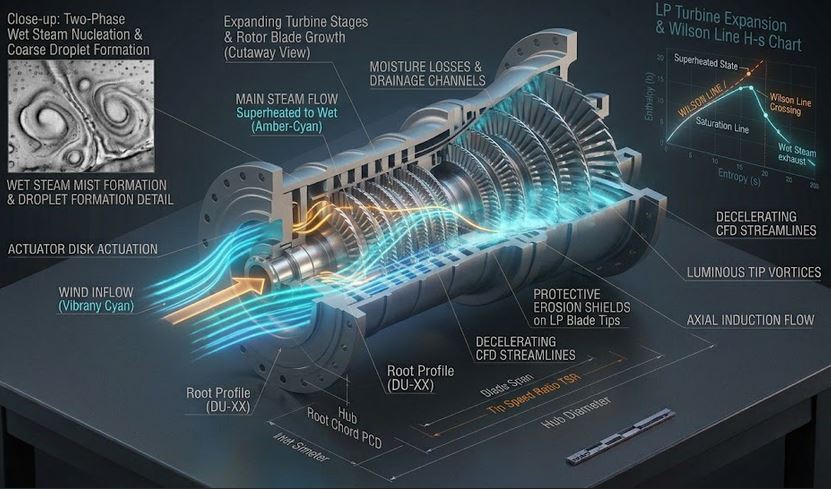
📈 Mollier h-s Diagram & LP Turbine Moisture Expansion
Real-time visual simulation: Superheat expansion crossing Wilson line into the two-phase moisture zone📝 Configuration & Presets
Baumann Wetness Rule & Wilson Condensation:
• Baumann Rule: ηwet = ηdry · [1 − α · (y2 / 2)]
• Moisture Content: y2 = 1 − x2 [%]
• Specific Work: Δh = (h1 − h2s) · ηwet · Reheat [kJ/kg]
• Turbine Power: Pturb = ṁ · Δh [MW].
• Baumann Rule: ηwet = ηdry · [1 − α · (y2 / 2)]
• Moisture Content: y2 = 1 − x2 [%]
• Specific Work: Δh = (h1 − h2s) · ηwet · Reheat [kJ/kg]
• Turbine Power: Pturb = ṁ · Δh [MW].
📊 Performance Results
Configure inputs and click Compute to view results.
📘 Calculation Methodology & Steam Turbine Standards
Wilson Line & Homogeneous Nucleation
During rapid expansion across the saturation boundary, steam becomes supersaturated and subcooled until reaching the Wilson line ($y \approx 4\%$), triggering spontaneous fog droplet condensation.
Baumann Wetness Rule & Blade Erosion
Liquid water droplets collide with high-speed LP blade leading edges, causing aerodynamic drag (Baumann loss ~1% per 1% moisture) and mechanical pitting erosion if moisture exceeds 12%.
Key Engineering Assumptions
- IAPWS-IF97 steam property formulations.
- Baumann wetness factor $\alpha \approx 0.85 - 1.05$.
- Widely used in thermal power plants, nuclear LP turbines, and geothermal expanders.