📐 Axial Turbine Stage Velocity Triangles
Calculate axial turbine stage velocity triangles (stator NGV & rotor), degree of reaction R, loading coefficient psi, specific work output, and Soderberg stage efficiency.
⚡ Fortran 90 Engine
Double Precision (IEEE 754)
✓ ISO / ASME Validated
 Turbomachinery
📊 Solver Telemetry
● ACTIVE
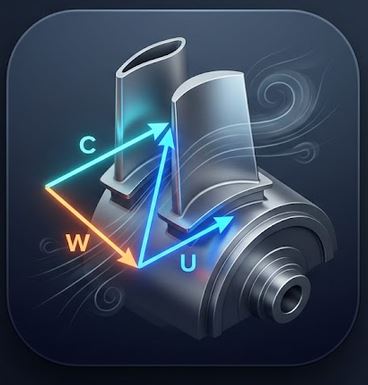
📐 2D Velocity Triangles (Stator NGV & Rotor Rows)
Real-time visual kinematics: Absolute velocity V (blue), blade speed U (green), relative velocity W (red)📝 Configuration & Presets
Euler Turbine Equation & Stage Loading:
• Specific Work: Δh0 = U · [Vθ2 − Vθ3] = U · [Va·(tan α2 − tan β3) − U] [kJ/kg]
• Stage Loading Coeff: ψ = Δh0 / U² | Flow Coeff: φ = Va / U
• Degree of Reaction: R = 1 − (Vθ2 + Vθ3) / (2·U)
• Stage Power: P = ṁ · Δh0 [MW].
• Specific Work: Δh0 = U · [Vθ2 − Vθ3] = U · [Va·(tan α2 − tan β3) − U] [kJ/kg]
• Stage Loading Coeff: ψ = Δh0 / U² | Flow Coeff: φ = Va / U
• Degree of Reaction: R = 1 − (Vθ2 + Vθ3) / (2·U)
• Stage Power: P = ṁ · Δh0 [MW].
📊 Performance Results
Configure inputs and click Compute to view results.
📘 Calculation Methodology & Turbine Velocity Triangles
Euler Turbine Equation & Swirl
Specific work extracted by the rotor is determined directly by the change in angular momentum of the fluid: $\Delta h_0 = U (V_{\theta 2} - V_{\theta 3})$.
Degree of Reaction & Smith Chart
Degree of reaction $R$ measures the proportion of static enthalpy drop occurring across the rotor vs stator. $R = 0$ corresponds to pure impulse stages, while $R = 0.5$ represents symmetrical 50% Parsons reaction stages.
Key Engineering Assumptions
- 1D mean-line aerodynamic formulation.
- Soderberg profile and secondary loss model.
- Widely used in gas turbine design, aircraft jet engines, and steam turbomachinery.