🔥 Underfloor Radiant (EN 1264)
Size underfloor radiant heating and cooling systems per EN 1264, calculating specific heat flux (W/m²), surface temperature limits, and dew point condensation safety.
⚡ Fortran 90 Engine
Double Precision (IEEE 754)
✓ ISO / ASME Validated
 Hvac
Hvac
📊 Solver Telemetry
● ACTIVE
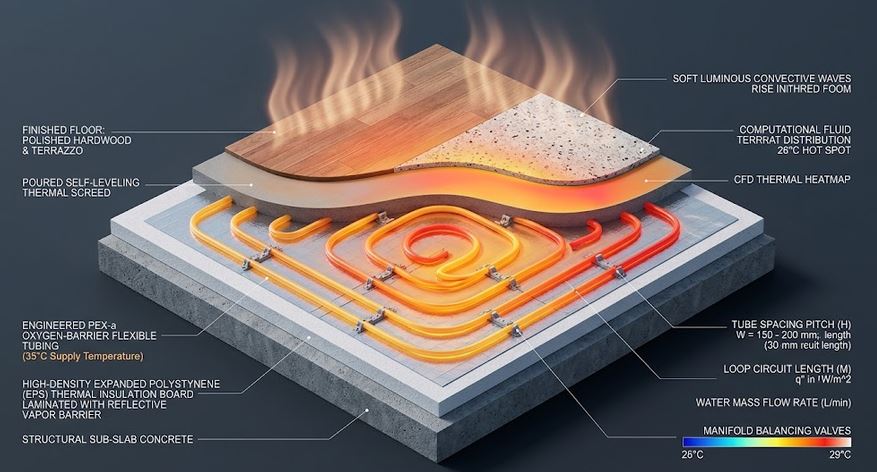
🔥 Underfloor Embedded PEX Pipe Thermal Layer Cross-Section
Real-time thermal flux distribution across screed, insulation & surface finish📝 Configuration & Presets
🔥 Tile Floor Heating (150 mm pitch)
🪵 Wood Parquet (100 mm pitch)
❄️ Summer Radiant Cooling (16°C)
🚿 Bathroom Comfort
EN 1264 Formulations:
• Specific Output: q = B · ΔθH [W/m²]
• Floor Surface Temp: TF = Ti ± (q / α) [°C]
• Heating Limit: TF ≤ 29°C (occupied spaces)
• Cooling Limit: TF ≥ Tdew + 1.0°C (dew point safety)
• Specific Output: q = B · ΔθH [W/m²]
• Floor Surface Temp: TF = Ti ± (q / α) [°C]
• Heating Limit: TF ≤ 29°C (occupied spaces)
• Cooling Limit: TF ≥ Tdew + 1.0°C (dew point safety)
📊 Radiant Output Results
Configure inputs and click Compute to view results.
📘 Calculation Methodology & EN 1264 Standards
EN 1264 Calculation Engine
The characteristic emission curves determine the thermal flux $q$ based on logarithmic mean temperature difference $\Delta \theta_H$ and floor resistance:
q = B · ΔθH [W/m²]
Surface Temperature Limitations
- Heating: Maximum $29^\circ\text{C}$ in living areas ($33^\circ\text{C}$ in bathrooms) to prevent venous foot discomfort.
- Cooling: Surface temperature must remain $\ge T_{dew} + 1.0^\circ\text{C}$ to prevent slippery floor condensation.
Key Engineering Assumptions
- Standard $16\times 2\,\text{mm}$ cross-linked polyethylene (PEX-a/b) tubes.
- Cement screed conductivity $k = 1.2\,\text{W/(m}\cdot\text{K)}$ with 45 mm thickness.
- Heat capacity of circulating water $c_p = 4.186\,\text{kJ/(kg·K)}$.