🏛️ Stack Effect & Ventilation
Calculate thermal stack buoyancy draft, neutral pressure level (NPL), wind surface pressure, and natural ventilation airflow through atriums and shafts.
⚡ Fortran 90 Engine
Double Precision (IEEE 754)
✓ ISO / ASME Validated
 Hvac
Hvac
📊 Solver Telemetry
● ACTIVE
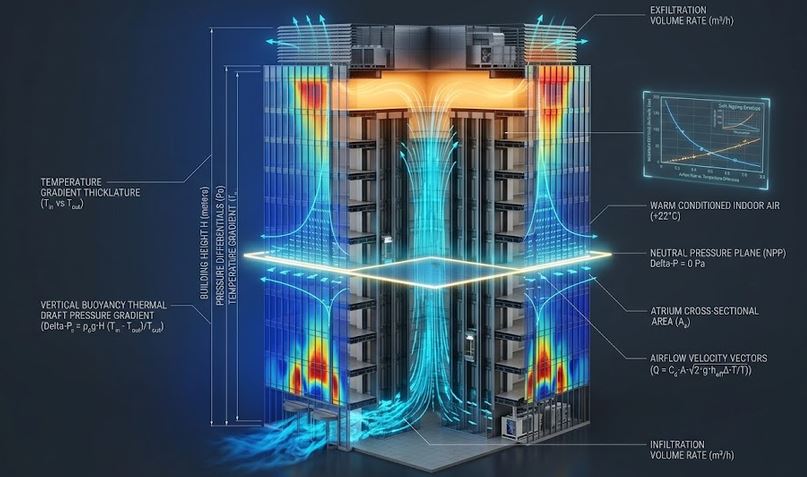
🏛️ Atrium Thermal Plume Convection & Neutral Pressure Level (NPL)
Real-time visual simulation of buoyancy updraft, inlet louvers & roof exhaust ventilation📝 Configuration & Presets
CIBSE / ASHRAE Stack Formulations:
• Stack Pressure: ΔPstack = ρo · g · H · (Ti − To) / Ti
• Wind Pressure: ΔPwind = ½ · ΔCp · ρo · vw²
• Effective Area: Aeff = (A₁ · A₂) / √(A₁² + A₂²)
• Natural Flow: Q = Cd · Aeff · √[ (2 ΔPtotal) / ρo ]
• Stack Pressure: ΔPstack = ρo · g · H · (Ti − To) / Ti
• Wind Pressure: ΔPwind = ½ · ΔCp · ρo · vw²
• Effective Area: Aeff = (A₁ · A₂) / √(A₁² + A₂²)
• Natural Flow: Q = Cd · Aeff · √[ (2 ΔPtotal) / ρo ]
📊 Natural Ventilation Results
Configure inputs and click Compute to view results.
📘 Calculation Methodology & CIBSE Standards
Thermal Buoyancy & Stack Effect
Warm indoor air is less dense than cold outdoor air, creating an upward hydrostatic pressure gradient driving warm air out upper roof openings:
ΔPstack = ρo · g · H · (Ti − To) / Ti
Neutral Pressure Level (NPL)
The NPL is the elevation where indoor and outdoor pressures are equal. Below the NPL, air infiltrates inwards; above the NPL, air exhausts outwards.
Key Engineering Assumptions
- Standard discharge coefficient $C_d = 0.62$ across louver openings.
- Combined stack and wind driving heads summed in quadrature per BS 5925.
- Uniform vertical temperature distribution inside the stack envelope.