☀️ Blackbody Radiation Calculator
Compute ideal blackbody total emissive power, peak radiation wavelength, and compare Planck spectral distribution curves.
📝 Configuration
Key Equations:
Stefan-Boltzmann Law:
$E_b = \sigma T^4$
Wien's Displacement Law:
$\lambda_{max} = 2897.8 / T \quad [\mu\text{m}]$
Planck's Distribution:
$E_{b\lambda} = C_1 / (\lambda^5 [\exp(C_2/\lambda T) - 1])$
Stefan-Boltzmann Law:
$E_b = \sigma T^4$
Wien's Displacement Law:
$\lambda_{max} = 2897.8 / T \quad [\mu\text{m}]$
Planck's Distribution:
$E_{b\lambda} = C_1 / (\lambda^5 [\exp(C_2/\lambda T) - 1])$
☀️ Radiative Exchange Model
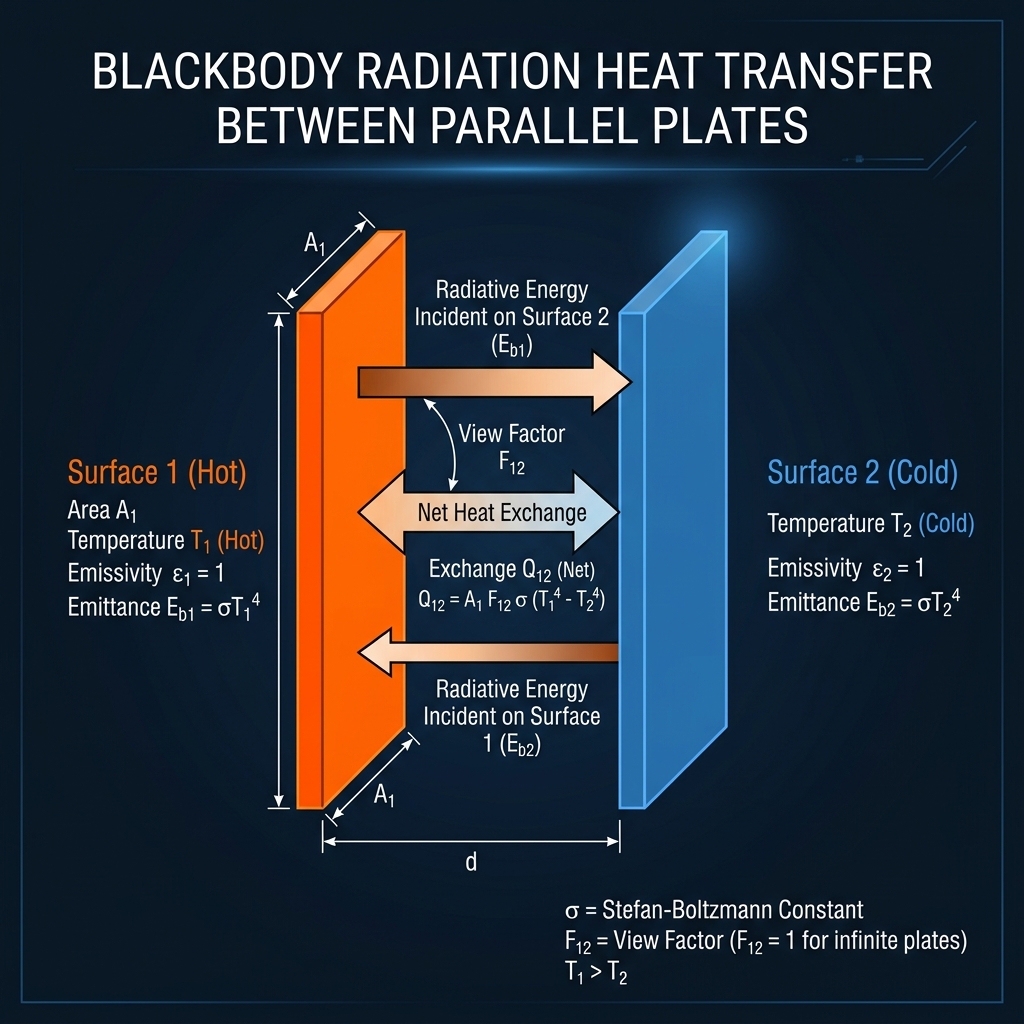 Schematic illustrating the exchange parameters ($T_1, T_2, A_1,$ and $F_{12}$) used by the computation engine.
📊 Results & Spectral Curves
Configure parameters and click Calculate to view results.
📘 Calculation Methodology & Theory
Mathematical Model & Theory
A blackbody represents an ideal emitter and absorber of radiation. Its spectral distribution is governed by Planck's Law:
$$E_{b,\lambda}(\lambda, T) = \frac{C_1}{\lambda^5 \left[ \exp\left( \frac{C_2}{\lambda T} \right) - 1 \right]}$$
The total emissive power over all wavelengths is given by the Stefan-Boltzmann Law:
$$E_b = \sigma T^4$$
The peak emission wavelength is described by Wien's Displacement Law:
$$\lambda_{max} \cdot T \approx 2897.8 \quad [\mu\text{m}\cdot\text{K}]$$
Worked Engineering Example
Problem Statement:
A blackbody surface at $1000\text{ K}$ radiates to surroundings at $300\text{ K}$. The surface area is $0.5\text{ m}^2$, and the view factor is $F_{12} = 1.0$. Calculate the peak emission wavelength, total emissive power, and net heat transfer rate.
Step-by-step Solution:
1. Calculate peak wavelength using Wien's Law:
$$\lambda_{max} = \frac{2897.8}{1000} = 2.898 \ \mu\text{m}$$ 2. Calculate total blackbody emissive power of the surface:
$$E_{b1} = \sigma T_1^4 = (5.67037 \times 10^{-8}) \times (1000)^4 = 56,704 \text{ W/m}^2$$ 3. Calculate total blackbody emissive power of surroundings:
$$E_{b2} = \sigma T_2^4 = (5.67037 \times 10^{-8}) \times (300)^4 = 459 \text{ W/m}^2$$ 4. Calculate net heat transfer rate:
$$Q_{12} = A_1 F_{12} (E_{b1} - E_{b2})$$ $$Q_{12} = 0.5 \times 1.0 \times (56,704 - 459) = 28,122.5 \text{ W}$$
Final Result:
The peak emission is at $2.898\ \mu\text{m}$, and the net radiative heat exchange is $28.12\text{ kW}$.
A blackbody surface at $1000\text{ K}$ radiates to surroundings at $300\text{ K}$. The surface area is $0.5\text{ m}^2$, and the view factor is $F_{12} = 1.0$. Calculate the peak emission wavelength, total emissive power, and net heat transfer rate.
Step-by-step Solution:
1. Calculate peak wavelength using Wien's Law:
$$\lambda_{max} = \frac{2897.8}{1000} = 2.898 \ \mu\text{m}$$ 2. Calculate total blackbody emissive power of the surface:
$$E_{b1} = \sigma T_1^4 = (5.67037 \times 10^{-8}) \times (1000)^4 = 56,704 \text{ W/m}^2$$ 3. Calculate total blackbody emissive power of surroundings:
$$E_{b2} = \sigma T_2^4 = (5.67037 \times 10^{-8}) \times (300)^4 = 459 \text{ W/m}^2$$ 4. Calculate net heat transfer rate:
$$Q_{12} = A_1 F_{12} (E_{b1} - E_{b2})$$ $$Q_{12} = 0.5 \times 1.0 \times (56,704 - 459) = 28,122.5 \text{ W}$$
Final Result:
The peak emission is at $2.898\ \mu\text{m}$, and the net radiative heat exchange is $28.12\text{ kW}$.
Standard Assumptions & References
Assumptions: The emitter and receiver act as ideal blackbodies (absorptivity $\alpha = 1.0$, emissivity $\epsilon = 1.0$). Steady-state conditions are assumed with no participating media between surfaces.
References:
- Incropera, F. P., & DeWitt, D. P. Fundamentals of Heat and Mass Transfer, John Wiley & Sons.
- Modest, M. F. Radiative Heat Transfer, Academic Press.
- Cengel, Y. A. Heat and Mass Transfer: A Practical Approach, McGraw-Hill.