🔬 Cross-Flow Ultrafiltration & Gel Polarization
Size cross-flow ultrafiltration modules, evaluate concentration polarization, mass transfer coefficient (km), and critical gel limiting flux (LMH) using film theory.
⚡ Fortran 90 Engine
Double Precision (IEEE 754)
✓ ISO / ASME Validated
 Mass Transfer
📊 Solver Telemetry
● ACTIVE
💡
Hardware & Sizing Partner: Need to size a control valve or check ASME flange bolt torque for this line?
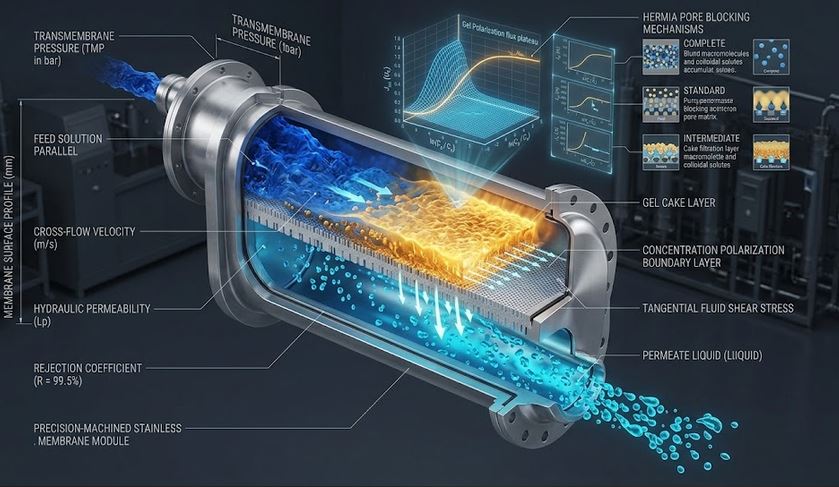
🧪 Tangential Cross-Flow Channel & Concentration Polarization Boundary Layer
Real-time visual simulation of macromolecule boundary layer build-up & transverse permeate flux📝 Configuration & Presets
🥛 Whey Protein (800 L/h)
💊 Biopharma mAb UF/DF
🦠 Biomass Ferment (2500 L/h)
🛢️ Oily Emulsion Ceramic UF
Film Theory Formulations:
• Limiting Flux: Jlim = km · ln( Cgel / Cb ) [LMH]
• Mass Transfer Coeff: km = 0.023 (D/dh) Re0.8 Sc0.33
• Operating Flux: Jop = min( Jpressure, Jlim )
• Membrane Area: Am = Qperm / Jop [m²]
• Limiting Flux: Jlim = km · ln( Cgel / Cb ) [LMH]
• Mass Transfer Coeff: km = 0.023 (D/dh) Re0.8 Sc0.33
• Operating Flux: Jop = min( Jpressure, Jlim )
• Membrane Area: Am = Qperm / Jop [m²]
📊 Ultrafiltration Sizing Results
Configure inputs and click Compute to view results.
📘 Calculation Methodology & Membrane Film Theory Standards
Concentration Polarization & Gel Film Theory
Accumulation of retained macromolecules at the membrane wall creates an opposing concentration gradient that back-diffuses into the bulk feed under shear flow:
J = km · ln[ (Cwall − Cp) / (Cbulk − Cp) ]
Pressure-Independence at High TMP
Beyond the critical TMP, further pressure increases only compress the gel boundary layer, leading to the well-known limiting flux plateau.
Key Engineering Assumptions
- 1 LMH = $1\,\text{L/(m}^2\cdot\text{h)} = 2.778\times 10^{-7}\,\text{m/s}$.
- Chilton-Colburn analogy for turbulent channels ($Re > 2100$).
- Complete solute retention ($R = 100\%$, $C_p = 0$).