
🧪 Fixed-Bed Adsorption Breakthrough (Thomas & BDST)
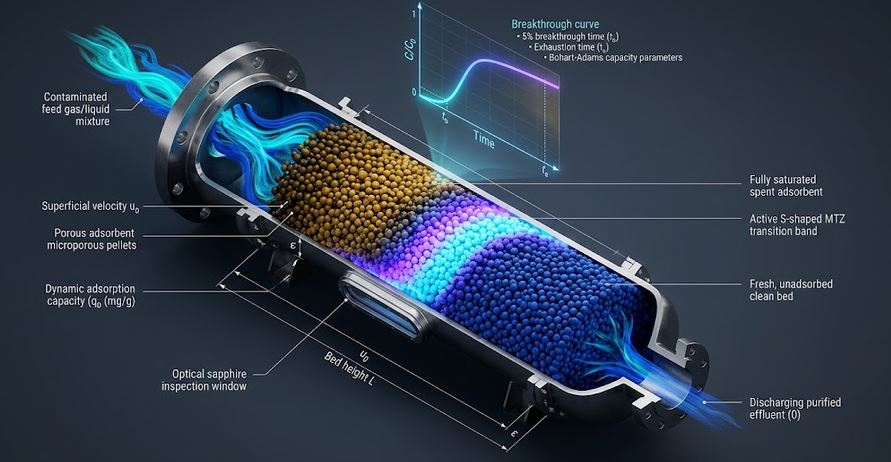
Model dynamic packed-bed adsorption breakthrough curves (S-curves), exhaustion times, Bed Depth Service Time (BDST), and Mass Transfer Zone (MTZ) migration.
⚡ Fortran 90 Engine
Double Precision (IEEE 754)
✓ ISO / ASME Validated
 Mass Transfer
📊 Solver Telemetry
● ACTIVE
🧪 Packed Adsorbent Bed Mass Transfer Wave Front Migration
Real-time visual simulation of solute adsorption gradient wave advancing through porous bed📝 Configuration & Presets
🪨 GAC Phenol (350 L/h)
🪵 Biochar Heavy Metal (Pb²⁺)
💎 Zeolite PFAS Trace Bed
🎨 Textile Dye Decolorization
Thomas & BDST Formulations:
• Thomas S-Curve: C/C₀ = 1 / [ 1 + exp( (kTh q₀ M / Q) − kTh C₀ t ) ]
• Breakthrough Time (5%): tb = t₅₀ − ln(19) / (kTh C₀)
• Exhaustion Time (95%): ts = t₅₀ + ln(19) / (kTh C₀)
• Critical Bed Depth: Z₀ = (u₀ / (kBA N₀)) · ln(C₀/Cb − 1)
• Thomas S-Curve: C/C₀ = 1 / [ 1 + exp( (kTh q₀ M / Q) − kTh C₀ t ) ]
• Breakthrough Time (5%): tb = t₅₀ − ln(19) / (kTh C₀)
• Exhaustion Time (95%): ts = t₅₀ + ln(19) / (kTh C₀)
• Critical Bed Depth: Z₀ = (u₀ / (kBA N₀)) · ln(C₀/Cb − 1)
📊 Breakthrough Performance Results
Configure inputs and click Compute to view results.
📘 Calculation Methodology & Adsorption Kinetics Standards
Thomas Column Model
The Thomas model assumes plug flow with second-order reversible Langmuir adsorption kinetics, providing the classic analytical S-curve:
C/C₀ = 1 / [ 1 + exp( (kTh q₀ M / Q) − kTh C₀ t ) ]
Bed Depth Service Time (BDST)
BDST relates service time linearly to bed depth. The x-intercept represents the critical depth $Z_0$ below which instantaneous breakthrough occurs.
Key Engineering Assumptions
- Isothermal operation with negligible axial fluid dispersion.
- Breakthrough criterion defined at $C/C_0 = 5\%$ ($0.05$).
- Exhaustion criterion defined at $C/C_0 = 95\%$ ($0.95$).