⚡ Two-Phase Closed Thermosiphon & Heat Pipe Sizer
Size two-phase closed thermosiphons (TPCT) and heat pipes: flooding/entrainment limit, boiling burnout limit, effective thermal conductivity (W/m·K), and temperature drop.
⚡ Fortran 90 Engine
Double Precision (IEEE 754)
✓ ISO / ASME Validated
 Heat Exchangers
📊 Solver Telemetry
● ACTIVE
💡
Hardware & Sizing Partner: Need to size a control valve or check ASME flange bolt torque for this line?
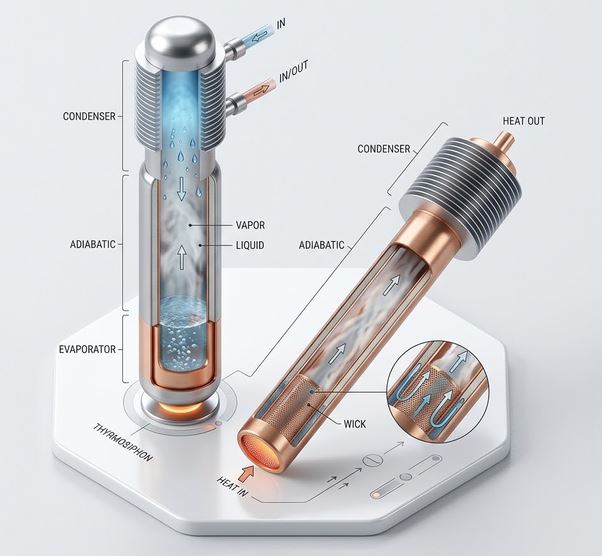
⚡ Two-Phase Evaporation, Vapor Transport & Condensation Loop
Real-time visual simulation: Bottom pool boiling, rising vapor core, top condenser film return📝 Configuration & Presets
☀️ Solar Evacuated Tube
🖥️ CPU Sintered Heat Pipe
🏭 Industrial Waste Heat TPCT
🛰️ Satellite Ammonia Loop
Two-Phase Thermosiphon Formulation:
• Flooding Limit (Wallis/Faghri): Q̇flood = Ck² Av hfg [g·σ·(ρL−ρv)]1/4 [ρv-1/4 + ρL-1/4]-2
• Boiling Burnout Limit: Q̇boiling = 0.18 Ae hfg ρv1/2 [g·σ·(ρL−ρv)]1/4
• Effective Conductivity: keff = (Q̇ · Leff) / (Av · ΔT) >> 100,000 W/(m·K).
• Flooding Limit (Wallis/Faghri): Q̇flood = Ck² Av hfg [g·σ·(ρL−ρv)]1/4 [ρv-1/4 + ρL-1/4]-2
• Boiling Burnout Limit: Q̇boiling = 0.18 Ae hfg ρv1/2 [g·σ·(ρL−ρv)]1/4
• Effective Conductivity: keff = (Q̇ · Leff) / (Av · ΔT) >> 100,000 W/(m·K).
📊 Operating Limits & Results
Configure inputs and click Compute to view results.
📘 Calculation Methodology & Heat Pipe Standards
Latent Heat Phase-Change Loop
Heat is absorbed by liquid boiling in the evaporator, transported at high speed as vapor along the core, and released by condensation at the cold condenser end, achieving thermal conductivities $100\times$ to $500\times$ higher than solid copper.
Flooding / Entrainment Limit
Occurs when high-velocity upward vapor strips droplets from the downward-returning liquid film, causing evaporator dryout and sharp temperature runaway.
Key Engineering Assumptions
- Gravity-assisted thermosiphon or wick-assisted heat pipe orientation.
- Wallis/Faghri flooding correlation and Kutateladze boiling limit.
- Widely used in solar evacuated tubes, electronics CPU coolers, permafrost ground stabilization, and industrial heat recovery.