💨 Pressurized Gas Vessel Transient Blowdown Sizer
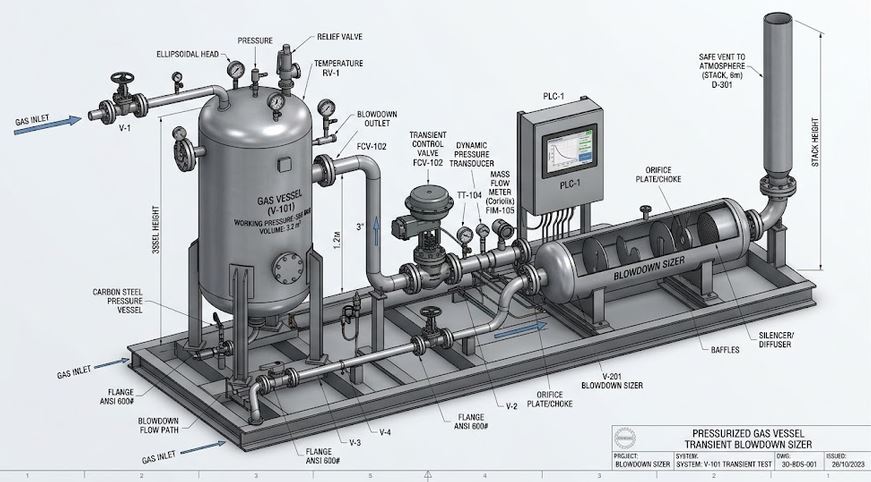
Size pressurized gas vessel emergency depressurization and blowdown per API 521 / ISO 23251: blowdown duration (min), peak sonic choked mass flow, expansion cooling, and low-temp MDMT brittle fracture risk.
⚡ Fortran 90 Engine
Double Precision (IEEE 754)
✓ ISO / ASME Validated
 Fluid Mechanics
📊 Solver Telemetry
● ACTIVE
💨 Pressurized Vessel Emergency Depressurization & Supersonic Flare Jet
Real-time visual simulation: Choked gas release ($M=1$), expanding sonic plume, and auto-cooling vessel wall temperature📝 Configuration & Presets
🔥 API 521 Separator (15 min)
⚡ Hydrogen 250 bar Vent
🌐 Nitrogen Sphere (50 m³)
🧯 CO2 Cylinder Discharge
API 521 Transient Blowdown Formulation:
• Initial Peak Choked Flow: ṁ₀ = Cd · Ao · P₀ · √[ (γ M) / (R T₀) ] · (2/(γ+1))(γ+1)/(2(γ−1))
• Minimum Gas Temperature: Tmin = T₀ · (Ptarget / P₀)(γ−1)/γ
• Blowdown Duration: tblow = [ 2 V / ((γ−1) Cd Ao a₀) ] · [ (P₀/Ptgt)(γ−1)/(2γ) − 1 ]
• MDMT Risk: Carbon steel risks brittle fracture below −29°C (ASME Section VIII).
• Initial Peak Choked Flow: ṁ₀ = Cd · Ao · P₀ · √[ (γ M) / (R T₀) ] · (2/(γ+1))(γ+1)/(2(γ−1))
• Minimum Gas Temperature: Tmin = T₀ · (Ptarget / P₀)(γ−1)/γ
• Blowdown Duration: tblow = [ 2 V / ((γ−1) Cd Ao a₀) ] · [ (P₀/Ptgt)(γ−1)/(2γ) − 1 ]
• MDMT Risk: Carbon steel risks brittle fracture below −29°C (ASME Section VIII).
📊 Blowdown Results
Configure inputs and click Compute to view results.
📘 Calculation Methodology & API 521 Blowdown Standards
API 521 15-Minute Depressurization Rule
In fire emergencies, vessels must be depressurized to $6.9\,\text{bar}$ (or $50\%$ of design pressure) within $15\,\text{minutes}$ to prevent boiling liquid expanding vapor explosions (BLEVE) and vessel rupture.
Low-Temperature Auto-Refrigeration & MDMT
Rapid gas expansion causes extreme adiabatic cooling (Joule-Thomson / isentropic drop). If metal temperature drops below the Minimum Design Metal Temperature (MDMT, e.g. $-29^\circ\text{C}$), carbon steel risks catastrophic brittle fracture.
Key Engineering Assumptions
- Choked sonic discharge ($M=1$) across the blowdown restriction orifice.
- Isentropic / ideal gas expansion thermodynamics.
- Applicable to gas processing separators, LNG storage vessels, and hydrogen fuel trailers.