
🌀 Cavity Enclosure Natural Convection (Catton)
Model natural convection in differentially heated vertical cavity enclosures (double glazing, solar gaps), computing Rayleigh number, average Nusselt, total heat flow Q, and boundary layer thickness.
⚡ Fortran 90 Engine
Double Precision (IEEE 754)
✓ ISO / ASME Validated
 Convection
📊 Solver Telemetry
● ACTIVE
👁️ Views
39
⚡ Solves
32
💾 Downloads
516
📦 Fortran Code
10.8 KB
📅 Released
Jun 2026
⏱️ Latency
< 1 ms
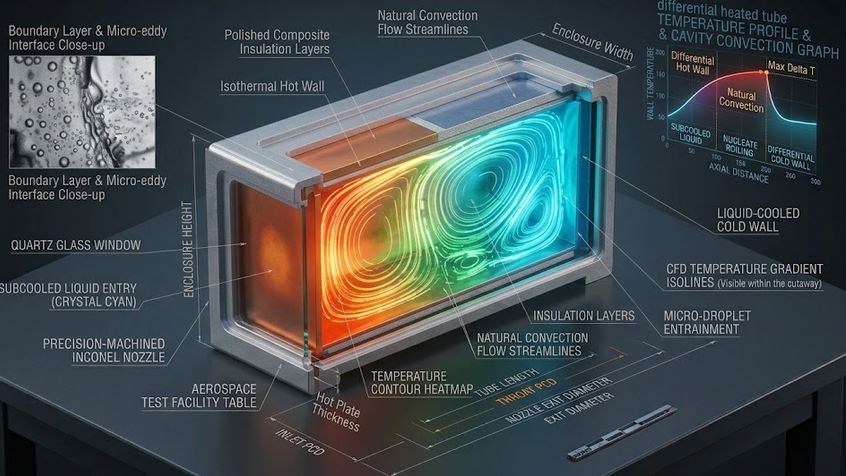
🌀 Enclosed Differentially Heated Cavity & Recirculation Roll
Real-time visual simulation of buoyant fluid rising along hot left wall and sinking along cold right wall📝 Configuration & Presets
🪟 Double Glazing Air Gap
☀️ Solar Thermal Collector
⚡ Transformer Oil Channel
☢️ Nuclear Containment Gap
Catton Enclosure Formulation:
• Rayleigh Number: RaW = [ g β (Th − Tc) W³ ] / (ν α)
• Average Nusselt: Nu = 0.22 · [ RaW Pr / (0.2 + Pr) ]0.28 · (H/W)−0.25
• Heat Rate: Q̇ = Nu · (k / W) · (H · L) · (Th − Tc) [W]
• Boundary Layer Thickness: δ ≈ W · RaW−1/4
• Rayleigh Number: RaW = [ g β (Th − Tc) W³ ] / (ν α)
• Average Nusselt: Nu = 0.22 · [ RaW Pr / (0.2 + Pr) ]0.28 · (H/W)−0.25
• Heat Rate: Q̇ = Nu · (k / W) · (H · L) · (Th − Tc) [W]
• Boundary Layer Thickness: δ ≈ W · RaW−1/4
📊 Cavity Convection Results
Configure inputs and click Compute to view results.
📘 Calculation Methodology & Cavity Convection Standards
Catton & Berkovsky-Polevikov Model
Natural convection in differentially heated tall enclosures transitions through three regimes based on $Ra_W$:
• Ra < 10³: Conduction ($Nu = 1$)
• 10⁴ ≤ Ra ≤ 10⁷: $Nu = 0.22 (Ra Pr / (0.2+Pr))^{0.28} A^{-0.25}$
• 10⁴ ≤ Ra ≤ 10⁷: $Nu = 0.22 (Ra Pr / (0.2+Pr))^{0.28} A^{-0.25}$
Boundary Layer & Core Circulation
Hot fluid rises in a thin layer along the left wall, turns horizontally at the top, and sinks along the cold wall, creating an inner thermally stratified core.
Key Engineering Assumptions
- 2D rectangular vertical cavity with adiabatic top and bottom.
- Boussinesq fluid approximation with temperature-dependent density.
- Laminar flow regime up to $Ra_W \approx 10^7$.