
❄️ Stefan Moving Boundary Solidification Front
Solve two-phase moving boundary Stefan phase change problems: solid front position s(t), total freezing time, solid Stefan number (Stes), and instantaneous cooling heat flux.
⚡ Fortran 90 Engine
Double Precision (IEEE 754)
✓ ISO / ASME Validated
 Conduction
📊 Solver Telemetry
● ACTIVE
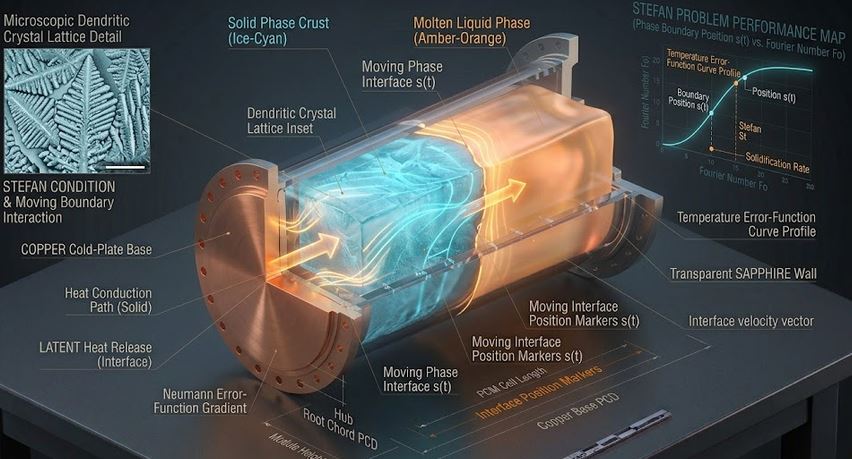
❄️ Two-Phase Moving Solidification Front Interface s(t)
Real-time visual simulation: Frozen solid crystal layer advancing dynamically into liquid domain📝 Configuration & Presets
🧊 Ice Rink Freezing Plate
🔋 Paraffin Wax PCM Battery
🥩 Industrial Food Freezing
🏭 Continuous Steel Casting
Stefan Problem Formulation:
• Solid Stefan Number: Stes = cp,s (Tm − T₀) / Lf
• Front Constant: λ · eλ² · erf(λ) = Stes / √π
• Front Position: s(t) = 2 λ √(αs · t) [mm]
• Freezing Time: tfreeze = L² / (4 λ² αs) [hours]
• Solid Stefan Number: Stes = cp,s (Tm − T₀) / Lf
• Front Constant: λ · eλ² · erf(λ) = Stes / √π
• Front Position: s(t) = 2 λ √(αs · t) [mm]
• Freezing Time: tfreeze = L² / (4 λ² αs) [hours]
📊 Stefan Solidification Results
Configure inputs and click Compute to view results.
📘 Calculation Methodology & Stefan Problem Standards
Neumann Transcendental Solution
Solves the exact non-linear energy balance at the moving phase change interface $x = s(t)$:
λ · eλ² · erf(λ) = Stes / √π
Parabolic Growth Law
The solid front advances with the square root of time: $s(t) = 2\lambda \sqrt{\alpha_s t}$. Freezing rate decelerates as solid thermal resistance grows.
Key Engineering Assumptions
- 1D semi-infinite or planar slab geometry with sharp phase interface.
- Constant solid thermophysical properties ($\rho_s, k_s, c_{p,s}$).
- Applicable to ice makers, PCM thermal storage, casting, and food freezing.